How Much Water Should I Drink In An Hour

You’re halfway through your morning yoga flow, and suddenly you grab your bottle like it’s a lifeline. Guilty as charged—we’ve all been there. But the question swirling in you...

You’re halfway through your morning yoga flow, and suddenly you grab your bottle like it’s a lifeline. Guilty as charged—we’ve all been there. But the question swirling in your mind—how much water should I actually drink in an hour?—is a legit wellness quandary that deserves a cool, clear answer.
The golden rule: your body isn’t a firehose
Let’s start with a hard truth: more is not always better. The average healthy adult can safely process about 0.8 to 1.0 liters (roughly 27 to 34 ounces) of water per hour. That’s about two standard water bottles, sipped steadily, not chugged like you’re in a frat house challenge.
Think of your kidneys as a polite bouncer at a VIP lounge. They can manage a steady flow, but if you flood them all at once, they’ll wave a warning sign—or worse, send you home with a headache and a bloated belly.
Must Read
The “gulp and regret” trap
You know that feeling: you down a liter post-spin class, and within twenty minutes, your stomach sounds like a washing machine in spin cycle. That’s your body’s polite way of saying “slow down, buddy.” Drinking too much water in under an hour can dilute your blood sodium, leading to hyponatremia—a fancy word for “water intoxication” that can cause nausea, confusion, and in rare cases, serious trouble.
So, pace yourself. Aim for a glass (8 ounces) every 15 to 20 minutes when you’re active. That’s roughly 1 to 1.5 cups per hour during light exercise, and up to 2 cups if you’re sweating like a marathon runner in July.
Real life cheats: how to nail it without a stopwatch
Forget counting milliliters like a chemist. Use these three foolproof tricks to stay in the sweet spot. First, sip, don’t chug. Take a few swallows every 10–15 minutes, even if you’re not thirsty—thirst is a late signal, like a smoke alarm that only goes off when the kitchen is on fire.
Second, check your pee. Pale straw color is the holy grail; dark amber means you’re behind, and clear as vodka means you’re overdoing it. Third, set a gentle timer on your phone—every 20 minutes, a quiet buzz that says “hey, take a sip.” It’s like a hydration nanny, minus the judgment.
When life throws curveballs
Hot yoga, a humid beach day, or a dancing-all-night wedding? Bump your hourly intake to 1.2–1.5 liters, max. But listen to your body—if you feel sloshy or your stomach is grumbling, dial back. Your brain isn’t a mathematical formula; it’s a living system that adapts.
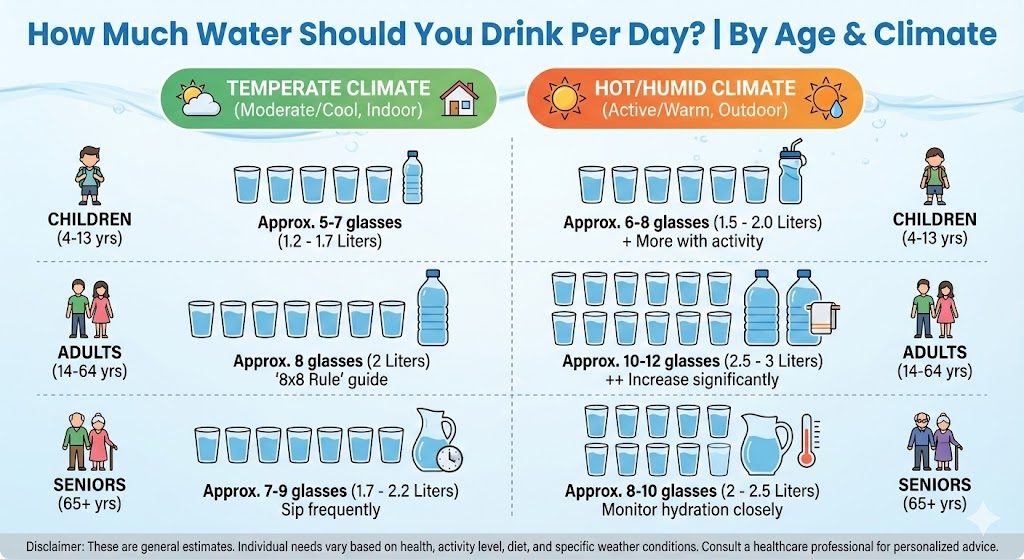 How Much Water Should You Drink Per Day?
And yes, that latte counts for hydration too, but caffeine is a mild diuretic, so balance it with a glass of water. Think of it as a polite trade: one espresso, one water chaser. Your kidneys will thank you with a silent nod.
Cultural water wisdom: from Japan to Silicon Valley
In Japan, the practice of mizu-kara (drinking small amounts of water frequently throughout the day) has been a wellness staple for centuries. Compare that to the modern “hydrate or die” culture in Silicon Valley, where employees guzzle Smartwater from sleek bottles like it’s a productivity hack.
The truth? Neither extreme wins. Slow and steady is the global secret. Even professional athletes—like tennis star Naomi Osaka—sip every changeover, not gulp an entire gallon at halftime. Fun fact: Olympic marathoners lose about 1 liter of sweat per hour, but they replace it with 400-800ml of water or electrolyte drinks, not more. They know overhydrating slows them down.
Practical tips for your day
Start your morning with a small glass (8 oz) within 30 minutes of waking. Then, during your workday, keep a 500ml bottle on your desk and aim to refill it once per hour. If you’re out for a brisk walk, take a sip every time you cross a street or finish a song on your playlist.
For heavy workouts, swap plain water for an electrolyte tablet every third glass—especially if you’re sweating a lot or the weather is tropical. Sodium and potassium are your hydration wingmen; they help your cells actually absorb the water instead of flushing it out.
 Water intake calculator how much water should you drink – Artofit
And here’s a wild fact: your brain is 73% water, so even a 1% drop in hydration can lower your mood and focus. That mid-afternoon slump? Might be thirst, not just boredom. Drink up, but drink smart.
The one-hour challenge
Try this tomorrow: for one hour, set a goal to drink exactly one 16-ounce bottle (0.5 liters). Take a sip every 12 minutes, and track how you feel afterward. Most people report feeling lighter, clearer, and less cranky—without the sloshy stomach.
Experiment with temperature, too. Iced water feels refreshing, but room-temperature water is absorbed faster by your body (true story: ancient Chinese medicine recommends warm water, and modern research agrees it’s easier on digestion). Find your groove.
A short reflection that sticks
We all want to be that person who glows, who has endless energy, who never gets a headache at 3 PM. But hydration isn’t about chasing a mythic perfect formula. It’s about respecting the rhythm of your own body—the quiet signals it sends, the gentle boundaries it sets.
So next time you pick up your water bottle, pause. Don’t guzzle. Sip. Notice. In that small act, you’re not just drinking water; you’re tuning in to a conversation that whispers, I’m here. I’ve got you. Let’s move through this hour together.
