Water Purification System For Laboratory

So there I was, in a shiny new lab, feeling like a total pro. I had my fresh pipettes, my pristine glassware, and a sample I was sure would make me famous. I filled my beaker...

So there I was, in a shiny new lab, feeling like a total pro. I had my fresh pipettes, my pristine glassware, and a sample I was sure would make me famous. I filled my beaker straight from the tap, added my reagents, and… nothing. The color was wrong, the reaction failed, and my grand experiment looked like a cup of swamp water. I had just learned the single most humiliating lesson in lab work: you cannot trust the tap.
That’s right, friend. Your experiments are only as good as your starting water. It’s a brutal truth, but once you accept it, you unlock the secret to actually reproducible science. The tap water in your house is great for washing dishes, but for a laboratory? It’s a rogue agent full of ions, bacteria, and organic crud just waiting to ruin your day.
The Dirty Truth About “Clean” Water
Let’s get specific. That clear liquid from the faucet is actually a chaotic soup of dissolved minerals (calcium, magnesium, silica) and microbes. These little hitchhikers will mess with your pH, kill your cell cultures, and leave ghostly residues on your instruments. Sound familiar? That’s why we need a full-blown purification system, not just a fancy filter.
Must Read
The goal here is to strip the water down to its most boring state: pure H₂O. We’re talking about a liquid so clean it’s almost aggressive—it wants to absorb everything from the air around it. That level of purity doesn’t happen by magic; it happens through a series of targeted attacks on the contaminants.
Meet the Players: The Purification Crew
First up is Reverse Osmosis (RO). Think of this as a bouncer at a club. It uses pressure to shove water through a semi-permeable membrane, kicking out 90-99% of the dissolved salts and big organic molecules. RO water is good, but it’s not lab-grade yet—it still has trace amounts of stuff and bacteria can actually grow on the membrane if you don’t watch out. Gross, right?
Next comes Deionization (DI). This is the real workhorse. DI uses special resins that act like magnets for charged particles (ions). The resin swaps positive ions (like calcium) for hydrogen, and negative ions (like chlorides) for hydroxide. They stick together to form more water. Boom. You now have water that measures almost zero conductivity. It’s the “pure water” you imagine in chemistry textbooks.
But wait—there’s more. For the super-picky folks (like molecular biologists or trace-metal analysts), you need Ultraviolet (UV) light and ultrafiltration. UV zaps any remaining bacteria and breaks down organic carbon. Ultrafiltration is a physical sieve that catches even tiny fragments of DNA or endotoxins. Yes, this is water that’s afraid of nothing.
Choosing Your Weapon: Which System for You?
Here’s where you need to pause and think about what you’re actually doing. Are you just making buffers for a general chemistry class? A Type III (RO water) system might be enough. It’s cheap, fast, and handles most wash steps.
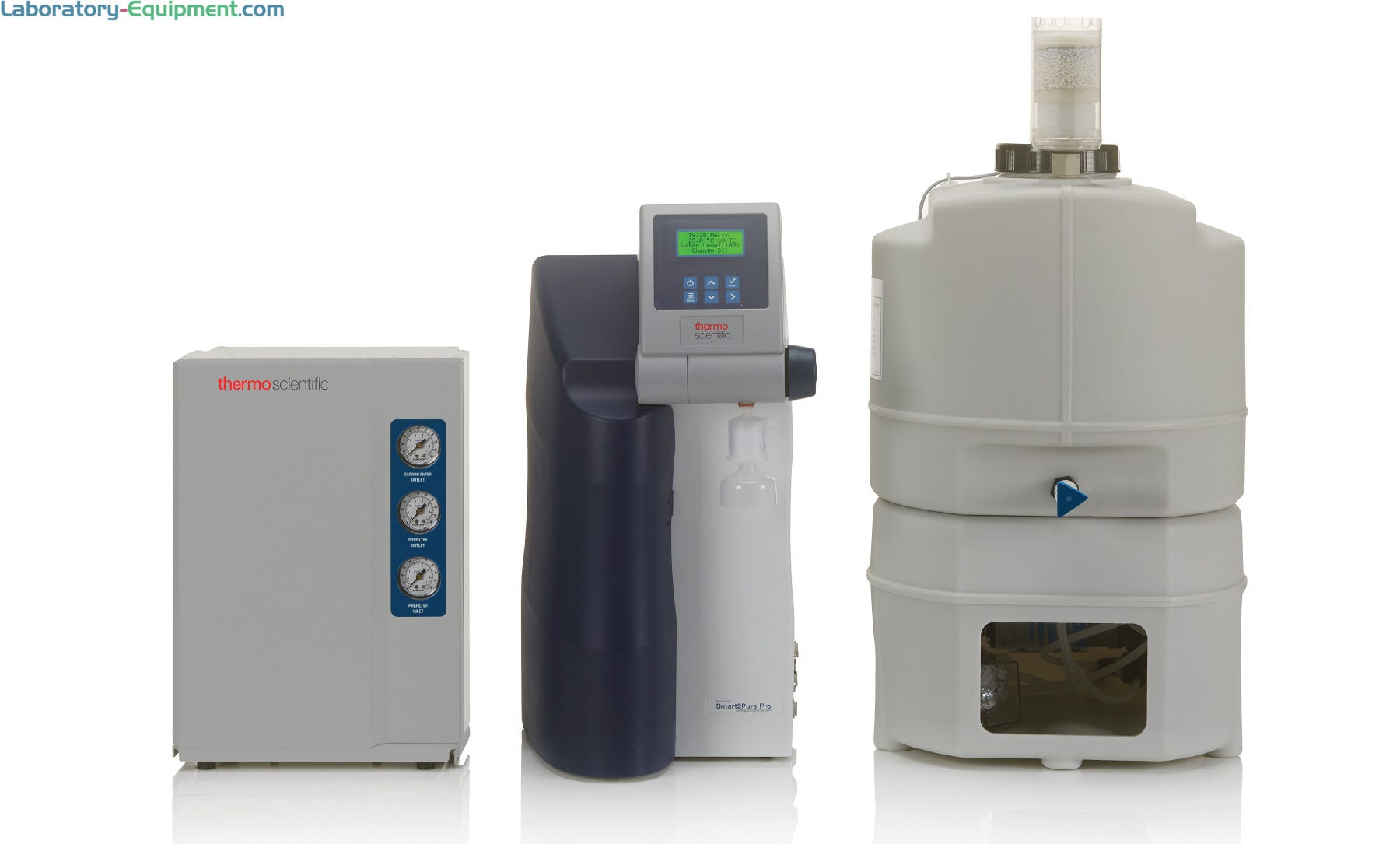 Water Purification Systems and Accessories | Laboratory Equipment
But if you’re doing HPLC, cell culture, or sensitive analytical work, you need the big guns: a Type I system that combines RO, DI, UV, and ultrafiltration. I laugh when people buy a fancy HPLC machine and then feed it tap water—it’s like buying a Ferrari and putting tractor fuel in it. Don’t be that person.
Maintenance: The Party You Didn’t Invite
Look, a water purification system is not a “set it and forget it” device. Those DI resins get exhausted. The RO membrane gets clogged. The UV lamp has a lifespan. If you ignore the maintenance, your “pure” water becomes a breeding ground for bacteria. You’ll notice when your results start looking weird. So set a reminder, swap the cartridges, and give your system a monthly check-up. Your experiments will thank you.
I’ve seen labs spend thousands on reagents and equipment, only to sabotage themselves with poor water. It’s the silent killer of reproducibility. A good system—and a logbook of when you changed the filters—is the cheapest insurance policy you’ll ever buy.
The Final Sip: A Simple Rule
Here’s the rule I live by: If you wouldn’t drink it straight from the source, don’t use it in your lab. But honestly, even if you would drink it, don’t use it in your lab. The standards for lab water are ridiculously high, and that’s a good thing. Your data deserves better than yesterday’s tap water.
So, learn from my swampy mistake. Invest in a proper lab water purification system. Respect the process. And the next time you see a crystal-clear beaker, remember the secret war going on inside that machine—a war against ions, bugs, and chaos. That’s science, baby. And it starts with a single, perfectly pure drop.
