Difference Between Distilled And Ro Water

Okay, let’s settle this once and for all: Distilled vs. RO water. You’ve probably seen both on shelves or heard your friend Karen rave about one while your cousin Dave swears...
Okay, let’s settle this once and for all: Distilled vs. RO water. You’ve probably seen both on shelves or heard your friend Karen rave about one while your cousin Dave swears by the other. It’s like the great “smooth or chunky peanut butter” debate, but for your faucet. Grab a glass of whatever you’re drinking (no judgment if it’s tap), and let’s dive in.
What’s the Big Idea? The Core Difference
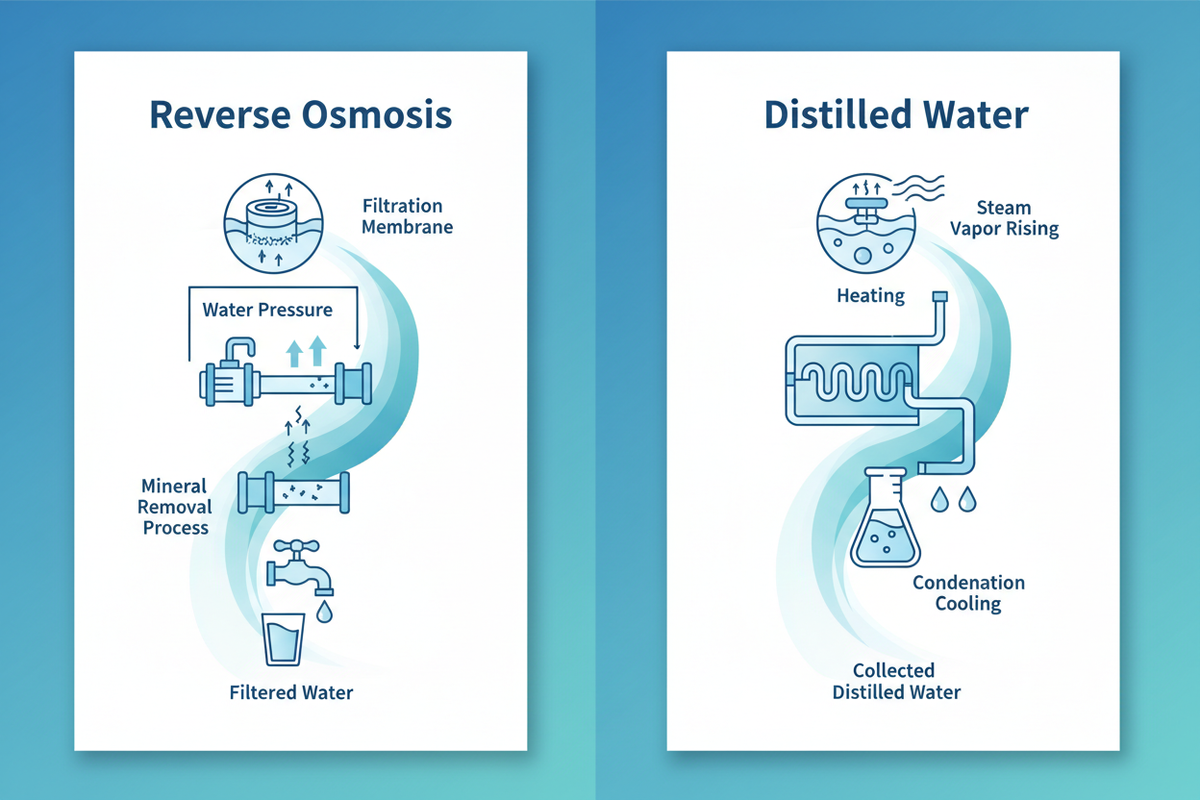
Distilled water is the drama queen of purification. It’s made by boiling water until it turns into steam, then catching that steam and cooling it back into liquid. Think of it like a sauna for H2O—everything else gets left behind. RO water (that’s reverse osmosis for the fancy folks) uses pressure to push water through a super-fine membrane. It’s like a bouncer at a club: only the water molecules get past; the minerals and impurities get kicked out.
In short: one uses heat, the other uses a fancy filter. Both want to give you pure water, but they take totally different road trips to get there. And yes, both are more high-maintenance than your regular tap water, but we love them anyway.
Must Read
The Science-y Stuff (Made Fun, I Promise)
Distillation: The Boil and Chill
Distillation is ancient—like, “alchemists trying to turn lead into gold” ancient. You boil the water until it becomes vapor, which leaves behind salts, metals, and that weird smell from your well water. The steam rises, cools, and turns into pure, innocent liquid again. But here’s the kicker: it also strips out everything, including the good stuff like calcium and magnesium that make water taste, well, watery.
So distilled water is basically the Karen of waters—extremely pure, a little boring, and it might give you a blank stare if you ask for flavor. It’s fantastic for irons, car batteries, and CPAP machines. For drinking? It’s like a plain cracker. No salt, no zest, just… wet.
Reverse Osmosis: The Pressure Cooker’s Cousin
RO water is the cool, modern cousin. It uses pressure (usually from your home’s water line) to force water through a semipermeable membrane. Think of it as a microscopic sieve that blocks contaminants like lead, chlorine, and fluoride. But here’s the twist: RO systems don’t remove absolutely everything. They let some minerals sneak through, which actually makes the water taste more like water and less like a science experiment.
Plus, RO systems often come with a carbon pre-filter that removes chlorine, so your water doesn’t smell like a swimming pool. It’s like the Goldilocks of purification—not too pure, not too dirty, just right for drinking. And it doesn’t need a full boil, so you save energy. Take that, distillation!
The Taste Test: Which One Wins Your Tongue?
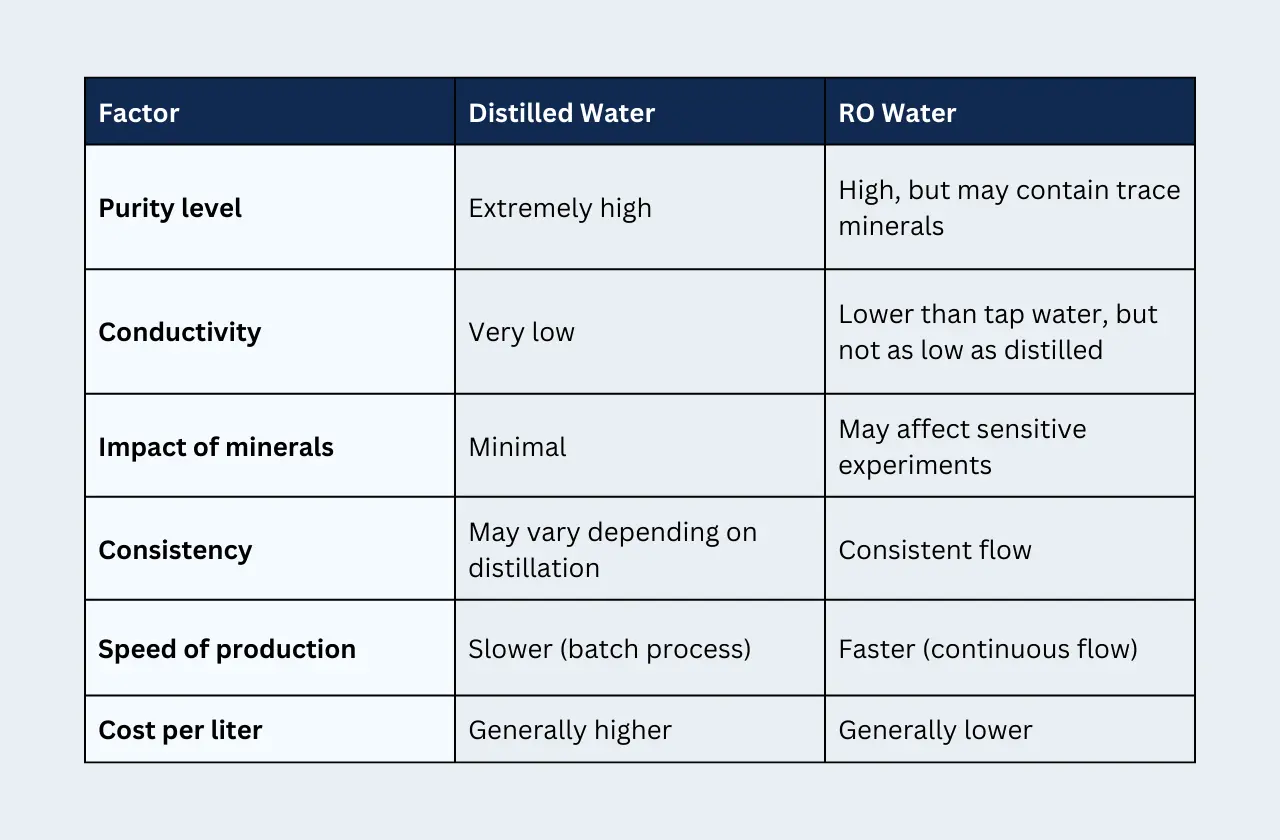
RO water wins this round, hands down. It has a crisp, clean taste without being flat. Distilled water, by contrast, tastes like nothing—literally. Your brain might actually reject it because it’s so devoid of minerals. Some people say distilled water tastes “dead.” RO water tastes “alive” and smooth. So if you’re drinking it straight, go RO. Your taste buds will thank you.
But if you’re mixing it into coffee or tea, distilled water can actually make your brew taste brighter because it doesn’t interfere with the flavors. It’s like the silent sidekick. RO water is your lead actor. Choose your character.
 Is Ro Water The Same As Distilled Water
The Health Factor: What’s in (or Out) of Your Glass?
Here’s where things get a little personal. Distilled water is so pure that it can actually leach minerals from your body if you drink it exclusively. Don’t panic! You’d have to chug it like a fish for months to see any issues. Still, it’s not ideal for everyday sipping. RO water retains trace minerals, so it’s kinder to your teeth and bones. Plus, it removes most of the bad stuff (like arsenic and nitrates) without making your body feel robbed.
Both are way better than tap water in places with high lead or chlorine—but for daily hydration, RO is the winner. Just don’t forget to eat your veggies too, okay? Water isn’t a meal.
Cost and Convenience: The Wallet Talk
Distilled water is cheap to make at home (just a pot and a lid), but it takes forever. A gallon can take hours on the stove. Store-bought distilled is affordable, but it’s heavy to carry. RO systems are pricier upfront—think $150 to $500 installed—but they give you unlimited clean water on demand. Over a year, RO is way cheaper than buying bottled distilled water.
Also, RO systems require filter changes every 6-12 months. Don’t forget, or your “pure” water starts tasting like a swamp. Set a reminder on your phone. I’m serious. Your future self will high-five you.
The Final Verdict: Which One Should You Pick?
For drinking every day? Go with RO water. It’s better tasting, safer for long-term use, and more convenient. For appliances, baby formula, or CPAP machines? Distilled water is the champ. It leaves zero mineral deposits, so your gadgets stay happy. For the environment? Both beat single-use plastic bottles, so you’re already a hero. For impressing your friends at parties? Just say, “I prefer a layered approach to hydration,” and watch them look confused.
Uplifting Conclusion: Water You Waiting For?
See? It’s not rocket science—it’s just water science with a sense of humor. Whether you choose distilled or RO, you’re already making a choice to drink cleaner, healthier water. And that’s something to smile about. So fill up your glass, toast to your new knowledge, and remember: life’s too short for bad water or boring articles. Cheers to you, you brilliant water-choosing superstar! Now go hydrate like the legend you are. 💧
