Whole House Water Filter Installation Cost

So, you’ve finally decided to stop drinking tap water that tastes like a swimming pool’s regret. Good for you! A whole house water filter is the superhero your plumbing never...
So, you’ve finally decided to stop drinking tap water that tastes like a swimming pool’s regret. Good for you! A whole house water filter is the superhero your plumbing never knew it needed. But before you start dreaming of crystal-clear showers and ice cubes that don’t smell like a swamp, let’s talk about the elephant in the room: the cost.
The Price Tag: A Rollercoaster of Emotions
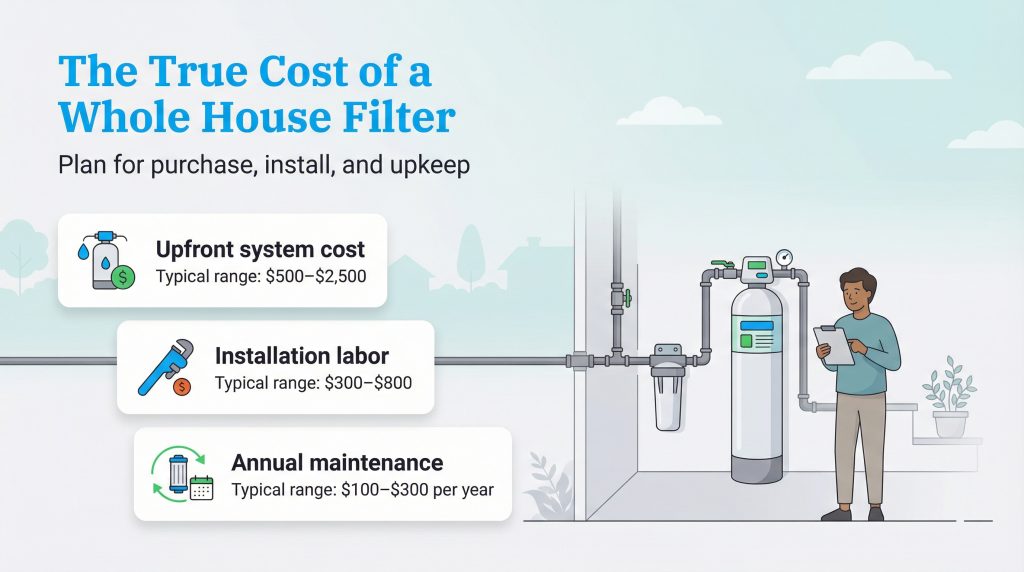
Here’s the brutal truth: installing a whole house water filter can cost anywhere from $1,000 to a jaw-dropping $6,000 or more. Yes, that’s the same price as a used car—or a very nice vacation to somewhere with good water. But hey, if your water currently smells like a wet dog wearing a chlorine cologne, it’s worth every penny.
Why such a wild range? Because not all filters are created equal. A basic carbon filter is like a cheap umbrella—it works until a storm hits. A reverse osmosis system, on the other hand, is the SUV of water treatment: expensive, overkill for city water, but glorious if you live in a rural area with well water that tastes like iron filings.
Must Read
Breaking Down the Madness
The biggest chunk of your cash goes to labor. Unless you’re a plumber with a death wish, you’re paying someone $300 to $1,000 to cut into your pipes and hope they don’t flood your basement. Pro tip: never hire a plumber who says “I’ll wing it”—that’s how you end up with a waterfall in your laundry room.
Then there’s the unit itself. A basic sediment filter (good for rust and sand) runs about $400 to $800. A fancy-pants catalytic carbon or UV light system? That’s $1,500 to $3,000, plus the cost of therapy when you realize you spent more on water than on your couch.
Surprising fact: The average American family spends $600 a year on bottled water. Over ten years, that’s $6,000—enough to buy two whole house filters and a lifetime supply of fancy shower heads. Math is a cruel mistress, but she’s right.
The Hidden Costs That Bite You in the Wallet
Don’t forget installation extras. You might need pressure tanks (another $200), bypass valves ($50), or a drain line ($100). And if your home was built before 1980, God help you—old pipes love to crumble the moment you touch them. That’s a surprise $500 repair right there.
Oh, and yearly maintenance? A filter replacement kit can be $100 to $400 per year. That’s like buying a new espresso machine every twelve months, but without the caffeine buzz. You’ll also need to flush the system every three months, which is about as exciting as watching paint dry, but less messy.
![Whole House Water Filter Cost 2025 [$1,500-$4,000 Guide]](https://bestwholehousewaterfilters.com/wp-content/uploads/2026/01/How-Much-to-Install-a-Whole-House-Water-Filter.png) Whole House Water Filter Cost 2025 [$1,500-$4,000 Guide]
Whole House Water Filter Cost 2025 [$1,500-$4,000 Guide]
Here’s a joke that’s barely funny but painfully true: “A whole house filter is like a marriage—expensive upfront, but worth it if you want clean water forever.” (I’ll show myself out.)
When to Call a Pro vs. DIY
If you’re a DIY warrior who can solder copper pipes without setting your hair on fire, you can save $400 or more. Kits start at $300 for a basic system. But if you confuse “water hammer” with a dance move, hire a pro. A leaky filter can turn your basement into an indoor pool, and nobody wants to swim with the water heater.
Another surprising fact: Some homes actually increase in value by $2,000 to $3,000 with a whole house filter. So you’re not just spending money—you’re investing in a future where your toilet water is as drinkable as your fridge water. You’ll never look at a bathroom faucet the same way again.
The Verdict: Is It Worth the Price?
Let’s be real: if your water tastes like a rusty nail soaked in bleach, you already know the answer. For most families, a mid-range $1,500 to $2,500 system (installed) is the sweet spot. That’s less than the cost of a kidney stone procedure, and far less painful.
But if you’re on a budget? Start with a point-of-use filter under your kitchen sink for $200. It’s like training wheels for water purity. You’ll still have to shower in swamp water, but at least your coffee won’t taste like a swimming pool’s revenge.
In the end, buying a whole house filter is about peace of mind. And the knowledge that your ice cubes won’t smell like a gym sock left in a rainstorm. Now go forth, call a plumber, and prepare to spend some cash—your water’s future is bright, clear, and (finally) delicious. Cheers to not drinking from a hose!
