Average Water Bill Per Month For A Business

So, you’re running a business. Congratulations (or my condolences, depending on the coffee situation). You’ve got payroll, rent, and that one weird shelf that squeaks. But hav...

So, you’re running a business. Congratulations (or my condolences, depending on the coffee situation). You’ve got payroll, rent, and that one weird shelf that squeaks. But have you thought about the water? Not the drinking kind—the bill kind. We’re talking about the average water bill for a business. It’s more exciting than it sounds. Promise.
The Big Splash: What’s the Number?
Hold onto your faucet. The average monthly water bill for a small business in the U.S. hovers around $150 to $400. Yes, you read that right. It’s like flushing a loaded pizza down the toilet every month. For a medium business, think $500 to $1,500. Large industrial users? They’re paying $3,000 to $10,000. That’s enough to buy a used car—or a lot of bottled water in a fancy shape.
But here’s the kicker: it’s not just about water. You’re paying for delivery, treatment, and sewer fees. That sewer charge? It’s often 50% to 100% of your water cost. So every drip, splash, and flush costs double. It’s like paying for a movie ticket, then paying again to watch the credits.
Must Read
Who Uses All That Water? (Spoiler: It’s Not Just the Toilet)
Restaurants are the undisputed champs. They burn through 5,000 to 10,000 gallons a month per location. That’s like filling a swimming pool just to wash dishes. Laundromats are close behind—think 10,000 gallons weekly. And offices? They’re the sneaky sippers. Just coffee, sinks, and that one guy who waters a dying fern every day.
But here’s a fun fact: a single dripping faucet can waste 3,000 gallons a year. That’s like giving a thirsty elephant a bath every month—unnecessarily. Your business might be leaking money without you even knowing.
Location, Location, Location (It’s the Water World)
Where you are matters—a lot. In Seattle, water is cheap and plentiful. Your bill might be a friendly $200. But in San Francisco? Prepare for $800+. That’s the difference between a gentle rain and a tsunami of fees. The same water in New York City? Probably a theatrical musical number—and a $600 surprise.
Why the wild difference? It’s all about infrastructure. Old pipes need fixing, and someone has to pay. Hint: it’s you. Also, drought-prone states like California get really expressive about conservation. Their water rates climb like a squirrel up a tree—fast and with a lot of chattering.
Why Should You Care? (Beyond the Obvious)
Here’s the fun twist: lowering your water bill is a competitive sport. Install low-flow toilets and save 20% instantly. That’s like finding $80 in the couch cushions every month. Fix that dripping faucet, and you just earned a free lunch. Audit your system? You might uncover a leak that’s been filling a phantom lake under your parking lot.
Plus, being water-wise makes your business look cool. Customers love green companies. They’ll clap for your water-saving ways—figuratively, unless you install a dramatic rainwater collection system. Then they might literally clap.
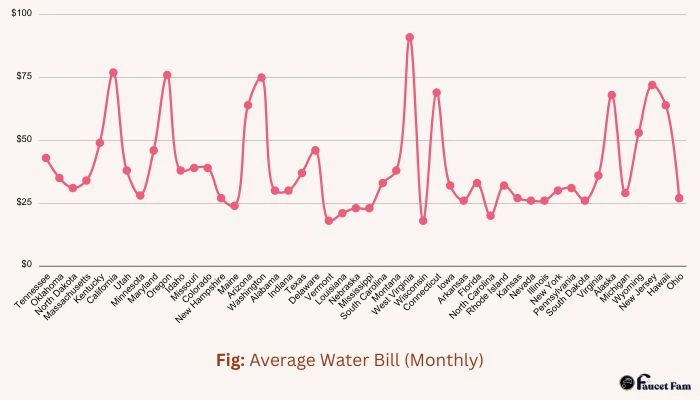 The Impact Of Faucet Leaks On Your Water Bill: A Data Analysis - Faucet Fam
The Quirky Details That’ll Make You Smile
Did you know that a commercial dishwasher can use 15 gallons per cycle? That’s like washing your car inside your coffee cup. And the average bakery uses 30,000 gallons a month—mostly for dough and cleaning. Imagine the croissant flood. It’s beautiful and terrifying.
Here’s another one: data centers use water to cool servers. A single large data center can slurp 300,000 gallons daily. That’s enough to fill a small lake—just to keep your cat videos streaming. Your business might not be that intense, but every gallon counts.
How to Win the Water Game (Without Getting Wet)
First, check your bill for “unaccounted usage.” Utilities sometimes estimate. If you see a spike, call them. They’re usually nice—like librarians with calculators. Second, invest in aerators. They mix air with water, so your sink feels the same but uses less. It’s wizardry, but legal.
Third, train your staff. No more leaving taps running while daydreaming. Make it a game: “Who can save the most water?” The winner gets a plastic crown and a month of free stoicism. It’s weird, but it works.
The Bottom Line (It’s Soggy, But Interesting)
The average water bill for a business isn’t just a number. It’s a story about geography, habits, and bad faucets. It’s a mystery you can solve every month. And the best part? You can actually make it smaller. That’s like shrinking a monster in a movie—except the monster is your utility bill, and you’re the hero with a wrench.
So next time you hear a drip, don’t ignore it. Chase it. Fix it. Laugh at it. Your wallet will thank you—and so will the planet. Now go turn that water off. (Okay, not all of it. Just the wasteful parts.)
