What's The Recommended Amount Of Water Per Day

We’ve all heard the mantra: eight glasses a day. It’s the wellness world’s most persistent rumor, whispered over gym lockers and printed on reusable water bottles. But here’s...

We’ve all heard the mantra: eight glasses a day. It’s the wellness world’s most persistent rumor, whispered over gym lockers and printed on reusable water bottles. But here’s the truth: that number is less science and more urban legend, a convenient myth born from a 1945 guideline that mentioned a vague “daily allowance.” The actual answer? It’s delightfully, annoyingly personal.
The Real Numbers (No Math Required)
The National Academies of Sciences, Engineering, and Medicine suggests around 3.7 liters (15.5 cups) for men and 2.7 liters (11.5 cups) for women from all sources. That includes the morning coffee, that slice of watermelon, and even your bowl of soup. Notice the key phrase: from all sources. You don’t need to chug that much plain H2O—food provides roughly 20% of your daily intake.
Think of your body as a high-maintenance houseplant. A fiddle-leaf fig doesn’t need the same water as a cactus, and neither do you. Your ideal number depends on your activity level, the climate, your size, and even how much you sweat when binge-watching your favorite show. The old “eight cups” rule isn’t wrong—it’s just lazy.
Must Read
The Sipping vs. Chugging Debate
Ever downed a whole bottle after a workout and felt sloshy? That’s your kidneys throwing up a white flag. Your body can only process about 0.8 to 1 liter per hour. Chugging more than that doesn’t hydrate you faster—it just makes you run to the bathroom, flushing out electrolytes. Sipping steadily throughout the day is your hydration superpower.
Imagine you’re at a chic Parisian café. You wouldn’t gulp your espresso in two seconds; you’d savor it. Apply that same energy to water. Keep a bottle on your desk and take polite, regular sips. Your cells will thank you, and you won’t feel like a human water balloon.
How to Know If You’re Dry (Without a Lab Test)
Forget the color of your urine for a moment—though, yes, pale straw is the goal. A simpler test? Check your skin pinch. Pinch the skin on the back of your hand; if it snaps back instantly, you’re golden. If it stays tented for a second, you’re probably behind. Also, if you feel a headache creeping in or your mouth feels like the Sahara, you’ve already lost. Thirst is a late signal—it means you’re about 1-2% dehydrated.
Fun fact: the human brain is about 73% water. That makes dehydration a literal brain drain. Studies show even mild fluid loss (1-3% of body weight) can impair mood, concentration, and short-term memory. So, that afternoon fog? Might not be a need for caffeine, but a need for a glass of water.
Culture, Coffee, and the Great Myth
You’ve heard coffee dehydrates you. It doesn’t. A 2014 study in PLOS ONE found that moderate coffee consumption (up to four cups) is just as hydrating as water for your daily fluid balance. That morning latte counts. Your tea, your sparkling water, even that beer—all count. The exception? High-alcohol spirits and sugary sodas, which can mess with your system.
Different cultures get creative. In Japan, people sip mugi-cha (barley tea) all day. In India, it’s salted lassi. In Mexico, it’s horchata. The point: hydration doesn’t have to be boring. Flavor your water with cucumber, mint, or a splash of citrus. Think of it as a cocktail for your kidneys.
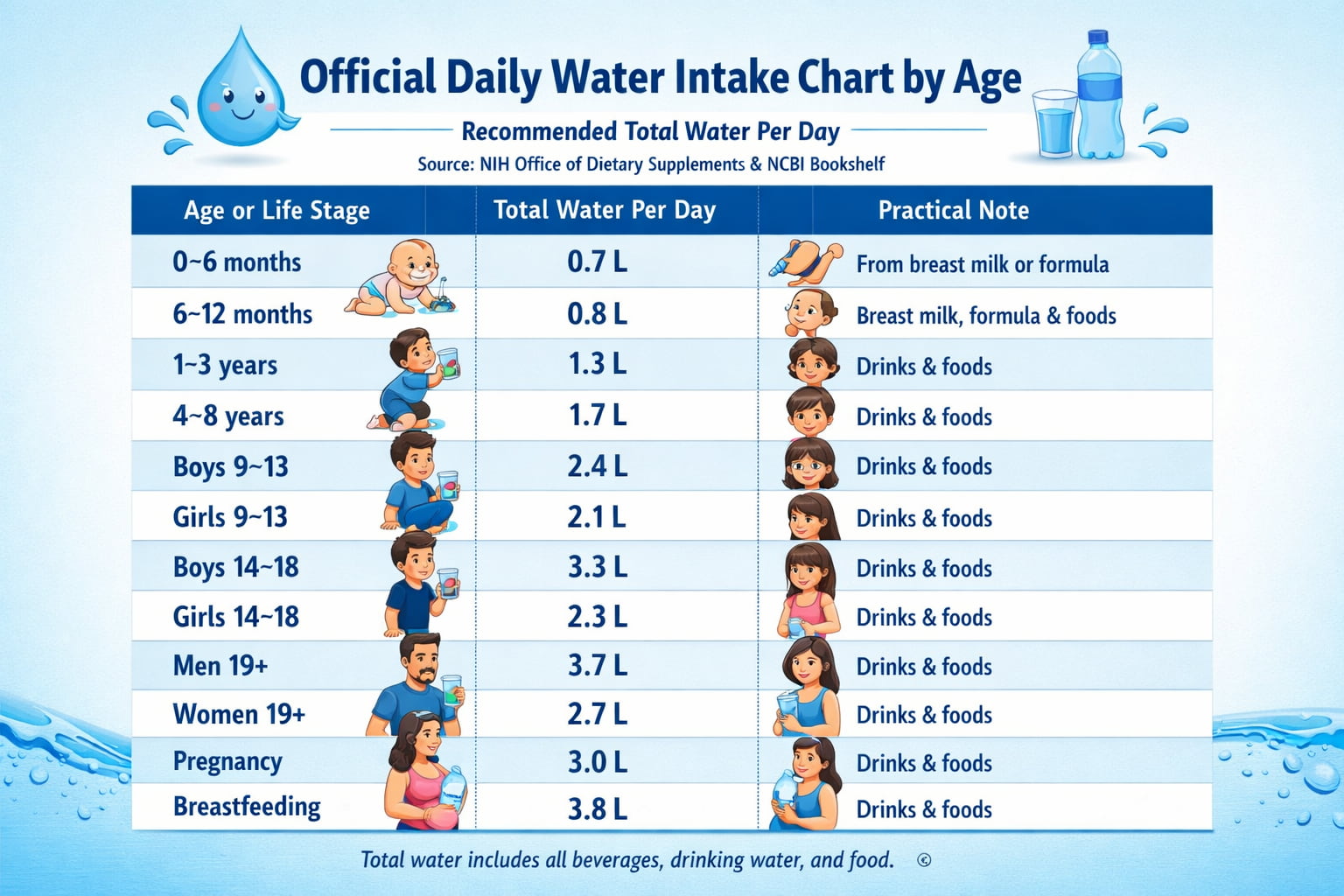 Daily Water Intake by Age: When Weight, Activity, and Climate Change
Practical Hacks for Real Life
Start the day with a glass. Your body wakes up dehydrated after hours without fluid. Placing a glass by your bed this evening means you’ll drink it before your morning screen scroll. That single habit nudges your intake up by 8 ounces with zero effort.
Use a bottle with time markers. Brands like HidrateSpark or even a basic marked Nalgene turn hydration into a game. If you see “12 PM” at noon and you’re behind, you’ll catch up. It’s like a Tamagotchi for grown-ups—except the virtual pet is your own bladder.
Pair water with cues. Every time you unlock your phone, take a sip. After brushing your teeth? Sip. When you stand up from your desk? Sip. These tiny ties create automatic habits. Before you know it, you’ve hit your target without a single thought.
When More Isn’t Better
Yes, you can over-hydrate. It’s called hyponatremia, and it happens when you drink so much water that your blood sodium drops dangerously low. It’s rare in everyday life, but marathon runners and hot yoga enthusiasts know the risk. The simple fix? Eat something salty and listen to your body. If water tastes disgusting or feels forced, stop. You’re done.
Your body is smarter than any recommendation. It has a built-in thirst mechanism that’s been refined over millions of years. The problem? We ignore it—we’re busy, we’re distracted, we’re drinking coffee. So the real recommended amount isn’t a number. It’s attention.
A Gentle Reflection
On a quiet Tuesday, after a long day of meetings and screen glare, you’ll pour a glass of cool water. You’ll take a sip, and it will feel like the best thing you’ve tasted all day. In that moment, you’re not just hydrating—you’re pausing. You’re giving your body exactly what it asked for, hours ago, while you were busy.
That’s the real recommendation. Not a rigid number, but a soft invitation to listen. Drink when you’re thirsty. Sip when you remember. And remember that every drop you take is a tiny, unglamorous act of kindness to the only body you’ll ever have. So refill that glass. Your houseplant self will thank you.
