How Do You Know What Size Water Softener To Get

So, there I was, standing in the plumbing aisle of the hardware store, staring at a wall of shiny metal cylinders. They looked like miniature sci-fi rockets, and honestly, I h...
So, there I was, standing in the plumbing aisle of the hardware store, staring at a wall of shiny metal cylinders. They looked like miniature sci-fi rockets, and honestly, I had no clue which one was supposed to save my skin (and my coffee maker) from the local hard water. I just knew my shower felt like I was washing with chalk, and my dishes looked like they’d been dusted with snow. It was the moment I realized: size actually matters—at least when it comes to water softeners.
That awkward silence in the aisle is exactly why we need to talk. You don’t want to guess, because getting the wrong size is like buying shoes for a baby elephant when you have clown feet. It’s a disaster in different ways. A too-small softener works itself to death, running constantly and burning out in a year. A too-big one? That’s just a waste of money and salt—like hiring a rocket scientist to change a lightbulb.
Step one: Stop counting family members (the math is easier than that)
You’ll hear people say “get a 30,000-grain unit for a family of three,” but that’s a trap. It’s not about bodies; it’s about water usage. Your kids might be tiny, but if they take 45-minute showers, they’re basically small water monsters. You need to know your household’s daily flow—and no, guessing “uh, like, a lot?” won’t cut it.
Must Read
Pulling out your water bill is the fastest way to look like a genius. Find your monthly usage in gallons (usually on page two, buried under charges you don’t understand), then divide by 30. That’s your daily number. A normal family of four uses about 400 gallons a day—but if you have a leaky toilet or a teenager who forgets to turn off the hose, that number might be scarier.
Here’s where the irony kicks in
You think you’re bad at math? The appliance industry assumes you’re terrible at it. So they made a formula: multiply your daily gallons by the hardness of your water (in grains per gallon). That gives you your “daily softening needed.” For me, with 10 grains of hardness and 300 gallons a day? That’s 3,000 grains I need to remove before breakfast.
But wait—softeners don’t work in one-day spurts. They regenerate (clean themselves) every few days, and you can’t let them run empty. You want a unit that holds enough softening capacity for about three days, with 20% headroom. So, multiply your daily number by 3, then add a little extra for your sanity.
The trap of the “family size” chart (and why I almost bought a wall ornament)
The guy at the store pointed to a chart: “2-3 people? Get a 24,000-grain unit.” That’s a lie dressed up as convenience. If you have hard water at 20 grains, that 24,000-grain softener lasts you exactly one day before it begs for mercy. You’d be regenerating every night, wasting salt and water like it’s a hobby.
So look at your actual numbers. A household with 500 gallons a day and 15-grain water needs 7,500 grains daily. For a three-day backup, you want a 30,000-grain or 32,000-grain unit. If you have 10-grain water and only 300 gallons, a 24,000-grain model might be perfect—but only if you promise not to invite your in-laws for a week-long stay.
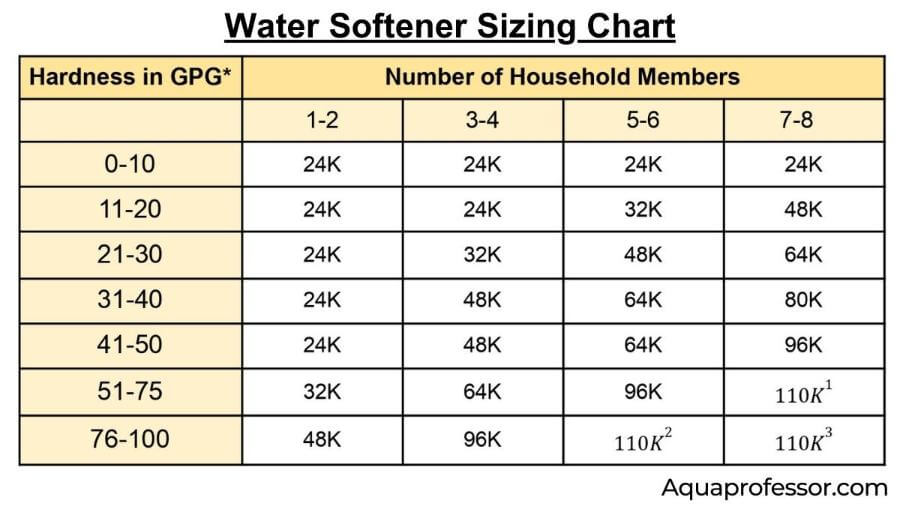 Water Softener Grain Chart & Calculator: Ultimate Cheatsheet
The weird part nobody tells you
Iron in your water changes everything. If your water looks clear but tastes like a rusty toolbox, you have “clear water iron.” It adds to the hardness number—each ppm of iron counts as 4 grains of hardness. So if you have 2 ppm iron and 10 grains hardness, you’re actually dealing with 18 grains. That tiny detail could push you from a 24,000-grain unit to a 40,000-grain giant.
And don’t forget about your flow rate—how fast water comes out of your taps. If you’re running the washing machine, a shower, and a dishwasher at the same time (chaos, I know), your softener needs to handle that peak flow. A small unit chokes and gives you hard water mid-shampoo. No one wants a head full of soap scum.
The “just in case” upgrade (spend once, cry once)
Here’s my final irony: I bought a 32,000-grain unit for my family of three. It’s overkill—my calculations said a 24,000 would work. But my neighbor’s unit died at year five, and I realized the extra capacity meant I could skip regeneration on vacation, or handle a burst pipe without panicking. It’s like buying a bigger suitcase than you need. You never regret having a little extra room.
So measure your water hardness (buy a $10 test kit—don’t trust the city report), count your actual gallons, and add that iron factor. Then add 20% for your sanity. You’ll end up with a size that feels right, not one a chart told you to buy. And next time you’re in the plumbing aisle, you’ll walk past the tiny rockets with the smug confidence of someone who did the homework.
Now go take a shower without feeling like you’re rubbing sandpaper on your skin. You deserve that.
