Is There A Faucet Filter To Take Out Sulfur Smell

Okay, let’s be honest. You turn on the tap, and bam—it smells like a dozen rotten eggs just exploded in your sink. You’re not alone, I promise. That lovely sulfur smell (techn...

Okay, let’s be honest. You turn on the tap, and bam—it smells like a dozen rotten eggs just exploded in your sink. You’re not alone, I promise. That lovely sulfur smell (technically hydrogen sulfide) is a common party crasher in well water and even some municipal supplies.
So, the burning question: Is there a faucet filter to take out sulfur smell? Short answer? Yes. But with a huge asterisk the size of your head. Let’s talk it out over this imaginary coffee.
The “Quick Fix” Mirage
You’ll see those sleek little faucet filters at the big box store. They promise clean water, no smells, and a better life. Do they work for sulfur? Sometimes. Most basic carbon filters are not built for this job.
Must Read
Think of a standard carbon filter like a gossip filter—it’s great at catching bad tastes and some chlorine. But sulfur? That’s a nastier rumor. It sneaks right past the carbon like it owns the place.
You need a filter with a very specific kind of media inside. Specifically, catalytic carbon or KDF (Kinetic Degradation Fluxion—say that three times fast). These are the heavy hitters for sulfur gas.
Enter the “Badass” Filters
Some faucet filters actually do contain catalytic carbon. These are the rare ones. They don't just trap the smell—they chemically convert the hydrogen sulfide into something harmless.
But here’s the catch: sulfur is aggressive. It exhausts filter media way, way faster than chlorine or dirt. You might be changing cartridges every month. That’s great for the filter company’s wallet, not so much for yours.
And another thing: Low flow. To actually kill the smell, the water needs to hang out with the filter media for a bit. If you’re in a hurry for a glass of water, you might die of old age waiting for your glass to fill. Patience is a virtue, I guess?
When a Faucet Filter Is Not Your Friend
Let’s get real for a second. Does the smell hit you in the hot water, but not the cold? If yes, a faucet filter will not fix it. That’s a different beast entirely.
That smell is usually from a sacrificial anode rod inside your water heater reacting with bacteria. A little filter on the tap is fighting a battle it cannot win. You’d need to treat the whole heater (or get a new anode). Don’t waste your money on a filter for that.
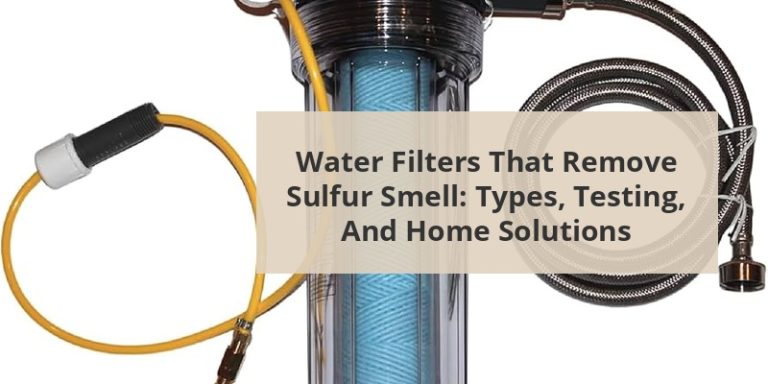 Water Filters That Remove Sulfur Smell: Types, Testing, and Home
Also, if your sulfur smell is powerful—like, it makes you gag before the glass hits your lips—a faucet filter is fighting a losing war. You might need a whole-house system (like an aeration tank or a greensand filter). Faucet filters are for “polishing,” not “slaying dragons.”
The “Buy This, Not That” Vibe
So, you’re determined to try a faucet filter anyway? I respect that. Look for these keywords on the box: “Cyst reduction,” “Turbidity,” and most importantly, “Hydrogen Sulfide reduction” or “Hydrogen Sulfate removal.” If it says “Reduces taste and odor” only, it’s useless.
Brands like Culligan and PUR have some models that claim sulfur reduction. But check the fine print. The flow rate will be sad, and the filter life will be short. It’s like hiring a bodyguard for your tap—they show up, but they need a vacation every three weeks.
The Doulton or Berkey countertop systems (with filters for sulfur) actually work better than most faucet ones, I hate to admit. They have more media volume. More media = more smell-killing power.
The Honest-to-Goodness Truth
If you have light sulfur (just a whiff, not a punch in the nose), a faucet filter can work. Catalytic carbon is your friend. But you’ll be replacing that cartridge like it’s a roll of paper towels. Expect to pay $30–$60 every 2–3 months.
If the smell is medium or strong? Don’t bother. You need a bigger solution: a whole-house carbon filter, a water softener (if it’s iron-related), or a chemical injection system. Sorry, but a tiny filter can’t fix a big plumbing problem. It’s science, not magic.
So here’s the coffee chat summary: Yes, they exist. No, they aren’t miracle workers. For a faint “eggy” tap, go for it. For a stench that follows you around the house, call a plumber and buy a whole-house filter. Your nose—and your guests—will thank you.
Now, go drink some water that doesn’t smell like a prank. You deserve it.
