How Do I Determine What Size Water Softener I Need

So, you’ve got that crunchy, white film on your coffee pot again. Your hair feels like straw, and your skin is as dry as the Sahara after a shower. Yep, that’s hard water, and...
So, you’ve got that crunchy, white film on your coffee pot again. Your hair feels like straw, and your skin is as dry as the Sahara after a shower. Yep, that’s hard water, and it’s time to think about a water softener.
But then comes the panic: “What size do I even need?” Don’t worry, friend. This isn’t rocket science—it’s more like figuring out how many pizzas to order for a party. Let’s break it down together, nice and easy.
Why Size Matters More Than You Think
Think of a water softener like a sponge. A tiny sponge can’t soak up a spilled bucket of juice. Pick a softener that’s too small, and it’ll run out of “sucking power” before breakfast is over.
Must Read
On the flip side, a giant softener for a small household is like buying a semi-truck just to get groceries. It wastes money, water, and salt. You want the Goldilocks softener: not too big, not too small, but just right for your home.
So, how do you find that sweet spot? You only need two numbers: how many people live in your house, and how hard your water is. Grab a coffee (from that clean pot you wish you had) and let’s do the math.
Step One: Count Your Crew
Every person in your home uses water. The average person goes through about 80 gallons per day. That includes showers, laundry, washing dishes, and yes, that long bath you take on Sundays.
Let’s say you’ve got a family of four. That’s 320 gallons of water running through your pipes every single day. A couple living alone? That’s only 160 gallons. See where this is going?
Write that number down. It’s the soul of your future softener. Don’t worry about being perfect—just use a round number like 300 for a family or 150 for a pair.
Step Two: Measure Your Madness (Water Hardness)
Now, we need to know how mean your water is. Hard water is full of calcium and magnesium. You can buy a simple test strip at the hardware store for a few bucks, or call your local water company.
They’ll give you a number in “grains per gallon” (GPG). If the number is 10, your water is really hard. If it’s 5, it’s moderate. I once tested a friend’s well water that hit 40 GPG—practically liquid rock!
Don’t let a high number scare you. It just means you need a bigger sponge, that’s all. For most homes, the range is between 5 and 15 GPG, so you’re probably in safe territory.
Step Three: Do the Simple Math (Don’t Freak Out)
Here’s the magic formula, and it’s easier than splitting a restaurant bill. Multiply your daily water use (from Step One) by the hardness number (from Step Two). Then multiply that result by 4—because you want the softener to run for a week without refilling.
Example: A family of four uses 320 gallons. Their hardness is 10 GPG. So: 320 x 10 = 3,200 grains per day. 3,200 x 7 days = 22,400 grains per week.
That number—22,400—is the minimum capacity you need. Look for a softener rated at about 24,000 to 30,000 grains. That gives you a little cushion, like ordering dessert after a big meal.
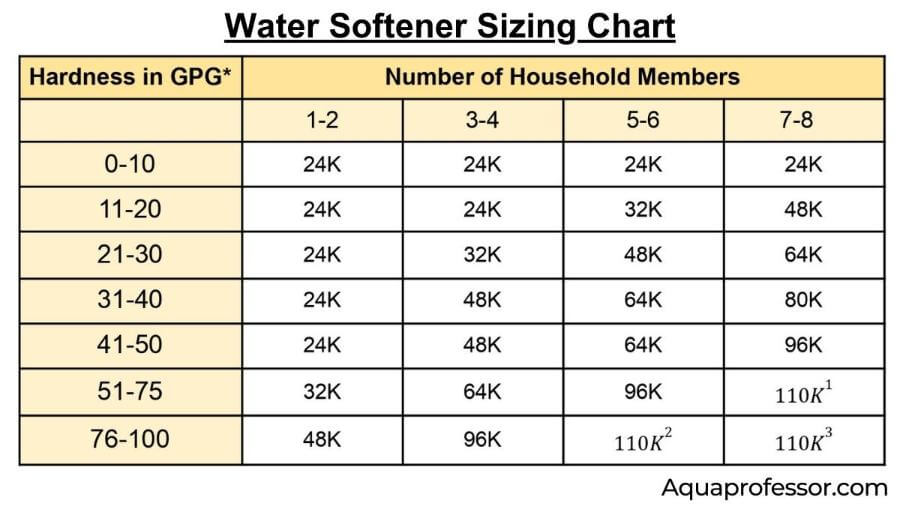 Water Softener Grain Chart & Calculator: Ultimate Cheatsheet
What If You Mess Up?
If you buy a softener that’s too small, it’ll regenerate (clean itself) every other day. That wastes salt and water, and you’ll still get hard water spots. Trust me, you don’t want to wake up to slimy, half-soft water on Monday morning.
If you buy one that’s too big, the tank is so huge it might not fit under your sink. Plus, it regenerates only once every two weeks, letting bacteria sit in the resin. That’s gross and wasteful.
So aim for that happy middle. And remember: most manufacturers have charts online. You just plug in your numbers and they spit out a recommendation. You’re basically a water scientist now.
A Little Story from My Own House
When I first moved into my home, I bought the smallest, cheapest softener I could find. Big mistake. My water still left white rings on my glasses. My kids called the spots “snowflakes,” but I was not amused.
After crunching the numbers, I realized I needed a 32,000-grain monster. Now my water feels like silk. My hair doesn’t squeak. And my coffee pot? Sparkling clean. It was worth the extra hundred bucks.
So please, take the five minutes to do the step above. Your appliances, your skin, and your coffee pot will throw you a thank-you party.
Quick Recap (Because You’re Busy)
Remember: People + Hardness = Size. Start with how many gallons your family uses daily. Multiply by your water’s hardness. Multiply by 7 for a week’s worth of soft water.
Don’t guess. Don’t just buy the one on sale at the hardware store. Your water softener is like a loyal pet—it needs the right amount of food to work well.
And hey, if you’re still confused, call a plumber or your local water treatment store. They love talking about grains and gallons. You’ll walk out feeling like a pro.
Final Smile for the Road
Hard water used to piss me off. Now I just smile and pour myself a glass of clear, cold, soft water. You deserve that too. Go get the right size, and may your showers never feel like sandpaper again.
Happy softening, my friend. You’ve got this.
