How Much Does A Whole House Reverse Osmosis System Cost

Let’s talk about water. Not just any water—the kind that makes your ice cubes crystal clear and your coffee taste like a hug. We’re diving into whole house reverse osmosis sys...

Let’s talk about water. Not just any water—the kind that makes your ice cubes crystal clear and your coffee taste like a hug. We’re diving into whole house reverse osmosis systems. Yes, it’s as fancy as it sounds.
The Big Question: What’s the Damage?
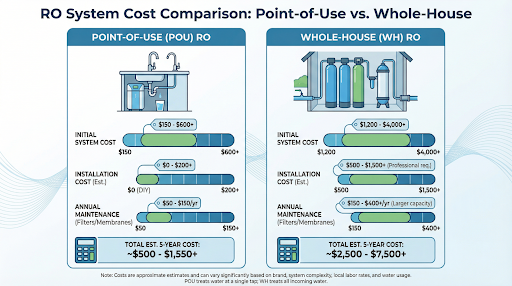
You want a number, right? Okay, here goes. A whole house RO system typically costs between $2,500 and $5,500—installed. That’s the sweet spot for a normal home. But wait, there’s more.
If you’ve got a mansion or freakishly hard water, you could hit $10,000 or more. That’s like buying a used car that only drinks water. Quirky, right?
Must Read
The Unboxing: What You’re Actually Paying For
Let’s break it down like a bad science experiment. You’re paying for the system itself—tanks, filters, and magical membranes. Then there’s installation, which can cost $500 to $1,500. Pro tip: don’t DIY this unless you love plumbing puzzles.
You’re also buying pure water from every tap. Imagine your shower, your ice maker, and your dog’s water bowl all getting a spa upgrade. Everything tastes cleaner. Including your morning cereal milk.
Funny Fact: Water Is Heavy
Here’s a thing nobody tells you. A whole house RO system creates wastewater. For every gallon of clean water, it dumps about 3 to 4 gallons down the drain. That’s like buying a ticket to a concert and paying for four empty seats.
Modern systems are better—some waste only 1 gallon per 1 gallon pure. But still. Your water bill will do a little dance. Factor in an extra $10 to $30 per month for water usage. It’s the price of perfection.
The Hidden Costs: Filters and Fairy Dust
You don’t just buy the system and ride off into the sunset. Filters need replacement every 6 to 12 months. That’s $100 to $300 per year. The big membrane lasts 3 to 5 years—replacing it costs $200 to $500.
 How Much Are Reverse Osmosis Systems? Pricing and Installation Guide
Think of it like owning a pet. You feed it filters, and it gives you amazing water. Except this pet never poops on your rug. Quirky, I know.
Why Size Matters (It Always Does)
A whole house RO system is rated by gallons per day (GPD). A family of four needs about 50 to 75 GPD. That’s enough for drinking, cooking, showering, and filling a kiddie pool (though please don’t).
Go too small, and your water pressure drops faster than your phone battery at 5 PM. You’ll be waiting forever for a shower. Go too big, and you’re burning cash on a system that feels like overkill. Like buying a Ferrari for grocery runs.
The Tank Tango
Most systems come with a storage tank—usually 4 to 20 gallons. It sits under your sink or in the basement. It’s bulky. It’s weird. Your friends will ask, “Is that a giant water bomb?” Answer: Yes. A delicious water bomb.
No tank systems exist too. They’re smaller, quieter, and cost 10% to 20% more. But they save space. Perfect for tiny homes or people who hate clutter. Or people who just want to brag about their no-tank RO.
The Fun Stuff: Why You’ll Love It
Okay, here’s why this topic is actually fun. You become a water snob. You’ll taste the difference between tap and RO water like a sommelier. Your houseplants will grow greener. Your skin will thank you for not bathing in chlorine.
 How Much Does a Reverse Osmosis System Cost in 2026?
Plus, you’ll never buy bottled water again. Save money. Save plastic. Be a hero with a hose. Your friends will visit just to drink from your fridge tap. You’ll become that person. Own it.
Wait, Is It Worth It?
Honestly? If your tap water tastes like a swimming pool or a rusty pipe, yes, 100% yes. If your water is already decent, you might be fine with a faucet-mounted filter. But whole house RO is the VIP pass of water.
It’s also an investment in your home. Resale value can bump up by 1% to 3%. That’s like buying a fancy toilet that pays you back. Weird, but true.
The Bottom Line (Without the Boring Math)
You’re looking at $2,500 to $5,500 upfront, plus $300 to $600 yearly maintenance. For that, you get water so pure it’s almost weird. Your tea won’t have floaty things. Your pasta won’t taste like minerals.
Is it a lot? Sure. Is it fun to talk about? Clearly. You can now go to parties and say, “My house has a reverse osmosis system.” People will think you’re fancy. Don’t correct them.
Go forth and hydrate, my friend. Your future self—sipping perfect water—will thank you. And if anyone asks about the massive tank in your basement? Just smile and say, “It’s a secret.”
