How Much Does An Ro System Cost

My friend Karen texted me last week, panic dripping from every emoji. She’d just bought a fancy glass water bottle, filled it from the tap, and spotted a floaty white speck do...

My friend Karen texted me last week, panic dripping from every emoji. She’d just bought a fancy glass water bottle, filled it from the tap, and spotted a floaty white speck doing the backstroke. “I’m never drinking tap water again!” she declared, immediately Googling “RO systems.” I told her to calm down—that speck was probably just a temporary air bubble—but it got me thinking. Suddenly, my own fridge filter felt like a medieval peasant’s well bucket.
So, how much does an RO system actually cost? Spoiler: it’s less than a new iPhone, but more than a decent pizza night. And like that pizza, the price depends entirely on how many extra toppings you add. Let’s break this down before you drain your savings account on something that sparkles.
The Base Model: Your Entry-Level Hero
The simplest under-sink RO systems, the ones that do the job without any bells or whistles (or fancy faucets), start around $150 to $300. Think of these as the reliable Toyota Corolla of water filters—they get you from A to B, but the cup holder doesn’t glow in the dark.
Must Read
You’ll find brands like APEC or iSpring in this range. They usually include a standard storage tank, a few basic filters, and a simple chrome faucet. The catch? Installation is on you, unless you pay extra for a plumber. And trust me, that “extra” will make you miss the simple days of just buying a Brita pitcher.
Pro tip: check if your local hardware store has an open-box return. I once snagged an RO system for $80 just because the box had a dent. The water tastes exactly the same as the $300 version, I promise.
The Mid-Tier Sweet Spot: Where Rogue Gets You More
If you want to stop wrestling with replacement filter schedules or hate the look of a tank under your sink, the $400 to $700 range is your happy place. These systems often come with tankless designs (goodbye, bacteria-fest in a plastic bladder) and smart monitor faucets that tell you when to swap filters.
Brands like Waterdrop and Express Water dominate here. They also include alkaline remineralization stages, which put healthy minerals back into the water (because RO strips everything out, even the good stuff). It feels very fancy—like upgrading from instant coffee to a pour-over station.
 How Much Does a Reverse Osmosis System Cost? (2026)
But here’s the irony: a tankless system often costs more in replacement filters over five years. You save on space, not on cash. My wallet did a little cry when I did the math, and yours will too.
The Premium Class: For People Who Fluoride-Fight at Dinner Parties
Ready to enter the $1,000+ realm? We’re talking whole-house RO systems or units with UV sterilizers, multiple remineralization stages, and WiFi connectivity. Yes, your water filter might soon have a stronger Wi-Fi signal than your laptop. Systems like Aquasana OptimH2O or Hydroviv charge this premium for brand name and custom filtration based on your zip code’s water report.
At this level, you pay for convenience: pre-installed tubing, no tools required, and customer support that actually picks up the phone. But honestly? The water coming out of a $1,500 system is chemically identical to the water from a $300 system. The only difference is that the expensive one might have a glowing blue LED that matches your kitchen backsplash.
I once visited a friend with a $2,000 RO setup. He bragged about its “ion exchange resin.” I took a sip, shrugged, and said, “Tastes like water.” He looked so betrayed.
The Hidden Costs That Sneak Up on You
Here’s where most bloggers leave you high and dry: installation and maintenance. Professional installation for a basic system can run $100 to $250, especially if your sink drain needs a new hole. And then there are replacement filters—you’ll need to swap those pre- and post-filters every 6-12 months, costing roughly $50 to $150 per year. The RO membrane itself lasts 2-3 years and costs another $50 to $100.
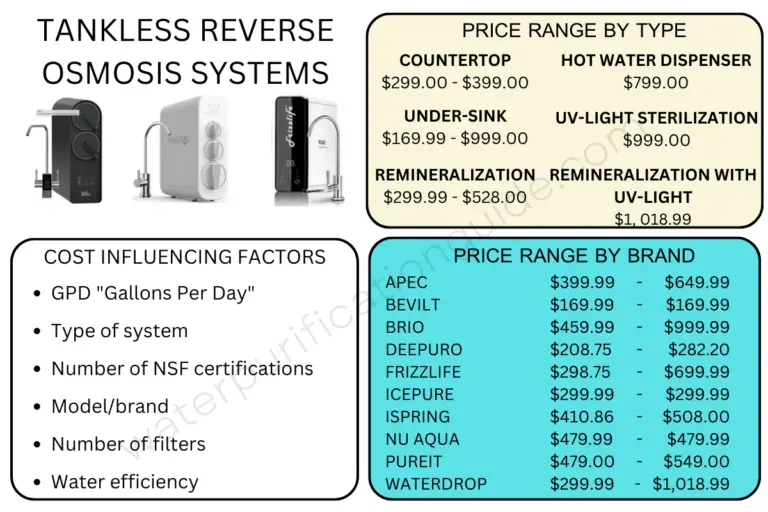 How Much Tankless Reverse Osmosis Systems Really Cost - Water
Do the math for five years: a $500 system plus installation plus filters equals roughly $1,000 total. That’s a lot of bottled water, but also a lot of plastic saved. I’m not here to judge your carbon footprint, just your budget.
Oh, and wastewater? Typical RO systems waste 3 to 4 gallons of water for every 1 gallon they produce. That’s a shock to your water bill if you live in a drought-prone area. Suddenly, that “free” filtered water doesn’t feel so free.
So, Is It Worth It?
If you live somewhere with genuinely nasty tap water (think: rust, chlorine smell, or lead), an RO system is a game-changer. Your pasta will taste better, your coffee won’t have a metallic aftertaste, and your skin might stop throwing tantrums. But if your tap water is already decent? You’re basically paying for peace of mind and a slight upgrade in taste.
My advice? Start with a $40 faucet-mounted filter for a month. If you still feel the pull towards RO, then buy the mid-range model. Your future self will thank you—or curse you when you have to change the membrane at 3 AM.
Either way, just know this: no RO system in the world will make your tap water taste as good as the free water from your grandma’s garden hose. That flavor is non-negotiable, and it costs $0.
