How Does Water Purifier Works

You fill a glass from the tap. It looks clear. But you wonder what else is floating around in there, invisible to the eye. That’s where the quiet hero of modern kitchens comes...
You fill a glass from the tap. It looks clear. But you wonder what else is floating around in there, invisible to the eye. That’s where the quiet hero of modern kitchens comes in: the water purifier.
The Magic of Layers
Think of a water purifier as a very picky bouncer at an exclusive club. It only lets the good stuff—pure water molecules—slip past. Everything else, from chlorine to microplastics, gets left out in the cold.
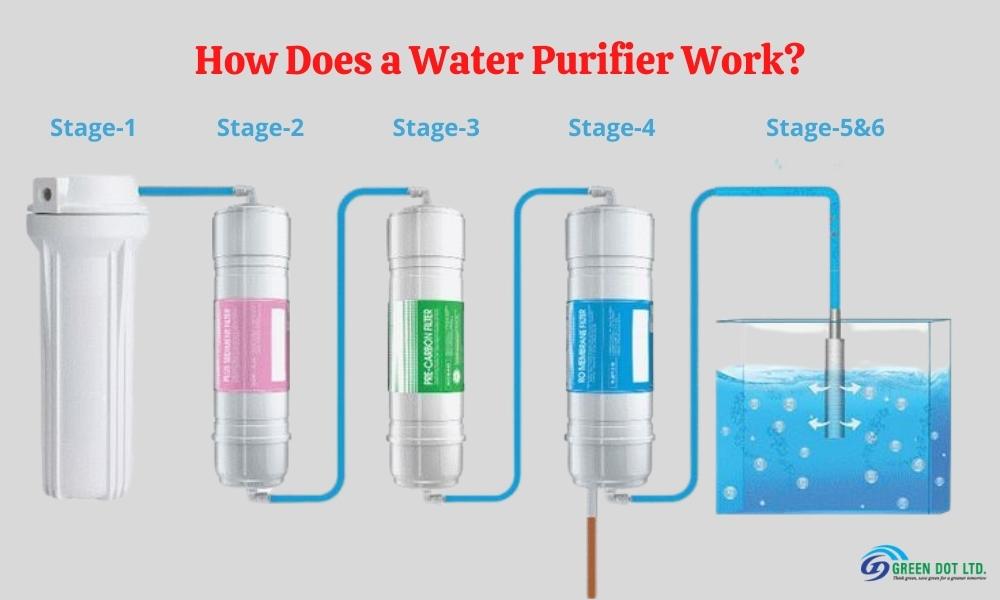
Most systems use a series of filters, each with a specific job. It’s not one giant sponge; it’s a team of specialists working in sequence.
Must Read
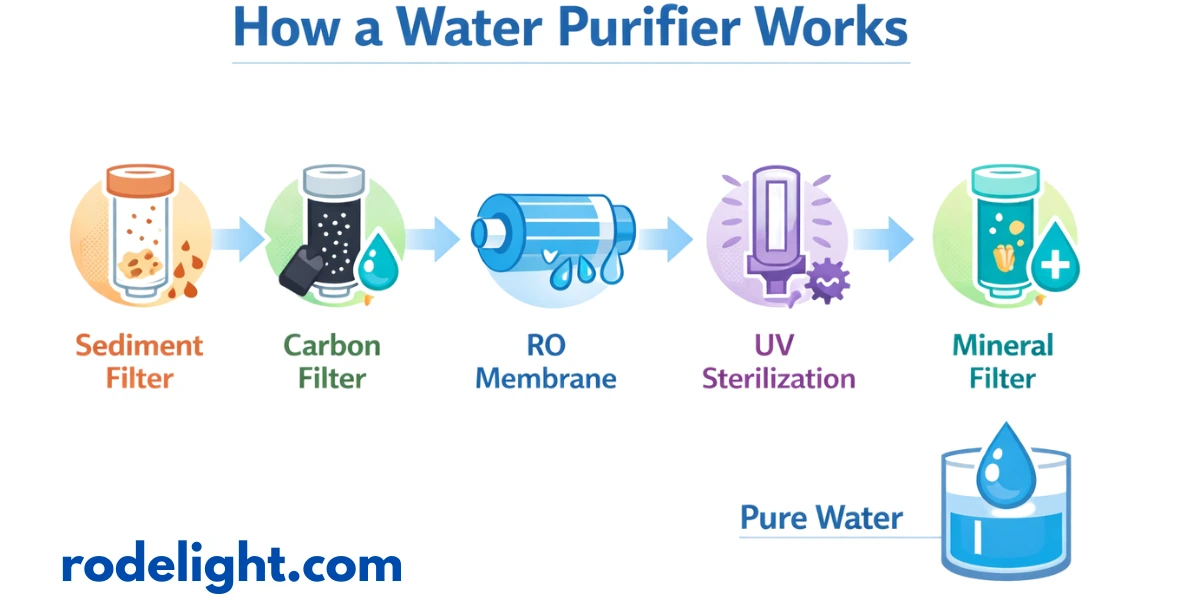
First up is the sediment filter, the brute force of the operation. It catches big particles like sand, rust, and dirt. Think of it as the velvet rope that stops the rowdy crowd before they even get close to the door.
The Carbon Stage
Next comes the carbon filter, and this one is a chemistry wizard. Activated carbon is incredibly porous, with a massive surface area packed into a tiny block.
It grabs hold of chlorine, which gives tap water that swimming-pool taste, plus any weird odors. It’s also a master at trapping volatile organic compounds, better known as VOCs—those chemical leftovers from lawn care or industrial runoff.
Fun fact: Carbon filtration is ancient tech. The Ancient Egyptians used charcoal to purify water over 4,000 years ago. They were basically drinking from a prehistoric Brita.
RO: The Heavy Hitter
For homes with really tough water—or just a serious health obsession—there’s Reverse Osmosis. It’s the gold standard, and it sounds more complicated than it actually is.
Imagine pushing water through a membrane so fine that only water vapor could theoretically pass through. The holes are tiny—0.0001 microns tiny. That’s smaller than a virus.
This process removes everything: lead, arsenic, fluoride, nitrates, even pharmaceuticals. It’s the equivalent of a microscopic TSA agent patting down every single molecule.
There’s a catch, though. RO systems waste a bit of water, usually about three or four gallons for every one purified. But modern models are getting smarter, wasting less and saving more.
 How does water purifier work? step by step best guide in 2026
UV Light: The Final Blast
For a touch of sci-fi cool, some purifiers add a UV light stage. This is not for taste; it’s biological warfare against bacteria and viruses.
The ultraviolet radiation scrambles the DNA of any leftover germs. They can’t reproduce, which means they can’t make you sick. It’s like giving every microbe a tiny, fatal sunburn.
This is especially popular in countries like Japan, where advanced water tech is a cultural norm. They love their gadgets, and hitting water with ultraviolet light feels very on-brand.
Practical Tips for Your Home
Know your enemy. Before buying a purifier, test your tap water. You can buy a simple kit online for ten bucks.
If your water tastes like a swimming pool, you need strong carbon filtration. If you live in an older house with lead pipes, you want the full RO suite.
Change your filters on time. A clogged filter is worse than no filter. It becomes a breeding ground for bacteria.
Set a reminder on your phone. Every six months for carbon. Every two years for the RO membrane. Your future self will thank you.
Consider a countertop unit. They’re less expensive than under-sink models, and they’re portable. Take it camping, to a rental, or just to the kitchen island.
 How Does a Water Filter Work Step-by-Step?
Cultural Quirks and Myths
In India, many families still boil water as a sacred ritual. Boiling kills germs, but it does nothing for heavy metals or pesticides. A purifier handles both.
In the United States, we tend to overcomplicate things. You don’t need a $500 system if your municipal water is already clean. A simple pitcher filter might be all you need.
There’s a persistent myth that distilled water is the best. Wrong. Distillation strips everything, including healthy minerals like calcium and magnesium. Long-term, that’s not great for your bones.
A good purifier keeps minerals but removes the junk. It’s about balance, not extremes.
The Reflection
When you sip that cold, clean glass of water from your purifier, pause for a second. You’re not just drinking H₂O.
You’re tasting the result of a precise, multi-stage choreography that takes place in a box under your sink. You’ve removed the noise, the chemicals, and the doubt.
Everyday hydration becomes a small act of self-care. It’s a quiet reminder that we don’t need dramatic change to feel better. Sometimes, we just need to filter out what we don’t need, one glass at a time.
And let’s be honest: there’s something deeply satisfying about watching that water flow clear and cold, knowing the drama stayed hidden inside the machine. It’s life’s little luxury—clean, simple, and always there when you need it.
