What Does Tds Mean In Water

You’ve probably seen “TDS” on a water filter pitcher or maybe a smart bottle at your friend’s place. It’s not a toxic relationship status—though it can feel that way with your...
You’ve probably seen “TDS” on a water filter pitcher or maybe a smart bottle at your friend’s place. It’s not a toxic relationship status—though it can feel that way with your tap water. TDS stands for Total Dissolved Solids, and understanding it is surprisingly easy and kind of fun.
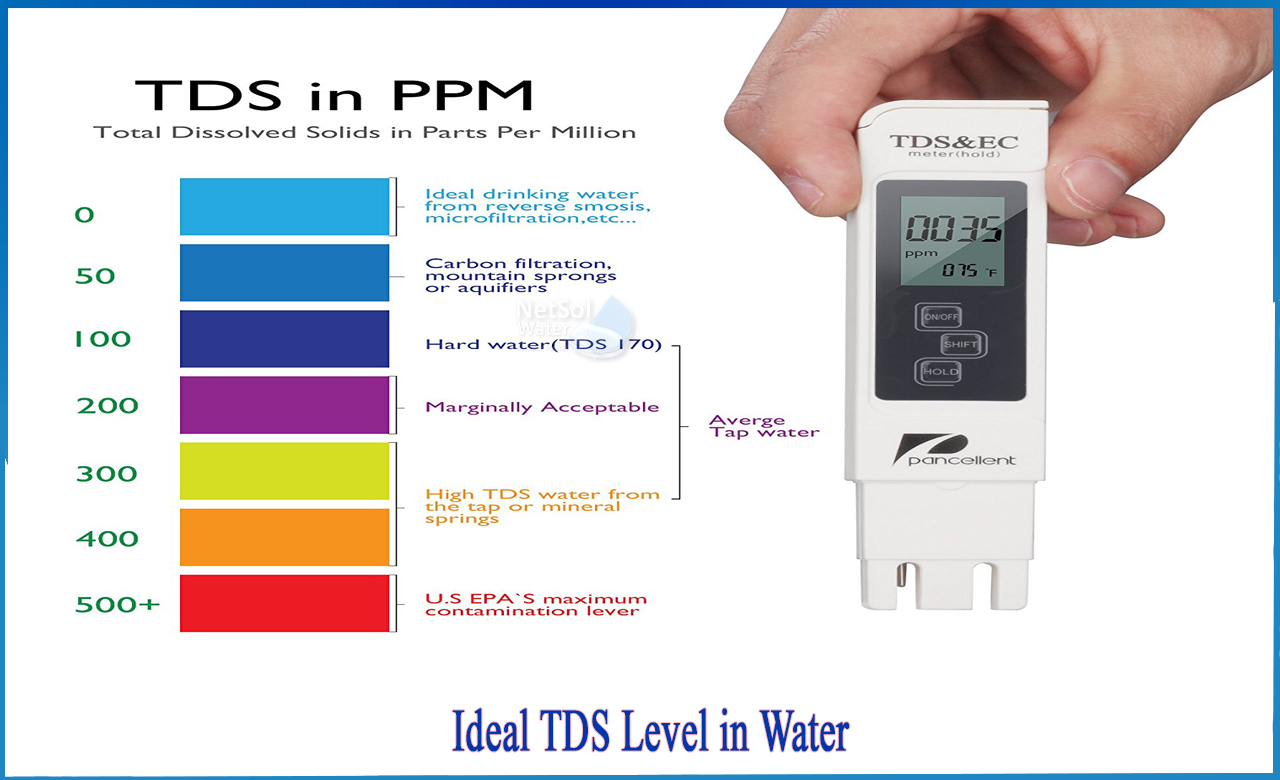
Think of your water as a mineral soup. TDS measures everything dissolved in it: calcium, magnesium, sodium, bicarbonates, sulfates, even tiny amounts of lead or copper. A simple TDS meter gives you a number in parts per million (ppm), which is basically the “saltiness” or “mineral intensity” of your water.
Here’s the cultural twist: that fancy water sommelier at a high-end restaurant brags about high TDS—think 250–500 ppm from a natural spring. Meanwhile, your kitchen tap might run at 150 ppm, which is completely fine. It’s all about context, baby.
Must Read
Fun fact: the purest water (like distilled) has a TDS of 0 ppm. It tastes flat and sad—your taste buds need some minerals to feel alive. Water without any TDS is like a conversation with no personality.
The Sweet Spot for Your Daily Sip
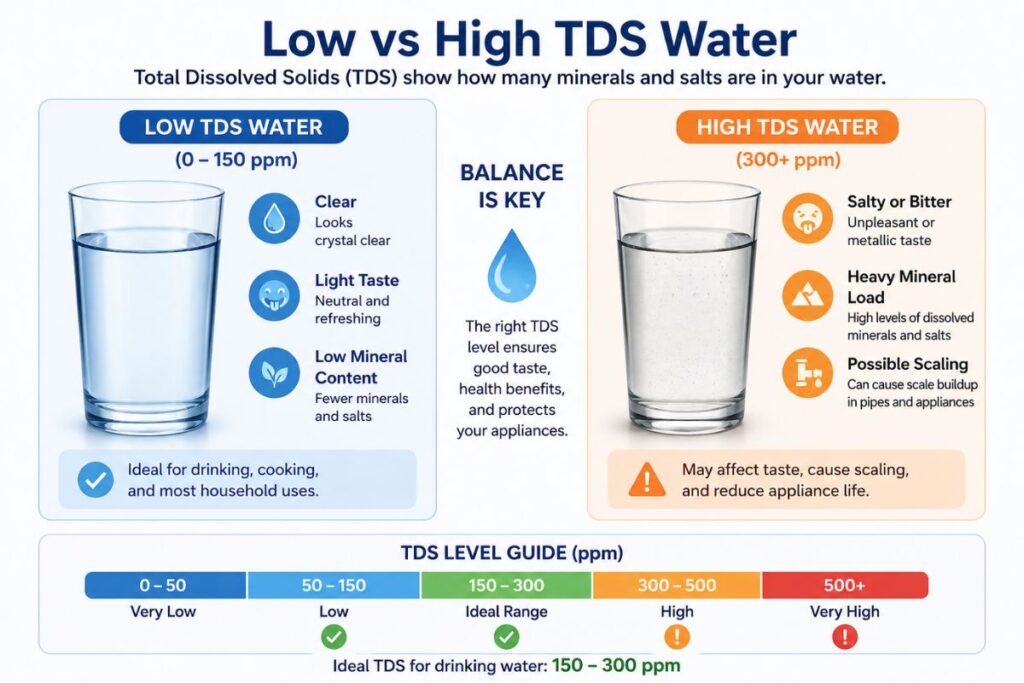
Most health experts and the WHO agree on a comfortable range: 50–300 ppm is excellent for hydration and taste. Below 50 ppm, water feels “empty”; above 600 ppm, it might taste salty or metallic. Your ideal TDS depends on what you’re used to—a New Yorker’s tap might feel different from a Parisian’s saintly spring water.
Tap water usually sits between 100 and 400 ppm depending on where you live. If your number jumps over 500, you might notice a “chalky” residue on your kettle. That’s just hard water being itself—not dangerous, but annoying for your espresso machine.
Bottled water brands love to flex their TDS numbers. Evian is around 300 ppm, while Fiji flaunts about 210 ppm. It’s basically a mineral-rich flex that your wallet pays for. But your city water can be just as good—so don’t let the marketing fool you.
Practical Tip: When to Worry
High TDS itself isn’t a health hazard—it’s usually just calcium and magnesium. But if your meter shows a sudden spike (say, from 200 to 800 ppm), that could mean a pipe leak or contamination. Start with a quick call to your water department.
 What Is TDS In Water & Why Should You Measure It?
Low TDS isn’t a health risk either, but it might mean your water isn’t as tasty. If you’re brewing coffee or tea, low TDS actually makes for a brighter, cleaner flavor. Specialty coffee shops use RO (reverse osmosis) water with TDS around 50 ppm on purpose.
And here’s the kicker: a TDS meter can’t tell you if your water has viruses, bacteria, or heavy metals. It’s like a thermometer for your health—useful, but not the whole story. Use it as a curiosity tool, not a diagnostic device.
Lifestyle Hacks: Test, Then Taste
Buy a cheap TDS meter for $10–15. Test your tap water, then test your bottled water, then test your neighbor’s (they’ll think you’re a science genius). It’s a party trick that actually teaches you something about your local geology.
If you’re using a filter, test before and after. A Brita pitcher typically reduces TDS by 20–30%, while an RO system can drop it to near zero. For daily drinking, 50–150 ppm is lovely—it feels crisp but not stripped.
Pro tip for travelers: check the TDS of tap water in a new city before you drink. If it’s above 600 ppm, consider bottled water for a few days until your gut adjusts. Your stomach will thank you for the data.
 What Is TDS in Water and What Does it Indicate?
The Fun Fact Zone
Did you know that the Dead Sea has a TDS of 330,000 ppm? That’s why you float—but don’t drink it. In contrast, rainwater is usually below 10 ppm. The range of how we define “water” is wild.
In Japan, some people pay premium prices for water with a specific TDS from local mountains. It’s like the hipster vinyl of hydration. Meanwhile, in parts of India, high TDS is common and accepted as normal—different geology, different norms.
Even your body has a TDS equivalent: human blood plasma runs around 9,000 ppm of dissolved solids. You are basically walking around as a very salty bag of water. No wonder we crave balance.
A Short Reflection
Here’s the real takeaway: TDS is just a number that helps you make better choices about what you drink. It’s not about purity or perfection—it’s about knowing your water’s personality. The same way you choose a wine or a playlist, you can choose water that feels right for you.
When you sip from your glass tonight, think of all the tiny minerals doing their quiet dance. That little TDS meter is a conversation starter with the earth itself. And honestly, that’s a pretty cool thing to carry in your kitchen drawer.
So drink up, test on, and remember: water doesn’t have to be perfect—it just has to be yours.
