How To Test Your Home Water

Let’s be honest: when was the last time you actually thought about the water coming out of your tap? You probably use it for coffee, pasta, and morning showers without a secon...

Let’s be honest: when was the last time you actually thought about the water coming out of your tap? You probably use it for coffee, pasta, and morning showers without a second glance. But here’s the thing—your water has a secret life, and testing it can turn a boring chore into a fun little science experiment. Ready to become your own home water detective? Let’s dive in.
Why should you even care?
Water quality isn’t just for survivalists or eco-warriors. It directly affects how your coffee tastes, how your skin feels, and even how long your appliances last. Think about it: hard water can make your hair frizzy and your dishes spotty, while weird pH levels can corrode your pipes. Testing your water is like giving your home a friendly check-up—and it might just save you from a surprise plumbing bill.
Plus, it’s oddly satisfying. You get to play with little vials, color-changing strips, and maybe even a fancy digital meter. Who knew science could be this fun?
Must Read
What exactly are you looking for?
Most home tests focus on a few key suspects. You’ve got hardness (calcium and magnesium), pH level (how acidic or alkaline your water is), and chlorine (the stuff that makes pool water smell). Some kits also check for iron, copper, or lead—things you definitely want to know about. Don’t worry, you don’t need a chemistry degree. The instructions are usually as simple as “dip, wait, compare colors.”
And if you spot something funky? That’s a win! It means you can take action, like adding a filter or calling a pro. Knowledge is power—and in this case, it’s also better-tasting water.
Grab your gear: the simple stuff
You can start with a DIY test kit from your local hardware store or online for under $20. They come with strips you dip into a glass of tap water. Wait a few seconds, then match the colors to a chart. Easy peasy. If you want to get fancy, buy a digital TDS meter (Total Dissolved Solids)—it gives you a number that tells you how much “stuff” is floating in your water. It’s like a fitness tracker for your tap.
 How to Test Water Quality at Home: Your Complete Guide – World Water
Another option is a mail-in lab test. You fill a bottle, send it off, and get a detailed report back. This is for the overachievers who want hard data on bacteria or heavy metals. Both methods take less than an hour of your time—and the payoff? You’ll feel like a water wizard.
How to actually do it (no lab coat required)
Start by running your cold tap for two minutes. This clears out stagnant water from pipes. Fill a clean glass, then dip your test strip according to the package directions. Don’t wave it around like a magic wand—just hold it steady for the exact time. Compare the colors while the strip is still wet (some change fast). Write down your results, and maybe snap a photo for bragging rights.
For the TDS meter, simply submerge the tip and wait for a reading. A number under 300 ppm (parts per million) is generally good; above 500 means you might want a filter. See? You’re already a pro.
What to do with all this data?
Now you have numbers—so what? If your water is hard (lots of calcium), consider a water softener. If pH is too low (acidic), a simple neutralizer can help. High chlorine? A carbon filter does the trick. And if you find lead or bacteria, call a professional immediately—your health is worth it.
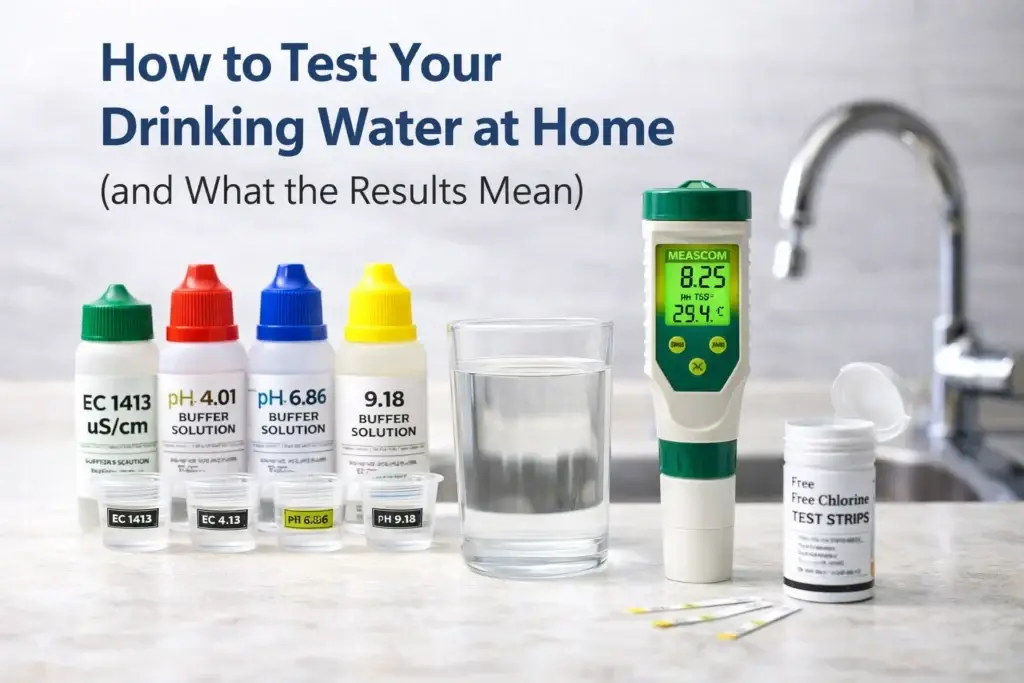 How to Test Drinking Water at Home (and What the Results Mean) - MEASCOM
But here’s the fun part: you can taste the difference. Make a cup of tea with filtered vs. unfiltered water and do a blind test. Invite friends over for a “water tasting party.” Yes, that’s a real thing, and it’s hilarious. You’ll never look at a glass the same way again.
Turn it into a game
Testing your water doesn’t have to be a one-time thing. Do it every season and track how it changes. Maybe after a heavy rain, your pH spikes. Or after a dry spell, the hardness goes up. You’ll start noticing patterns—and that makes you a true water nerd in the best way possible. Share your findings with neighbors; they’ll think you’re a genius.
And let’s not forget the bragging rights. When your friend complains about their crusty showerhead, you can casually say, “Have you tested your water’s hardness? I use a simple kit.” Instant credibility.
An uplifting note to send you off
Your home water is more than just a utility—it’s a living, flowing part of your daily joy. By testing it, you’re not just being responsible; you’re inviting curiosity into your routine. Every drop tells a story, and now you have the tools to listen. So go ahead, grab a kit, and start your little adventure. Who knows? You might just fall in love with your tap all over again. Cheers to that—and to the crisp, clear sips ahead.
