What Is Ro Water Filter

You know that moment when you fill a glass from the tap and it tastes a little… off? Maybe it’s a faint chlorine whisper or a metallic coppery note. That’s your water having a...

You know that moment when you fill a glass from the tap and it tastes a little… off? Maybe it’s a faint chlorine whisper or a metallic coppery note. That’s your water having a bit of a personality, and not always the good kind. Enter the RO water filter, the quiet overachiever of the kitchen counter.
The Science of Squeaky Clean
RO stands for Reverse Osmosis, which sounds like a villain from a Marvel movie but is actually a brilliantly simple process. It pushes water through a super-fine membrane that acts like a strict bouncer at an exclusive club. Only water molecules get in; everything else—lead, chlorine, fluoride, even those pesky microplastics—gets politely turned away at the door.
Think of it as a giant colander for your tap water, except the holes are so tiny you’d need a microscope to see them. This isn’t your basic pitcher filter; this is the VIP treatment. The result? Water so pure it’s almost annoyingly clean, like a spa day for every glass you drink.
Must Read
Why Your Coffee and Skin Are Grateful
Here’s the fun part: RO water doesn’t just taste better; it changes your entire routine. That morning pour-over coffee? With RO water, the minerals are stripped out, so the coffee’s actual flavor shines through without any metallic bitterness. It’s like turning the volume up on your beans.
And your skin? Oh, it notices. Hard water leaves a film of calcium and magnesium on your face, which can clog pores and dull your glow. RO water is soft, pure, and mineral-free, leaving your skin feeling rinsed, not residue-coated. Even your kettle will stop developing that chalky white scale—no more scraping!
Fun fact: Astronauts use RO systems on the International Space Station to recycle water. That means your kitchen gadget shares DNA with space tech. Pretty cool for something that lives under your sink, right?
The Pros and the Quirks
Let’s get real: RO filters aren’t perfect unicorns. They do produce waste water—typically three to four gallons of rejected water for every one gallon of filtered water. That’s a lot of H2O down the drain, though newer models are getting more efficient. If you’re eco-conscious, look for systems with a 1:1 ratio.
Another thing: RO water strips out beneficial minerals like calcium and magnesium. While you get those from food easily, some purists add a remineralization filter to put the good stuff back in. It’s like having your pure water cake and eating it with a mineral frosting.
Installation can be a tiny hassle—you’ll need a dedicated faucet and a storage tank under your sink. But once it’s in, you basically become the water sommelier of your household. Friends will ask, “Is this water from a spring?” and you’ll smirk knowingly.
 RO Water Filters: The Ultimate FAQ Guide - NEWater
Practical Tips for the Curious
Don’t buy the cheapest unit you find online. Spend around $150–$300 for a decent system with replaceable filters. The membrane lasts 2–3 years, but the pre-filters need swapping every 6–12 months. Set a calendar reminder or you’ll forget—trust me.
If you live in an apartment, consider a countertop RO system that doesn’t require plumbing. They look sleek, plug in like a coffee maker, and still deliver that crisp, space-station quality water. Perfect for renters who want zero commitment.
Also, store your RO water in glass or stainless steel, not plastic. The whole point is avoiding microplastics, so don’t put the clean stuff back into a plastic jug. It’s like taking a detox bath and then jumping into a muddy puddle.
Cultural Water Wisdom
Cultures around the world have always obsessed over water purity. In Japan, it’s a Zen ritual to listen to the sound of dripping water. In Scandinavia, you might travel miles for a natural spring. We’ve traded the journey for a filter, but the intention is the same: we want water that feels like a reset.
Even your grandmother’s “let it run cold for a minute” trick was a primitive filter—just flushing out the old pipes. Now we have membranes and carbon blocks, but the goal hasn’t changed. We’re all just trying to get back to that first sip from a mountain stream.
A little humor: RO water is sometimes called “dead water” by wellness influencers who prefer mineral-rich alkaline water. But honestly, your body knows how to handle demineralized water just fine. Unless you’re a marathon runner who only drinks distilled water, you’ll be more than okay.
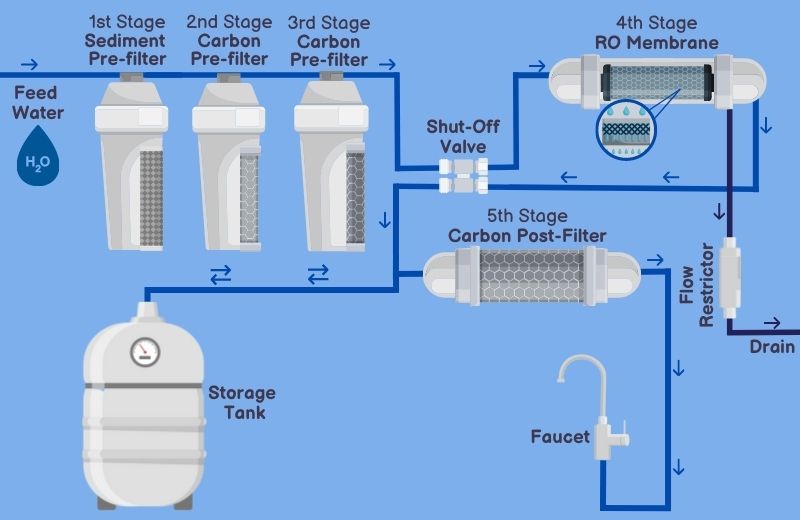 Reverse Osmosis Water Filter Diagram
A Quick Reality Check
Do you need an RO system? If you live in a house with old pipes, well water, or a municipal supply that tastes like a swimming pool, then yes, absolutely. If your tap water already tastes clean and tests well, you might be fine with a simple carbon pitcher.
Price check: A basic RO system costs about the same as a good pair of sneakers. And unlike sneakers, it doesn’t wear out in a year. Think of it as an investment in your daily rituals—the water you drink, the tea you brew, the soup you simmer.
If you’re still on the fence, buy a single bottle of RO water from a grocery store. Taste it blind next to tap water. Your taste buds will probably tell you everything you need to know. That’s the cheapest science experiment you’ll ever love.
The Reflection
Here’s the thing: We spend so much energy curating our food, our coffee beans, our yoga mats. But water—the thing we consume most—often gets ignored. Installing an RO filter is a small act of saying, “I deserve this to be excellent too.”
In a world full of noise, clean water is a quiet anchor. It doesn’t shout; it just hydrates. It makes your morning ritual smoother, your afternoon productivity sharper, your evening tea more comforting. That first glass of cold, neutral, pure water from your own tap? It’s not just thirst-quenching. It’s a tiny, everyday luxury that costs pennies per hour.
So next time you hold that glass up to the light, remember: That water passed through a bouncer, a membrane, and a filter. It earned its spot. And so did you.
