Best Water Filter To Remove Arsenic

So, you’ve just discovered that your tap water harbors arsenic. That’s a bit like finding out your friendly neighborhood barista is secretly a supervillain. Sudden, unsettling...

So, you’ve just discovered that your tap water harbors arsenic. That’s a bit like finding out your friendly neighborhood barista is secretly a supervillain. Sudden, unsettling, and terribly inconvenient for your morning routine. But before you start packing your bags for a pristine mountain spring, take a deep breath.
The good news? We can absolutely defeat this watery villain with the right filter. Arsenic is sneaky and odorless, but it’s no match for modern technology. And a little humor helps when facing a poison once favored by Victorian-era murderers (yes, really—arsenic was the “go-to” for fictional and real poisoners alike).
Why Your Old Brita Pitcher Just Won’t Cut It
Let’s be brutally honest: that plastic jug you’re carrying around is great for taste, not toxic element removal. Carbon filters are like a polite bouncer at a club—they stop dirt and bad smells, but they’ll wave a heavy metal straight through. Arsenic laughs at basic carbon filters. It’s basically the VIP guest that slips past security.
Must Read
You need something that says, “Not today, Metallica reject.” That means specialized filtration like reverse osmosis, ion exchange, or distillation. Yes, these sound like terms from a sci-fi movie—but they’re actually your new best friends. Think of them as the armor against a microscopic Trojan horse.
The Heavyweight Champion: Reverse Osmosis (RO)
If filters were boxers, reverse osmosis would be Mike Tyson in his prime—except less ear-biting and more water purifying. An RO system forces water through a membrane so fine that almost nothing gets through. We’re talking molecules of arsenic, lead, and even fluoride throwing their hands up in surrender. It removes over 95% of arsenic, which is about as effective as it gets.
![Best Water Filters for Arsenic Removal [In 2026]](https://bathroomexplorer.com/wp-content/uploads/2025/08/Best-Water-Filters-for-Arsenic-Removal.jpg) Best Water Filters for Arsenic Removal [In 2026]
Best Water Filters for Arsenic Removal [In 2026]
Downside? RO systems are a bit dramatic. They waste some water and need a semi-regular membrane swap, like changing a car tire. But if you want peace of mind and a glass of water that tastes like a crystal from a mountaintop, this is your huckleberry.
The Feisty Alternative: Distillation
Imagine boiling water, catching the steam, and letting it condense back into liquid—like making a tiny, intense cloud in your kitchen. That’s distillation. It destroys arsenic by leaving it behind as a nasty sludge. Fun fact: distillers also remove everything else, including beneficial minerals, so your water is technically “dead.” But hey, dead water is better than poisoned water, right? Just add a pinch of pink salt to revive it.
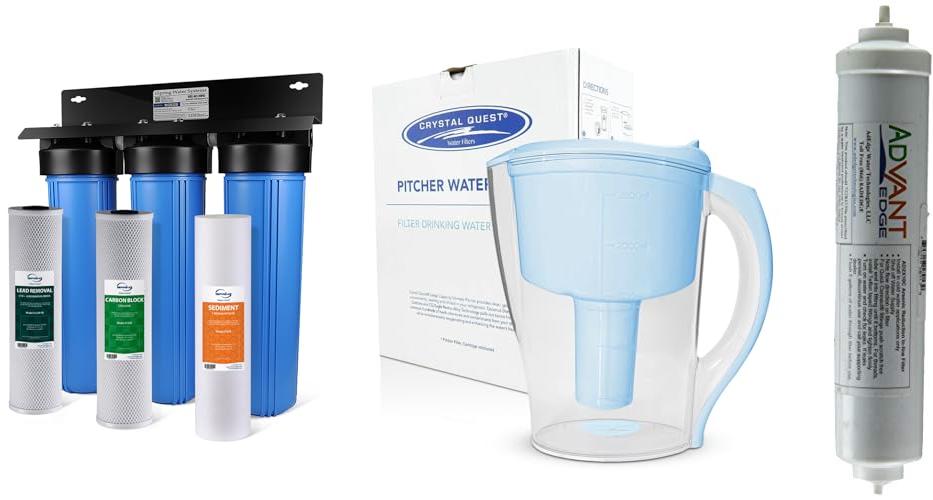 Top 5 Water Filters To Remove Arsenic: A Comprehensive Review
Distillers are loud and slow—they take hours to produce a gallon. You’ll feel like a mad scientist watching a pot boil. But for homeowners on a well with known arsenic, it’s a solid, nuclear-option backup.
The Budget Rock Star: Ion Exchange Adsorption Filters
Not ready to install a full RO system under your sink? Enter the ion exchange filter. It’s like a chemical swap meet: it trades arsenic ions for harmless chloride ions. Eco-friendly and easy, these pitchers or countertop units cost less than dinner for two. Brands like ZeroWater use this technology and actually have a TDS meter to prove it works. Beware: you’ll need to replace the cartridge frequently, else the arsenic party resumes.
One surprising fact: some “arsenic removal” pitchers only work on Pentavalent Arsenic (As(V))—the easier form to remove. Groundwater often contains Trivalent Arsenic (As(III)), which is way harder to catch. Check your water test results! You don’t want to buy a filter that only fights half the problem.
 Top 5 Water Filters That Remove Arsenic: Smart Choices (October 2024
What You Actually Need to Do Right Now
First: test your water. You can’t filter what you don’t understand. Call your local health department or buy a cheap lab kit. Arsenic is invisible and tasteless, so you’re basically flying blind without that test. Don’t be that person who buys a $500 filter only to find out your only issue is a weird grapefruit-like smell.
Second: match the filter to your arsenic type. If it’s mostly As(III), you’ll need a pre-oxidation step (like chlorine or ozone) to convert it to As(V) before filtration. Yes, it’s a science experiment—but one where you don’t blow anything up.
 9 Best Water Filter To Remove Arsenic In 2022 (Top Rated List)
Third: don’t cheap out on maintenance. A clogged filter actually concentrates arsenic over time. That’s like hiring a guard who becomes besties with the thief. Replace cartridges on schedule, or you’re drinking a concentrated vintage of poison. Not a wine tasting you want.
The Final Sip
You don’t need to move to a desert island to avoid arsenic. With a good reverse osmosis system or a reliable ion exchange pitcher, you can turn your tap from a villain’s lair into a clean, refreshing ally. Just remember: arsenic is a natural element in many rocks, not a personal attack. It’s also the same stuff used in embalming fluids—so if you drink it unfiltered, you’re basically pickling yourself from the inside. Let’s not pickle ourselves.
Now go buy a test kit. And maybe a funny mug that says “Arsenic: Not Today, Satan.” Your kidneys will thank you—and your taste buds will never know the difference.
