Water Hardness Setting For Water Softener

Ever wonder why your soap feels a little… slimy? Or why your white shirts have that weird grayish tint after a few washes? Blame the water—specifically, hard water packed with...

Ever wonder why your soap feels a little… slimy? Or why your white shirts have that weird grayish tint after a few washes? Blame the water—specifically, hard water packed with calcium and magnesium.
That’s where a water softener comes in, the unsung hero of your plumbing. But here's the kicker: it only works if you tell it how hard your water actually is. That tiny dial or digital menu? It’s not just for show.
The Magic of the "Grain" Setting
Your water softener has a secret number: the hardness setting, measured in grains per gallon (or parts per million). Think of it like a coffee maker’s brew strength dial. Set it too low, and you get weak coffee—or worse, still-hard water. Set it too high, and you’re wasting salt and money.
Must Read
Why does this matter? Because every drop of hard water that hits your shower head leaves a tiny mineral barnacle behind. Over months, those barnacles choke your pipes, ruin your water heater, and make your hair feel like straw.
Getting the number wrong is like trying to season a soup without tasting it. You might add too much salt, or not enough—and your faucets will be the ones that suffer.
How To Find Your Water’s "Personality"
First, you need a water test kit. It’s cheaper than a pizza and way more useful for your home’s health. Dip a strip in your tap, wait 10 seconds, and compare colors. That little strip is your water’s résumé.
Hardness typically ranges from 1 to 10+ grains per gallon (gpg). If your test says 7 gpg, that’s your baseline number. But here’s the cool part: you don’t just punch in “7” and call it a day. You also need to account for iron.
Iron in your water acts like a bully. It makes the hardness higher than it actually is. So if your water has 2 parts per million (ppm) of iron, you typically add 4 or 5 grains to your setting. It’s like turning up the volume because the room is big and noisy.
The "Sweet Spot" That Saves Your Skin
Why is this interesting? Because once you nail the setting, everything changes. Your shampoo actually lathers like a dream. Your dishes come out spotless without you scrubbing. Your skin? It stops feeling like dried parchment paper.
A good rule of thumb for most households is to set the softener 2 to 4 grains higher than your test result. This gives you a buffer, like carrying an extra umbrella just in case the forecast lies.
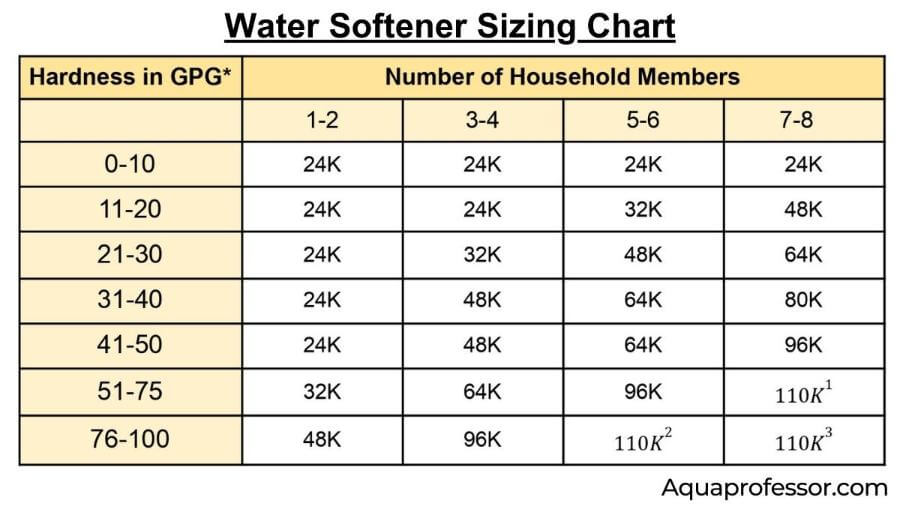 Water Softener Hardness Chart at Arnold Peete blog
But don't go overboard. If you set it way too high, your water will feel “slick” and might even leave a salty taste. It’s the Goldilocks principle—not too hard, not too soft, just right for your pipes and your morning shower.
The "Regeneration" Dance
Your water softener also has a regeneration frequency setting—how often it flushes out the trapped minerals. Many people ignore this, but it’s like forgetting to empty the lint trap in your dryer. Eventually, things get clogged.
If you have super hard water (10+ gpg), your system needs to regenerate more often—say, every 2 or 3 days. For softer water (3–5 gpg), once a week is plenty. The manual for your model usually has a quick chart, so don’t toss that thing in the recycling bin.
Fun comparison: think of the water softener resin beads as a sponge. When the sponge is full of hard water dirt, it needs to be wrung out. The regeneration cycle is that wringing action. If you set the time wrong, the sponge stays dirty, and you get hard water again.
Why It's Actually Cool (Not Just Nerdy)
Getting this setting right is like unlocking a cheat code for your home. Suddenly, your plumbing lasts 50% longer, your water heater uses less energy, and you use way less soap and detergent. That’s money back in your pocket.
It’s also a tiny act of chemistry every day. You’re telling the system: “Hey, swap those calcium ions for sodium ions, please.” It sounds technical, but it’s just swapping rock for salt—and your tea will taste better because of it.
So grab that test kit, check your water’s mood, and turn the dial with confidence. Your hair, your dishes, and your plumber will all thank you. Seriously—plumbers notice this stuff.
