Nsf International Water Filter Certification

You know that feeling when you fill up your glass with tap water and take a big gulp? It’s refreshing, right? But have you ever stopped to wonder what’s really in that water?...

You know that feeling when you fill up your glass with tap water and take a big gulp? It’s refreshing, right? But have you ever stopped to wonder what’s really in that water?
Maybe it’s a little chlorine, some minerals, or even tiny particles you can’t see. That’s where water filters come in—but not all filters are created equal.
Here’s the thing: NSF International certification is like the gold star of the water filter world. Think of it as the Michelin star for your faucet.
Must Read
It’s basically a third-party company that tests if a filter actually does what it claims. No hype, no marketing fluff—just cold, hard science.
Why Should You Care?
Look around your kitchen or bathroom. Is that filter on your counter just a fancy paperweight? Without NSF certification, you really don’t know.
NSF tests for stuff like lead, chlorine, bacteria, and even weird chemicals like pharmaceuticals. It’s like having a detective check your water for free.
And here’s the kicker: Not every filter brand bothers to get certified. Some just slap on a “health” label and call it a day. Sneaky, right?
What Does the Certification Actually Mean?
When you see “NSF/ANSI 53” or “NSF/ANSI 42” on a filter box, it’s not just alphabet soup. ANSI 53 means it reduces health-related contaminants like lead or mercury. ANSI 42 is about aesthetic stuff—like making water taste less like swimming pool.
Imagine buying a sunscreen that says “SPF 50” but doesn’t block UV rays. That’s basically what uncertified water filters are sometimes: a promise with no proof.
NSF runs controlled lab tests. They pump water loaded with contaminants through the filter and measure what comes out. If it doesn’t hit their strict limits, the certification fails.
The Cool Part: It’s Not Just One Test
Here’s where it gets interesting. NSF doesn’t just test the filter once and walk away. They do random factory inspections to make sure the company isn’t cutting corners later.
Think of it like a surprise pop quiz for filter manufacturers. Every year, they have to prove their product still works. That’s next-level accountability.
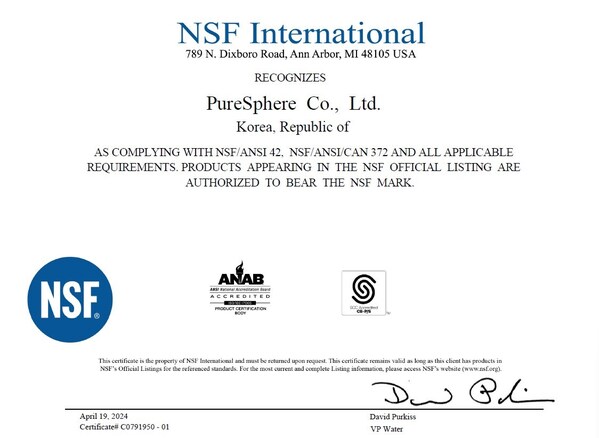 PureSphere Obtains US NSF 42/372 Certification for PureCarbon Filter M
Plus, the standards are updated regularly. So when science discovers a new contaminant, NSF tweaks the rules. Your filter doesn’t get a free pass forever.
A Quick Comparison: It’s Like the USDA Organic Label
You know how “organic” on a tomato might actually mean something because the USDA checks it? NSF is the same for water. One is for food, the other is for what you drink.
But here’s the fun twist: Some filters say “tested to NSF standards” but aren’t certified. That’s like saying “I’m a pilot” without ever getting a license. Big difference.
Look for the actual NSF seal on the package. If it’s missing, you’re basically trusting a stranger’s word about your water.
Is It Worth the Hype?
Okay, let’s be real. NSF-certified filters can cost a bit more. But so does organic milk, and you still buy it, right? It’s about peace of mind.
Imagine you’re hosting a dinner party. You pour a glass of tap water for a friend. If your filter is certified, you can genuinely say, “Yeah, this water’s been tested by experts.”
And if it’s not? You’re just crossing your fingers. Water is about 80% of your body, so maybe don’t gamble on it.
Final Thought: Trust, But Verify
So next time you see a shiny water filter on Amazon, scroll down to the specs. If it says “NSF certified,” that’s a green light. If it doesn’t, ask yourself: Why?
Because drinking clean water shouldn’t be a guessing game. It should be as reliable as a sunrise. And with NSF International, you can almost hear your faucet whisper, “I’ve got your back.”
So go ahead—fill that glass up, sip, and relax. You’ve got the science on your side.
