Well Water Filtration System Installation Cost

So, picture this: my aunt Marge, a woman who thinks “spring water” is whatever comes out of her garden hose, finally bought a house with a well. She called me up, triumphant....

So, picture this: my aunt Marge, a woman who thinks “spring water” is whatever comes out of her garden hose, finally bought a house with a well. She called me up, triumphant. “Free water forever!” she declared, already planning a pool in the backyard.
Fast forward two months, and I’m standing in her kitchen, watching her pour a glass of tap water that looks like weak iced tea. That is the moment reality sinks in—literally. The dream of “free” well water hits the hard wall of filtration system cost.
The Unicorn of “No Cost” Water
Let’s be real for a second: if you buy a house with a well, you are not escaping a water bill. You’re just trading it for a different kind of financial adventure. Your wallet will not stay dry—pun intended.
Must Read
What you get instead is control over what you drink. But that control comes with a price tag that changes faster than a toddler’s mood. One day it’s sediment, the next day it’s sulfur that smells like a dinosaur’s fart.
So, What Does It Actually Cost?
Alright, let’s rip the Band-Aid off. A basic sediment filter system—the kind that just catches sand and rust—will set you back anywhere from $400 to $1,000 installed. That’s your “starter home” of water filtration: better than nothing, but not exactly a luxury spa.
But wait—what if your water smells like rotten eggs? (Hello, sulfur!) Then you’re looking at a whole-home carbon filter. Installation plus gear? Expect $1,200 to $2,500. And yes, that’s before your neighbor tells you about some magical $50 filter he found on Amazon. Ignore him. You’re not him.
The Iron Curtain (And Your Money)
Here’s where it gets spicy. If your well water looks like orange soda—thanks, iron—you’ll need a specialized iron filter, often paired with a water softener. Brace yourself: this duo can run between $2,500 and $4,500 installed.
And just when you think you’re done, you test for bacteria. Because of course you do. An ultraviolet (UV) light system to kill microscopic freeloaders? Add another $800 to $1,500. Suddenly, “free” water sounds like a bargain-hunting nightmare, doesn’t it?
The Wild Card: Your Well’s Personality
Honestly, the biggest factor in cost isn’t the brand—it’s what your well decides to cough up that week. Your well has a personality, and sometimes it’s a jerk. You might just need a basic setup, or you might need the whole arsenal.
Here’s a side comment that might sting: don’t skip the water test. A $100 lab test now can save you from buying the wrong $3,000 filter later. I’m talking directly to you, the person who wants to “eyeball it” and guess. Don’t be that person.
 Home Water Filtration Systems: Types, Costs, and Eco-Friendly Options
The Installation Trap (DIY vs. Pro)
You can DIY a basic system for maybe $200 less, but plumbing a well is like doing brain surgery with a butter knife—possible, but the stakes are high. One wrong connection, and your basement becomes an indoor pool.
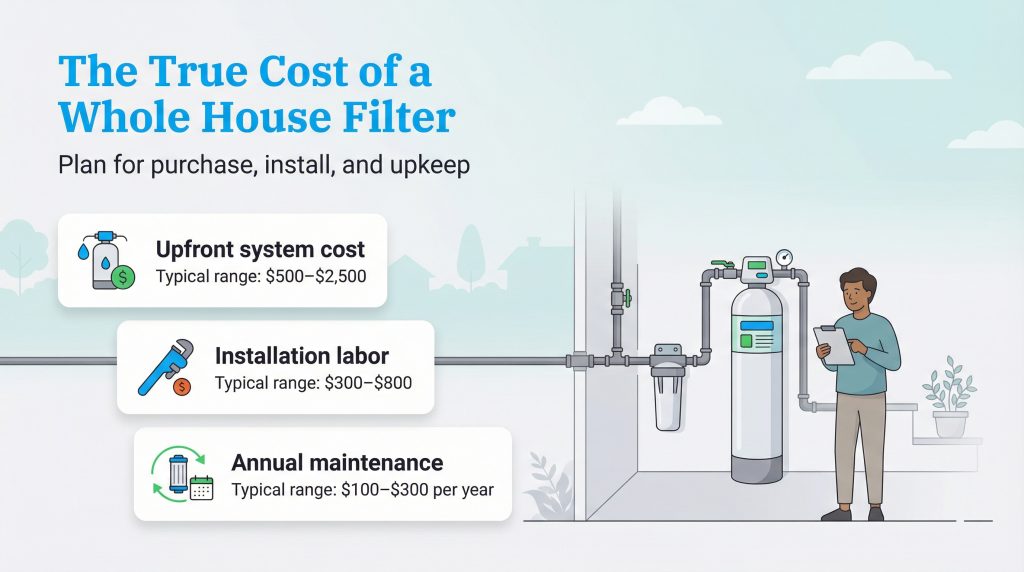
Professional installation usually adds $300 to $800 in labor. I know, I know—you’re handy. But ask yourself: is saving $400 worth waking up at 2 a.m. to a geyser in your utility closet? No. It’s not.
The “Optional” Stuff That Feels Mandatory
Let’s talk about reverse osmosis (RO) for drinking water. It’s the gold standard. A whole-house RO system? That’s $4,000 to $15,000. (Yeah, I just said fifteen-thousand.) Most people just get a small under-sink RO unit for $200 to $600 and call it a day. Smart move.
Then there’s the water softener. If your water is hard (try rubbing your hair with it—if it squeaks, you’re in trouble), add $1,500 to $2,800 for a decent one. Your appliances will thank you. Your wallet? Not so much.
Recurring Costs: The Squirrel Tax
Think installation is the end? Oh, you sweet summer child. Filters need replacing every 3 to 12 months. Those replacement cartridges? About $30 to $100 each. UV bulbs burn out yearly. Salt for softeners? That’s a monthly expense, like buying coffee you can’t taste.
So, while you’re not paying a monthly water bill, you are paying a “maintenance tax.” It’s not a bill, it’s a responsibility fee. You pay it in exchange for water that doesn’t taste like rusty pennies. Fair trade? Maybe.
The Bottom Line (Spoiler: It’s Complicated)
If you want a realistic budget for a good, reliable well water filtration system, set aside $2,500 to $5,000 for the full kit and caboodle. That includes sediment, carbon, softening, and UV. Less if you’re lucky. More if your well hates you.
And Marge? She ended up spending about $3,200 on a system that makes her water taste like bottled mountain spring water. No pool yet, but she now has a new hobby: testing every glass of water at my house and giving it a rating. (Currently, my tap water scores a 6. Hers is a 10.) So, is it worth it? Only if you like winning at water. And not having rusty teeth.
