How Often Should The Water Softener Regenerate

My aunt Edna once called me in a panic. “The water softener is making sounds like a dying moose,” she whispered, convinced her basement was haunted. Turns out, the poor thing...

My aunt Edna once called me in a panic. “The water softener is making sounds like a dying moose,” she whispered, convinced her basement was haunted. Turns out, the poor thing hadn’t regenerated in three months—it was just clogged with salt crust and resentment.
That story, as funny as it is now, gets right to the heart of the matter: how often should a water softener regenerate? It’s not a trick question, but the answer isn’t one-size-fits-all. And yes, that’s annoying.
The dirty little secret about regeneration cycles
Your water softener doesn’t regenerate on a whim—it responds to water hardness and usage. Think of it like a gas tank: run it dry, and you’re driving on fumes (hard water). Regenerate too often, and you’re wasting salt, water, and money.
Must Read
Most units are set to regenerate every 7 to 14 days. But here’s the wild part—that’s just a factory default. Your actual schedule depends on how many people are showering, flushing, and washing dishes (yes, that means you).
If you live alone and barely use water, your softener might stretch to two weeks. If you’ve got a house full of teenagers and a washing machine that runs nonstop, you could be looking at every 3 to 5 days.
Let’s talk about the “metered” vs. “timed” divide
Older systems—the ones your grandpa probably had—use a timed control. They regenerate at a set hour, say 2 AM every Saturday, whether you used water or not. This is like setting your coffee maker for 7 AM even if you’re on vacation. Kind of wasteful, right?
Newer models use metered (or “demand-initiated”) regeneration. They track how much water you’ve actually used, then regenerate only when necessary. This is the gold standard—smarter, greener, and kinder to your salt budget. (Your wallet will thank you.)
If you have a metered system, the answer is simple: let the machine decide. But if your unit is timed, you need to do a little math—or risk Edna’s moose problem.
The golden rule: check your hardness level
Your water’s hardness—measured in grains per gallon (gpg)—is the real puppet master here. Grab a test kit from any hardware store (they’re like $10, come on). If your water is 10 gpg, your softener needs to regenerate more often than if it’s 5 gpg. Harder water = shorter cycles.
For example: a standard 40,000-grain softener treating 10 gpg water will last about 4,000 gallons before exhausting its capacity. A family of four uses roughly 400 gallons a day, so that’s 10 days. Boom—regeneration every 10 days.
But if your water is 20 gpg (hello, well water folks), that drops to 5 days. And yes, that means more salt, more water waste, and more “dying moose” potential if you ignore it.
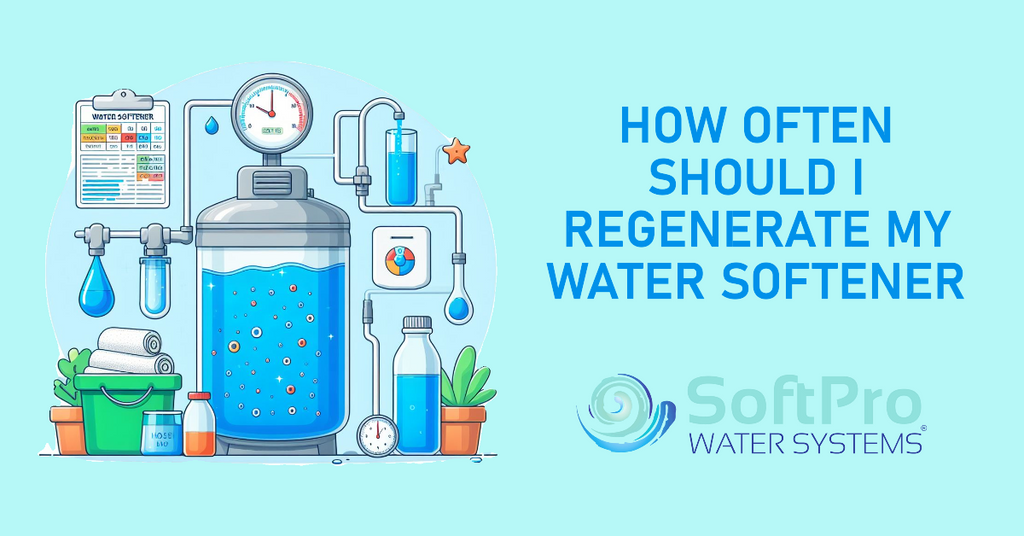 How Often Should I Regenerate My Water Softener? – SoftPro® Water Systems
What happens if you over- or under-regenerate?
Regenerating too often is like hitting the snooze button six times—everything seems fine, but you’re wasting resources. Your salt pile shrinks, your water bill climbs, and you’re flushing perfectly good resin beads unnecessarily. It’s a soft, silent money leak.
Under-regenerating is worse. Your resin beads become saturated with calcium and magnesium. They stop working, hard water sneaks back in, and you get scale buildup on your faucets, shower doors, and (gulp) your water heater. That’s a repair bill you don’t want.
And let’s not forget taste—hard water makes coffee taste flat. You deserve better than flat coffee.
The “I don’t want to think about it” solution
If you’re nodding along but already zoning out, here’s your cheat: set your softener to regenerate every 7 days. This works for most average households with moderate hardness (5–8 gpg). It’s not perfect, but it’s a safe middle ground.
For the lazy-but-clever among us, just buy a demand-initiated controller. It’s like giving your softener a brain. It monitors flow, calculates usage, and regenerates exactly when needed. No guessing, no moose sounds.
Or—and this is my favorite—just check the brine tank every two weeks. If salt is low and water feels slippery, it’s time. If the salt looks like a solid brick, you’ve waited too long. (Break it up with a screwdriver. Gently. We’re not cavemen here.)
A final, slightly sarcastic PSA
Stop treating your water softener like a mystical basement pet. It’s a machine with one job: remove hardness. Give it enough salt, enough time between cycles, and respect for its regeneration schedule.
And please—for the love of plumbers everywhere—don’t ignore the “no water” blinking light. That’s not a modern art piece; it’s a cry for help. Listen to your softener, and it will listen to you. Mostly.
Now go check your brine tank. Edna would be proud.
