Distilled Water And Deionised Water Difference

So, you’re standing in the water aisle of the supermarket, staring at two bottles labeled “Distilled” and “Deionised.” You’re thinking, “Aren’t they both just fancy tap water?...
So, you’re standing in the water aisle of the supermarket, staring at two bottles labeled “Distilled” and “Deionised.” You’re thinking, “Aren’t they both just fancy tap water?” Well, yes and no. Let’s unravel this watery mystery together, no Ph.D. required.
The Big Picture: What’s the Same?
Both distilled and deionised water are purified—they’ve kicked out the impurities that make tap water taste like a swimming pool. They’re the clean freaks of the H²O world. Think of them as the overachievers who study for the same test but use different methods.
But here’s the kicker: they achieve purity in completely different ways. One uses heat, the other uses magic (okay, science magic). And their end results are subtly, yet importantly, different.
Must Read
Distilled Water: The Boil-and-Chill Show
Distillation is the old-school method, like grandma’s secret soup recipe. You boil water until it turns into steam, then collect that steam as it cools back into liquid. It’s literally water evaporation on a science-fair budget.
Why does that work? Because most impurities—like minerals, bacteria, and that weird metallic taste—are left behind in the boiling pot. They don’t vaporize with the water. Poof! They’re gone.
But here’s the funny part: distillation is a bit of a slowcoach. It takes energy and time to boil that kettle. And it’s not perfect—some organic compounds with lower boiling points can hitch a ride with the steam.
So, distilled water is pure, but it’s a lazy purifier: it only removes what doesn’t vaporize. It still might leave behind a few sneaky chemicals that boil at lower temperatures.
Deionised Water: The Ion Bouncer
Now, deionisation is the cool new kid on the block—think of it as a nightclub bouncer for water. It uses special resin beads that physically grab and remove all the charged particles (ions) like calcium, magnesium, and even sodium.
This process doesn’t boil anything. Instead, it runs water through a filter that says, “Sorry, ions, you’re not on the guest list.” It’s like a VIP pass for pure H²O only.
Deionised water is extremely pure in terms of dissolved minerals. But here’s the catch: it might still contain bacteria or viruses, because those aren’t charged particles. Gross, but true.
So, while deionised water kicks mineral ion butt, it can’t banish the microscopic critters like distillation can. They’re like yin and yang, but with water.
The Showdown: Distilled vs. Deionised
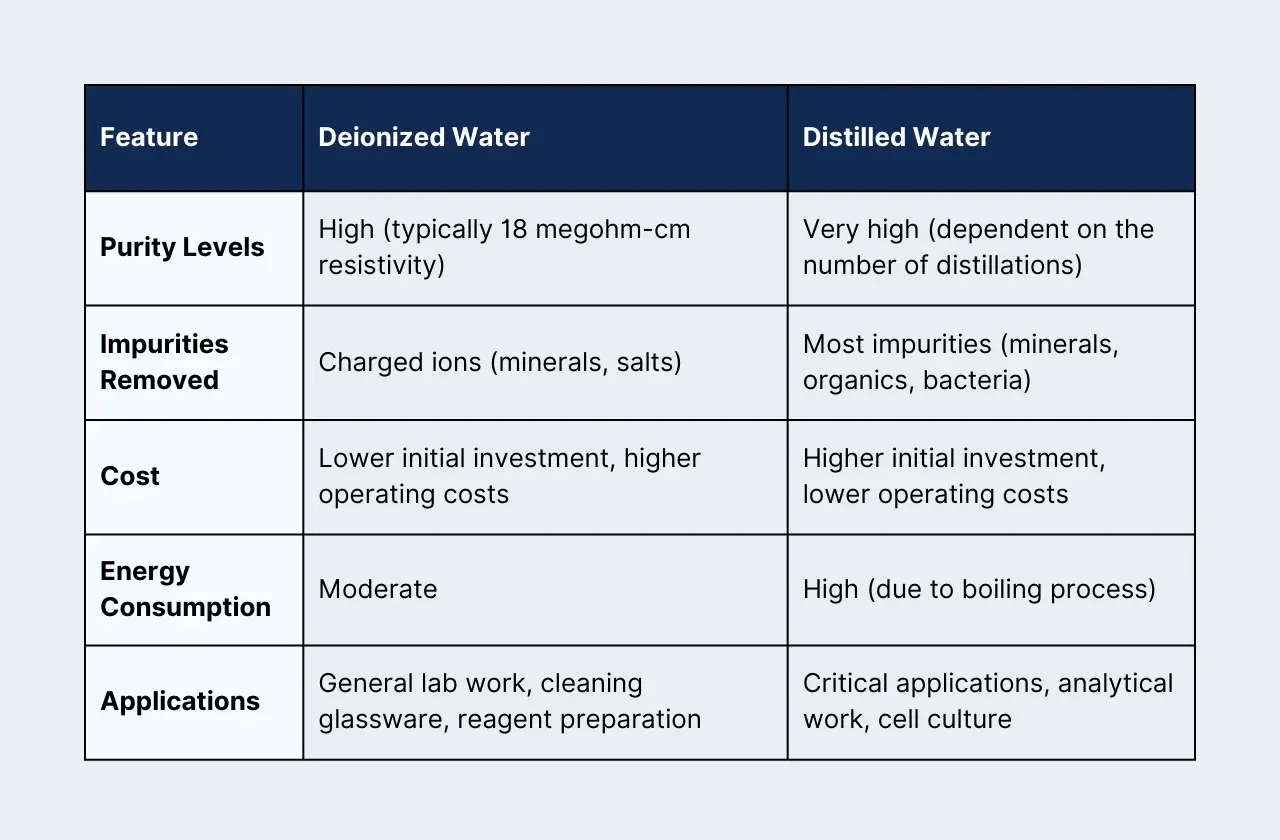
Let’s get down to brass tacks. Distilled water is the gentle giant—it removes a wide range of impurities, including bugs, but it’s not perfect for every lab experiment. Deionised water is the ion ninja—it removes charges faster than a breakup text, but ignores the living stuff.
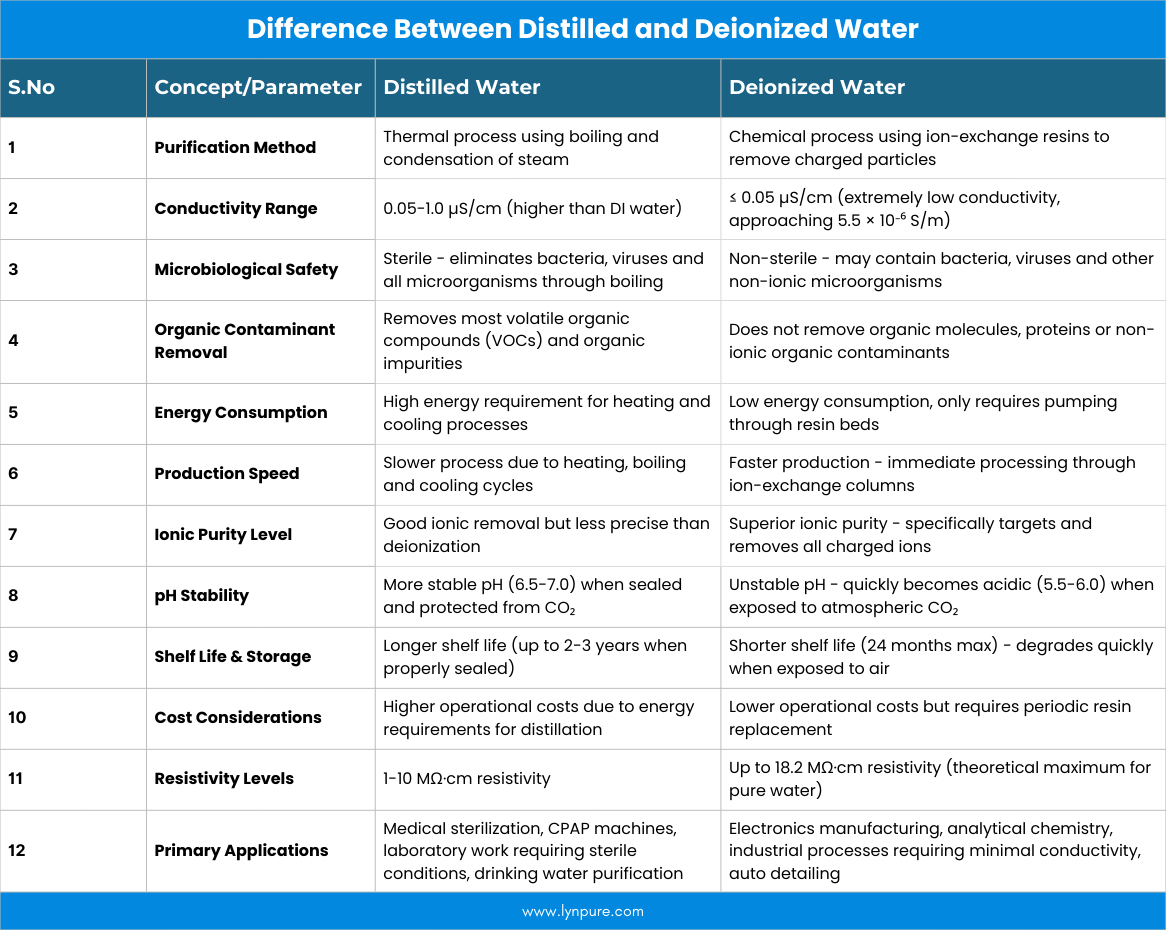 Distilled Water vs Deionized Water | Key Differences
If you want to top off a car battery or a steam iron, distilled water is your friend. It won’t leave mineral deposits that wreck your appliances. It’s also the go-to for aquariums and humidifiers.
But if you’re a lab geek mixing chemicals or making contact lens solution, deionised water is the star. It prevents those charged ions from messing with your reactions. It’s the clean slate for chemistry.
Here’s the real-world twist: many bottled “purified waters” are actually a mix of both processes. They distill first, then deionise. That’s like getting a double shower—twice as fresh.
Can You Drink Them?
Yes, you can drink both, but they taste like nothing. Literally. They have no minerals, so they’re flat, bland, and a little creepy. Your tongue will be confused.
Doctors say you can drink them, but your body might miss the trace minerals found in tap water. Don’t swap your regular water for purified stuff 24/7 unless you want to feel like a dehydrated sponge.
So, stick to tap or spring water for sipping, and save the distilled or deionised stuff for your gadgets and experiments. Your taste buds will thank you.
The Final Sip
So, what’s the real difference? Distillation is like evaporating your problems away—it gets rid of the big stuff. Deionisation is like sending an eviction notice to specific troublemakers—the ions.
Both are heroes in their own right, but they’re not interchangeable. Think of them as siblings with different superpowers. One works in the hospital (distilled for sterility), the other in the lab (deionised for chemistry).
And the next time you’re staring at those two bottles, remember this: you’re not just buying water—you’re buying a personality. Choose wisely, my friend.
But here’s the uplifting truth: whether it’s distilled, deionised, or even a glass of humble tap water, it’s still H²O. It still quenches your thirst, still hydrates your brain, and still makes up about 60% of your awesome self. So drink up, laugh a little, and don’t sweat the small stuff. After all, at the end of the day, we’re all just floating on a pale blue dot of water—and that’s pretty amazing.
