Difference Between Di Water And Distilled Water

So, the other day, my friend Mark tried to impress a date by making pour-over coffee. He bragged about his “triple-filtered, lab-grade water.” She asked, “Is that, like, disti...
So, the other day, my friend Mark tried to impress a date by making pour-over coffee. He bragged about his “triple-filtered, lab-grade water.” She asked, “Is that, like, distilled?” Mark froze, looked at the bottle labeled ‘Deionized Water,’ and mumbled something about ions. I watched him spiral. I knew right then I had to write this for you—so you never end up like Mark.
The Tap Water Origin Story (Where All Confusion Begins)
Let’s start with what you probably have running from your faucet: tap water. It’s a chaotic soup of minerals, chlorine, bacteria, and dissolved salts. Think of it as the wild west of H₂O.
Now, both DI water (deionized) and distilled water are the “purified” versions that try to tame this chaos. But they use completely different strategies. One is a bouncer kicking out specific troublemakers; the other is a magician who evaporates the whole party and rebuilds it.
Must Read
Your choice between them depends on why you need the water. Are you cleaning a lab beaker, topping off a car battery, or making fancy ice cubes? Let’s break it down, no lab coat required.
Distilled Water: The Old-School Evaporation Method
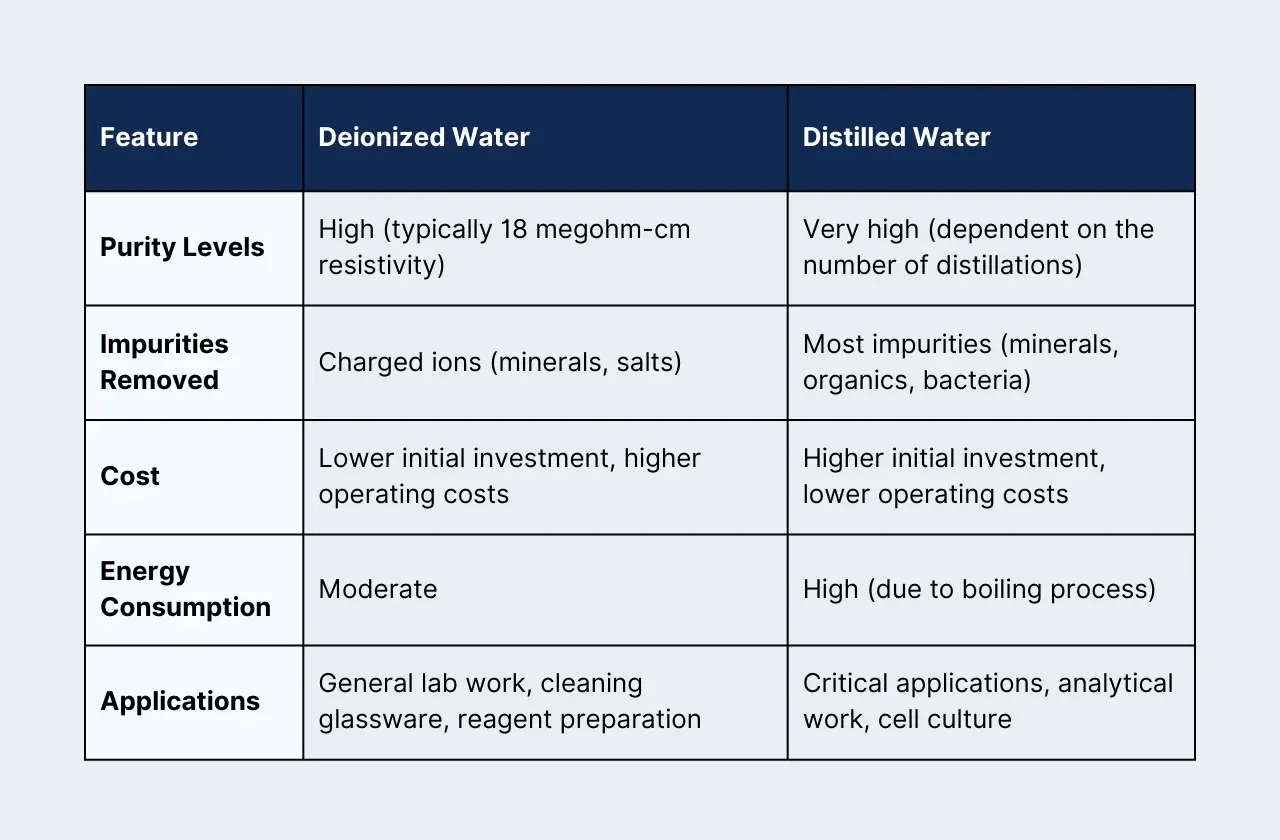
Distilled water is made by boiling water into steam and then condensing that steam back into liquid. It’s like the water equivalent of a steam sauna—only the pure vapor escapes, leaving behind all the heavy metals, minerals, and most bacteria.
This process is brutal on impurities. It removes nearly everything, including dissolved solids and even some volatile organic compounds (VOCs). You end up with water that’s about 99.9% pure H₂O.
But here’s the irony: distillation is energy-hungry. You’re boiling huge amounts of water just to get a little bit back. It’s like using a flamethrower to toast a marshmallow—effective, but wasteful. Your electricity bill will not thank you.
Deionized (DI) Water: The Ion-Swiping Ninja
Deionized water uses a different trick. It passes water through special resins that act like magnets for charged particles (ions). These resins grab calcium, magnesium, sodium, and other mineral ions, swapping them for hydrogen and hydroxide.
The result? Water that is incredibly pure in terms of electrical conductivity. In fact, DI water is so “empty” of ions that it’s a terrible conductor of electricity. Try sticking a multimeter in DI water—it barely registers.
But here’s the catch: DI water might still contain uncharged contaminants like bacteria, viruses, or organic molecules. Distillation kills those by heat; deionization just ignores them. So no, you can’t just swap one for the other in a fish tank or a humidifier.
When to Pick One Over the Other (A Handy, Slightly Judgy Guide)
Use distilled water if: You need water for a CPAP machine, a steam iron, or drinking (though it tastes flat). It’s also the go-to for car batteries and lab experiments that can’t risk any contaminants. Distillation is the cautious grandma—better safe than sorry.
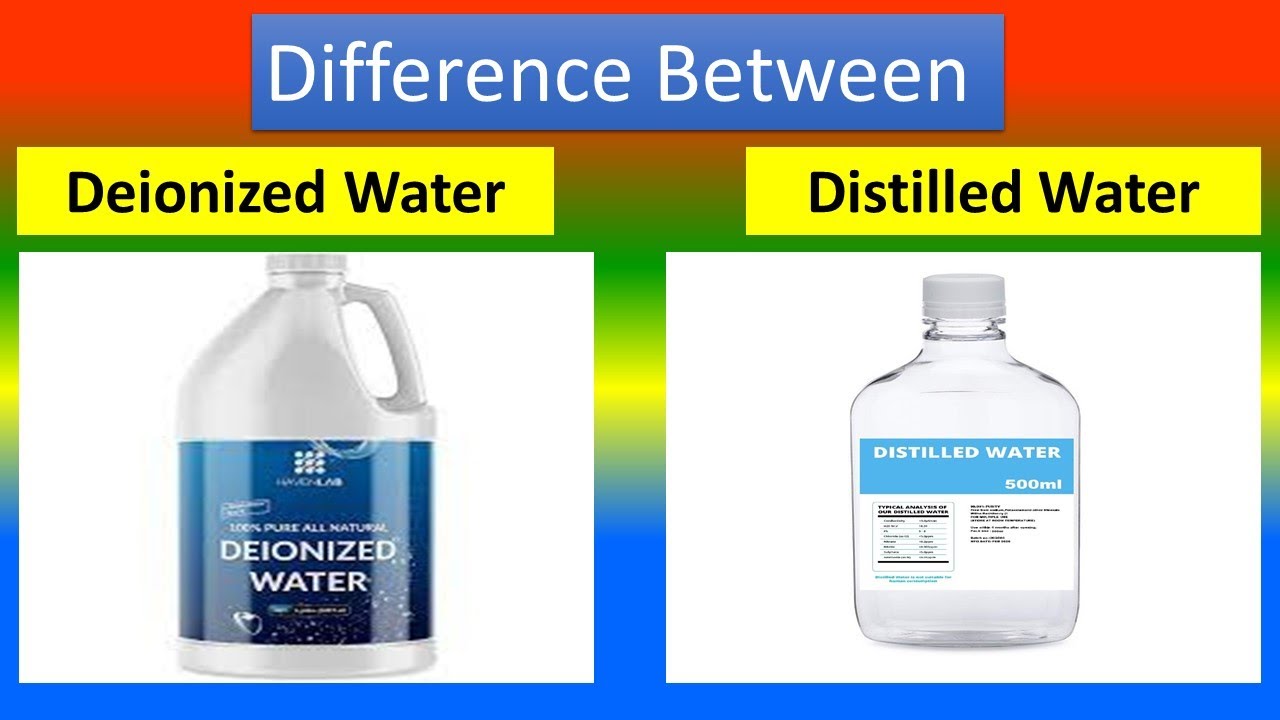 Chemical Makeup Of Distilled Water - Mugeek Vidalondon
Use DI water if: You’re a car enthusiast topping off a radiator, a photographer rinsing prints, or a microbiologist who needs ultra-pure water for sensitive equipment like spectrophotometers. DI water is faster and cheaper to produce in large quantities.
But here’s the real kicker: DI water is often more “pure” in terms of removing dissolved minerals than distilled water. A single pass through a good DI system can achieve resistivity of 18.2 megohm-cm. Distillation usually tops out at about 1.0 megohm-cm. Yeah, I just threw science at you. You’re welcome.
The “But Can I Drink It?” Question (You Knew It Was Coming)
Spoiler: You can drink both, but you probably shouldn’t as your main source. Distilled water is fine for occasional use, but it lacks minerals like calcium and magnesium your body uses. DI water is even more aggressive—it can leach minerals from your teeth and pipes.
Think of it this way: drinking DI water is like eating a meal with zero seasoning. It won’t kill you, but it’s bland and might mess with your gut if you overdo it. Stick to tap water for hydration, unless your tap water tastes like a swimming pool.
And please, never confuse DI water for distilled water in a medical device like a nebulizer. The FDA says no. Distilled is sterile-ish; DI is not guaranteed sterile. Your lungs deserve better.
The Final Sip (Where We Wrap This Chaos)
Here’s the cheat sheet: Distilled = boiled and condensed. Deionized = ion-swapped. One is about heat, the other about chemistry. They both remove different stuff, so they’re not interchangeable unless you just need to avoid dissolved solids.
So next time someone like Mark tries to flex their water knowledge, you can casually drop, “Oh, that’s deionized, not distilled. Different process.” Then wink. You’ll look like a genius. Or a water snob. Either way, you’ll be right.
Now go pour yourself a glass of whatever water you have—and maybe buy a Brita filter. No one needs this much drama over H₂O. But thanks for reading, you beautiful thirsty nerd.
