Which Of The Following Statements About Water Is False

We’ve all been there, staring at a multiple-choice question that feels more like a pop quiz from the universe. You know the one: “Which of the following statements about water...

We’ve all been there, staring at a multiple-choice question that feels more like a pop quiz from the universe. You know the one: “Which of the following statements about water is false?” It sounds simple, right? Water is just that wet stuff we drink, shower in, and occasionally slip on in the kitchen. But somehow, this innocent question can make you feel like you’re defending a Ph.D. thesis about a raindrop.
Water is supposed to be boring, but it keeps tricking us
I mean, water is the most common thing on the planet. You’d think we’d have it figured out by now. But then a friend casually says, “Did you know hot water freezes faster than cold water?” and suddenly you’re questioning every ice cube you’ve ever made. That’s the trap—water seems simple, but it’s a mischievous little molecule that loves to behave like a rebellious teenager.
Let’s start with the obvious false statement you’ve probably seen in a textbook or a Facebook meme. “Humans should drink eight glasses of water a day.” Is that false? Actually, it’s more of a guideline than a law—your body isn’t a measuring cup. But the real whopper of false statements is often something like, “Water expands when it freezes.” Wait, that’s true! Water is one of the few substances that does get bigger as ice. See? Even the false statements make us second-guess.
Must Read
The classic “false statement” that makes everyone smirk
Here’s the one that always gets people: “Water boils at 212 degrees Fahrenheit at all altitudes.” Oh, you sweet summer child. Try boiling an egg on a mountaintop and watch it take forever. That’s false—water’s boiling point drops as you go higher. It’s like water gets altitude sickness too, just without the headache. You’ll end up with a rubbery egg and a bruised ego.
I remember camping in Colorado once, and my buddy insisted on making pasta. He kept saying, “It’s bubbling, so it must be hot enough!” He was wrong—the water was boiling at like 198°F, and our spaghetti turned into sad, floppy noodles. The false statement wasn’t just in the textbook; it was in our pot, mocking us with al dente failure.
Why your brain loves to memorize this trivia (even if you forget the rest)
We get attached to water facts because they feel like secret knowledge. Knowing that “water is wet” is true, but “water is always 100% pure” is false—since tap water has minerals, chlorine, and probably a little bit of everyone in your town. That’s the fun part—the false statements often reveal how messy real life is. Water isn’t perfect; it’s just really good at hiding its imperfections.
Think about the false statement that says, “Water conducts electricity well.” This one is tricky because pure water is actually a terrible conductor. It’s the impurities—the salt, the minerals, the random bits of last night’s pizza—that makes it dangerous. So when your uncle warns you not to drop a hair dryer in the bathtub, he’s right because your bathwater isn’t pure. Thanks, tub gunk.
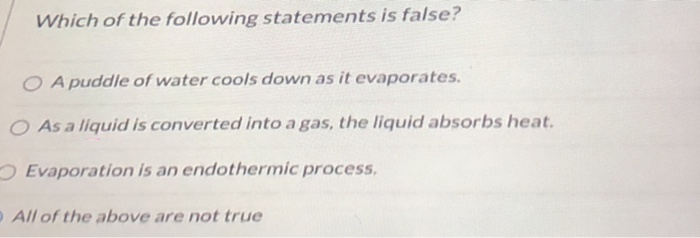 Solved Which of the following statements is false? O A | Chegg.com
Everyday water lies we’ve all believed at some point
Remember that time someone swore that “adding salt to water makes it boil faster”? False. It actually raises the boiling point, so technically it takes longer. But we all nod along because we want to feel like kitchen chemists. I once watched a friend dump a whole salt shaker into a pot, muttering about “science,” and then storm off when the pasta was still hard. Totally false, dude.
Another doozy: “You can’t drown in a teaspoon of water.” Technically false—babies and small animals can drown in very shallow water. But mostly, this statement is false because it ignores the real danger of a slippery floor. I’ve nearly drowned in a puddle of my own bathwater just trying to grab a towel. Life’s weird like that.
So, which statement is actually false? (Cue dramatic music)
If you’re cramming for a test or just trying to win a bar bet, the most common false statement about water is: “Water is a universal solvent.” That’s a half-truth at best. Water dissolves a ton of stuff, sure—but it’s terrible at dissolving oil, fat, or wax. False if you take it literally. Next time someone says that, just point to the salad dressing in your fridge. Oil and vinegar don’t mix, and neither does water with a greasy pan.
But honestly, the real false statement is the one we tell ourselves: “I’ll remember to drink more water tomorrow.” We all say it, and we all forget. So the next time you’re asked, “Which of the following statements about water is false?” just smile and say, “The one where humans have their hydration lives together.” That’s the biggest lie of all.
Water is wet, it’s heavy, and it sometimes takes the shape of a puddle under your fridge you swore wasn’t there. Embrace the confusion. It’s just H2O—crazy, life-giving, and always ready to turn a simple question into a story.
