Difference Between Reverse Osmosis And Filtered Water

So, there I was, standing in the kitchen of my new apartment, staring at two different water pitchers like a complete idiot. One was a fancy, chrome thing labeled “Reverse Osm...
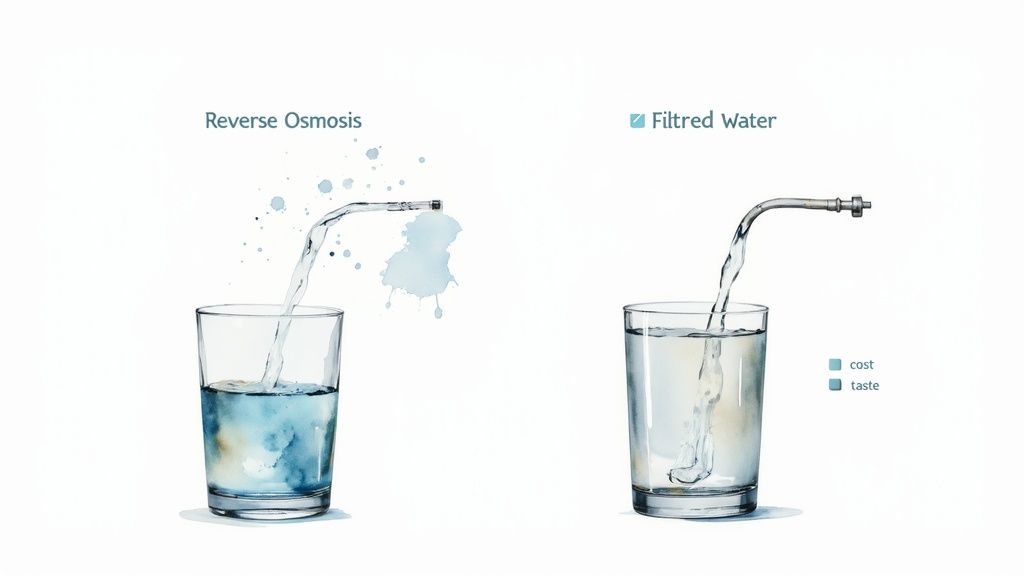
So, there I was, standing in the kitchen of my new apartment, staring at two different water pitchers like a complete idiot. One was a fancy, chrome thing labeled “Reverse Osmosis,” and the other was a simple plastic jug with a “Filtered” sticker. I filled both with tap water, took a sip from the “Filtered” one, and thought, “That’s… tap water, but nicer.” Then I tried the RO water, and I swear it felt like my taste buds went on a silent retreat. Nothing was happening. It was almost too clean.
That moment sparked my deep dive into the surprisingly dramatic world of water purification. It turns out, the difference between “filtered water” and “reverse osmosis water” is like the difference between a gentle rain and a pressure washer. Both clean your car, sure, but one is just doing the bare minimum while the other is blasting off the paint. Let’s break this down, because your hydration deserves better than random guesses.
The Basic Gig: What is Filtered Water?
Think of a standard water filter—the kind in your Brita pitcher or fridge dispenser—as a net for your tap water. It physically catches larger particles like sediment, rust, and chlorine, which is why your water suddenly doesn’t taste like a swimming pool. This is mostly carbon filtration, which is great for improving taste and odor, but it’s not exactly a microscopic cleanup.
Must Read
Here’s the kicker: it won’t remove everything. It leaves behind dissolved solids like calcium, magnesium, and even some heavy metals. If you’re super concerned about lead or pesticides, a basic filter is like showing up to a knife fight with a spoon—better than bare hands, but not ideal. It’s the “good enough” option for most people, and honestly, that’s totally fine.
The Heavy Lifter: What is Reverse Osmosis Water?
Now, reverse osmosis (RO) is the overachiever of the water world. It doesn’t just use a net; it uses a semi-permeable membrane with pores so tiny, they make a virus look like a whale. Think of it as a bodyguard for your glass—it forces water under pressure through a filter that blocks literally everything except pure H₂O molecules. Salts, bacteria, viruses, even fluoride—gone.
The result? Water that’s about as pure as you can get without distilling it yourself in a lab. It’s the kind of water coffee snobs and aquarium owners swear by. But here’s the ironic part: it works so well that it strips out beneficial minerals too. You get the cleanest water on Earth, but it’s a little… boring. Some people call it “dead water,” which feels dramatic but is fair.
The Real Trade-Offs You’ll Actually Care About
Let’s get practical. Filtered water is cheap, easy, and quick—you pour, you wait, you drink. It also keeps the trace minerals that some people claim are good for you (though our bodies get those from food, so don’t stress). RO water, on the other hand, is slow, wasteful, and pricey. A typical RO system wastes about 3 to 4 gallons of water for every 1 gallon it produces. Yikes.
 Reverse Osmosis vs. Carbon Water Filtration | Angi
But wait—there’s a plot twist for the anxious reader. Some RO systems now add a remineralization filter at the end, putting back the good stuff like calcium and magnesium. So you get the purity of RO without the blandness. It’s like having a superclean room that you then decorate with a nice rug. Fancy, right?
Which One Should You Actually Use?
Honestly? If your tap water tastes decent and you just want to ditch the chlorine and improve the smell, filtered water is your friend. It’s perfect for daily drinking, making iced tea, and not overthinking your life. I use a simple carbon filter for my morning water and I sleep fine.
Go for reverse osmosis only if you’re a water snob, you live in an area with sketchy tap water (hello, well water with nitrates), or you need super-pure water for a specific reason—like making baby formula or keeping exotic fish alive. Otherwise, you’re just paying extra for water that tastes like… nothing. And isn’t that a little philosophical?
So next time you’re staring at those two pitchers in a store, remember: one is a light cleanup crew, and the other is a total eviction. Both work. Just pick the one that matches your level of paranoia—er, I mean, discernment. Cheers, and stay hydrated, you beautiful human.
