Difference Between Demineralized Water And Deionized Water

So, picture this: I’m in my college chemistry lab, about to top off a lead-acid battery for my old, dying car. My lab partner—let’s call him Dave—hands me a jug labeled “Deion...
So, picture this: I’m in my college chemistry lab, about to top off a lead-acid battery for my old, dying car. My lab partner—let’s call him Dave—hands me a jug labeled “Deionized Water” with a flourish. “Use this,” he says, “it’s the pure stuff.” I pour it in, feeling like a pro. A week later, the battery is dead. Turns out, Dave grabbed the wrong jug. The one I used was demineralized water. And my battery? It was completely unhappy. That’s when I learned: demineralized and deionized water are not the same thing, even if they sound like twins.
You’ve probably seen both terms tossed around in labs, pharmacies, or even your home water filter ads. They’re often used interchangeably, which is a massive no-no if you’re a water snob (or a battery). So, let’s break it down without the boring chemistry textbook vibe. I’m talking to you, not to a classroom.
What’s the Bare Minimum Difference?
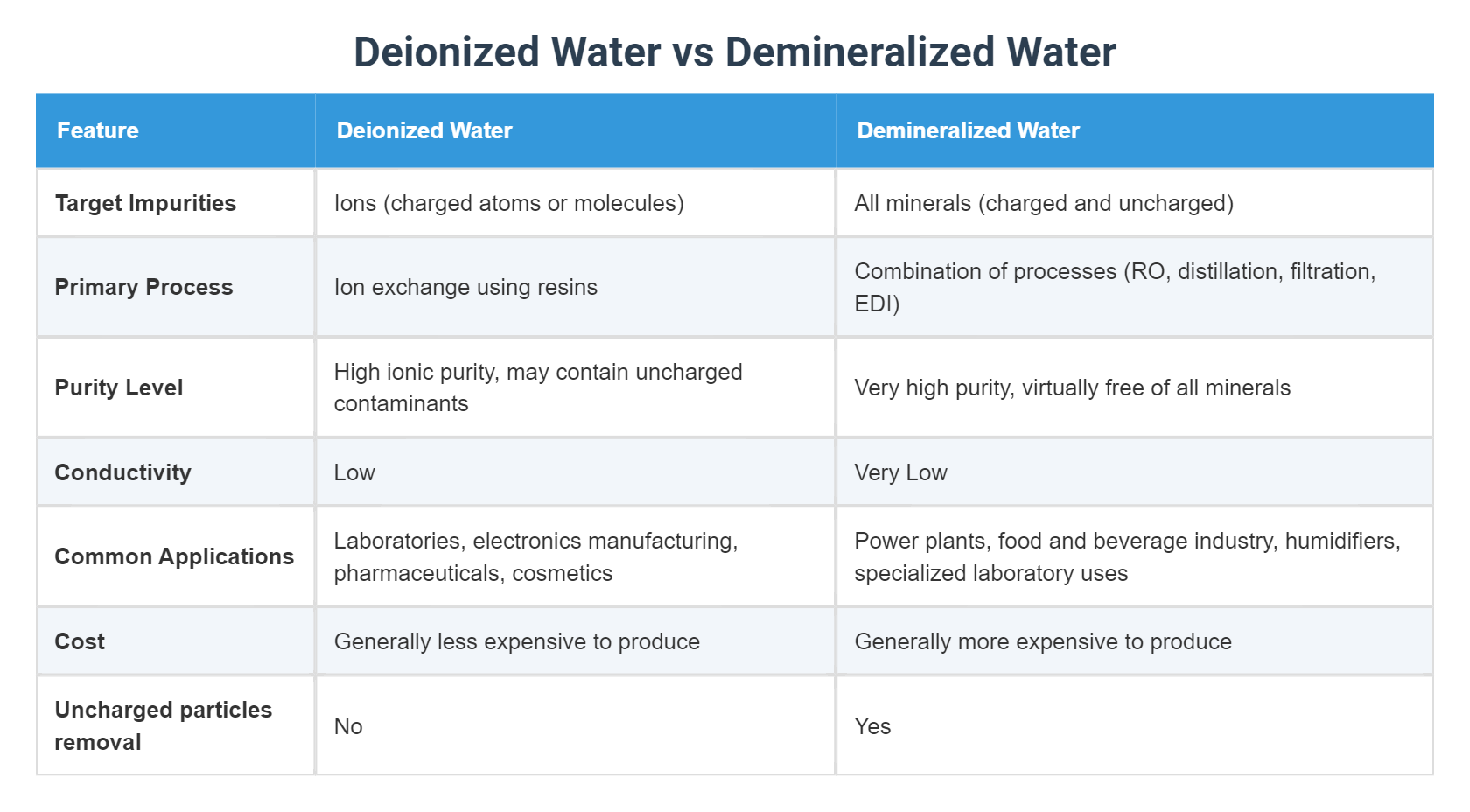
At their core, both demineralized and deionized water are purified forms of H₂O. They’ve had most of their dissolved solids—think salts, minerals, ions—yanked out. But here’s the twist: how they get cleaned is totally different. Deionized water uses a special process that targets ions specifically. Demineralized water takes a broader approach, removing minerals (which are often ions, but not always).
Must Read
Think of it like this: deionization is like a bouncer at a nightclub who only kicks out people wearing red shirts (ions). Demineralization is a janitor who mops up anything that looks like a mineral—red shirt, blue shirt, or even a weird hat. They both clean the floor, but one is obsessed with a specific color.
How Deionization Works (Short Version, Pinky Promise)
Deionization passes water through two types of resin beads: cation and anion resins. The cation resin grabs positively charged ions (like calcium, magnesium, sodium). The anion resin snatches negatively charged ones (like chloride, sulfate). It’s a tag-team match, and the result is water that’s nearly free of ions—super pure, but not necessarily free of non-ionic contaminants like organic molecules or bacteria.
A fun fact? Deionized water can be aggressively thirsty. It will try to pull ions from whatever it touches, including your skin or metal pipes. That’s why you never drink it straight—it’ll leach minerals from your body, and your tongue will feel weird. Trust me, I tried it in that lab. Don’t.
And Demineralization? Let’s Get Specific
Demineralization often uses reverse osmosis, distillation, or ion exchange (yes, it can overlap with deionization). But the goal here is to remove minerals—hard water culprits like calcium and magnesium. It’s great for preventing scale in kettles, steam irons, and car batteries (as I painfully learned). The catch? Demineralized water might still contain some uncharged particles, like dissolved organic compounds or tiny silica bits. It’s not as “ion-clean” as deionized water.
So, if you’re filling a lead-acid battery, you want demineralized water specifically. Deionized water can be too aggressive and damage the plates—same thing that killed my car battery. Dave and I learned that the hard way. Oops.
 Deionized Water vs Demineralized Water - Tabular Form | Functional
Why Should You Care? (A Tale of Two Waters)
In the real world, the difference matters more than you’d think. For a lab experiment requiring ultra-pure water for sensitive reactions, deionized is king. It’s the gold standard for electronics manufacturing, where even a speck of ion can mess up a microchip. But for your household steam iron or fish tank? Demineralized is often perfect—and cheaper.
Here’s the kicker: marketing loves to blur the line. A water filter bottle that says “removes minerals” might not remove ions. A bottled “deionized water” from the store might actually be demineralized by reverse osmosis. Always check the label if you’re a stickler. Or, you know, just accept that your coffee maker probably won’t explode either way.
The Ironic Truth
Both types of purified water are technically bad for long-term human consumption. Yes, you heard me. They lack the electrolytes and trace minerals your body needs. Drinking them exclusively can mess with your digestion and hydration balance. So, while we obsess over purity, the best water to drink is actually the slightly dirty stuff with a few minerals in it. Irony at its finest, right?
But hey, if you’re brewing beer or making espresso, deionized or demineralized water can be a great base—you can add back the precise minerals you want. That’s for another blog post, though.
So, Which One Do You Pick?
Here’s your cheat sheet, just between us: If you need water for a lab, car battery (demineralized only!), or microchip cleaning, go for deionized. If you’re scalding kettles, ironing shirts, or rinsing glassware, demineralized will do the job without the fuss. And if you’re just hydrating? Grab tap water or filtered spring water. Your stomach will thank you.
In the end, the difference is like choosing between a quadruple-distilled vodka and a triple-filtered one. They’re both clear, but one leaves a slightly different aftertaste—if you’re paying attention. Just don’t put the wrong one in your battery. Dave still brings that up at parties.
