What Is The Correct Order Of The Water Cycle

So, you want to know the correct order of the water cycle. That’s sweet, but let’s be honest—you probably stared at a diagram in third grade, nodded along, and then promptly f...

So, you want to know the correct order of the water cycle. That’s sweet, but let’s be honest—you probably stared at a diagram in third grade, nodded along, and then promptly forgot everything except that clouds are made of angry water. Don’t worry, I’ve got you. We’re going to sort this out with zero boring charts and a hundred percent attitude.
First up: Evaporation. This is the thirsty, dramatic phase where the sun heats up water in oceans, lakes, and that sad puddle your neighbor never cleans. The water turns into invisible vapor and floats away like it’s too good for the earth. Surprising fact: About 90% of Earth’s water vapor comes from oceans, which means the ocean is basically the planet’s loudest, wettest singer in a vast humidity concert.
But wait—don’t just picture a swimming pool boiling. Evaporation happens from soil, plants, and even your skin when you’re sweating after one pushup. It’s everywhere, all the time. That invisible gas is now a party guest looking for a cooler venue.
Must Read
Then Comes Transpiration (The Plant One)
Plants aren’t just sitting around looking pretty—they’re secretly sweating too. Transpiration is when trees and flowers release water vapor from their leaves, like tiny, green, sneezing steam engines. One tree can transpire 100 gallons of water a year. That’s enough to fill a bathtub and annoy your landlord. So yes, the forest is basically a giant, quiet, leafy geyser.
Don’t panic—scientists lump transpiration and evaporation together under the catchy name evapotranspiration. It sounds like a dinosaur that shoots steam, but it’s just nature’s way of giving the sky more wetness.
Next: Condensation (Cloud Assembly Line)
Now our invisible water vapor rises and gets cold. Real cold. This is condensation, where the vapor turns back into tiny liquid droplets. Those droplets cling to dust, salt, or pollution particles floating around. Surprising fact: Without dust, clouds wouldn’t form. You read that right—clouds are basically clingy dust bunnies wearing water jackets. So every time you sneeze, you’re technically helping the weather. You’re welcome, planet.
 Summarize the steps of the water cycle. - garetmrs
This is when clouds show up. They look fluffy and light, but a single cloud can weigh as much as a hundred elephants. Imagine a hundred elephants floating over your picnic. That’s not a cloud, that’s a life insurance claim waiting to happen. Luckily, those elephants are held together by teeny droplets, not trunk-to-tail chains.
Now We Get Precipitation (The Big Dump)
When the droplets in the cloud get too heavy—or bump into each other too much—they fall. This is precipitation. Not just rain, either. It could be snow, sleet, hail, or that weird frozen stuff that bounces off your car like angry popcorn. Fun fact: Hail forms when raindrops get tossed up and down in a storm cloud like a cosmic pinball machine. One hailstorm in 2018 dropped a chunk the size of a pineapple in Argentina. Ouch.
Precipitation is how the sky pays back its water debt. It dumps on mountains, rivers, your backyard barbecue, and the one umbrella you forgot to bring. The cycle is not polite—it’s water redistribution with attitude.
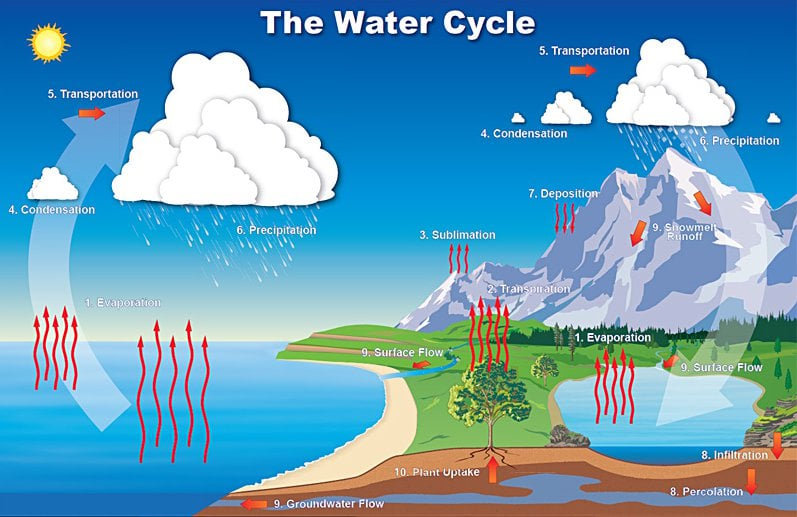 The Water Cycle: From Evaporation to Precipitation - The Filtered Files
But Wait—Where Does the Water Go?
After the sky finishes its tantrum, the water hits the ground. This is runoff and infiltration. Runoff is water that doesn’t sink in—it flows over rocks, streets, and into streams. Think of it as water lazy-skipping down a hill. Infiltration is water that soaks into the soil, refilling underground aquifers. Surprising fact: Some of that water has been underground for thousands of years. Imagine being stuck in a dark party for 10,000 years—you’d be desperate for a bathroom break.
Groundwater then slowly moves toward rivers and oceans, where it waits for the sun to crank up the heat and start the whole circus again. That’s the secret: there is no “end” to the order. It’s a loop. A wet, chaotic, never-ending loop.
So What’s the Correct Order?
If you want the official sequence: Evaporation (and transpiration) → Condensation → Precipitation → Runoff/Infiltration → Repeat. But if you want the emotional truth: Boiling drama → Cloud therapy → Sky tantrum → Earth cleanup → Repeat. And we never, ever include “dry laundry” in the cycle—that’s your problem, not the planet’s.
Now go outside and look at a cloud. Use your new knowledge wisely. And if someone asks you the water cycle order, you can smile, sip your coffee, and say: “It starts with the sun getting sassy and ends with the ground getting soaked. The rest is just weather gossip.”
