How To Reduce Fecal Coliform In Wastewater

So, you’ve got some wastewater on your hands. Maybe not literally, I hope. But if you’re dealing with fecal coliform, you know it’s the party guest nobody wants. Think E. coli...

So, you’ve got some wastewater on your hands. Maybe not literally, I hope. But if you’re dealing with fecal coliform, you know it’s the party guest nobody wants. Think E. coli and its buddies showing up uninvited.
Let’s be real: nasty stuff. But hey, we can kick these bacterial gate-crashers out. It’s easier than you think, and I promise no hazmat suits are required (for this conversation, at least).
First up: chlorination. It’s the old reliable, like that one friend who always has jumper cables. Chlorine zaps coliform dead—zap, zap, bye-bye. Just don’t overdo it, or you’ll smell like a swimming pool.
Must Read
But wait! Chlorine has a dark side. It can create disinfection byproducts (DBPs), which are basically chemical leftovers that nobody asked for. So, use it smart: dose it right, then dechlorinate before release.
Next up: UV light. Imagine a tanning bed for wastewater. Seriously. Ultraviolet light scrambles the DNA of coliform bacteria, making them unable to reproduce. It’s like giving them a permanent “do not disturb” sign.
The best part? No chemicals. No weird smells. Just pure, concentrated light therapy. The catch: the water needs to be pretty clear. Murky water blocks the UV, so you’ll need to filter first. Fair trade, right?
Another hero: ozonation. Ozone is fancy oxygen—O₃ instead of O₂. It’s a powerful oxidizer that shreds bacteria like a tiny tornado. The reaction is so fast it’s almost magical.
Ozone leaves no harmful residue, which is great. But it’s a bit pricey and requires equipment that hums like a refrigerator. Still, for tough coliform loads? Totally worth it.
Now, let’s talk about wetlands. Yes, actual wetlands. Build a marsh, and let plants and microbes do the work. It’s nature’s own sewage treatment plant, complete with cattails and dragonflies.
 PPT - Central Pollution Control Board PowerPoint Presentation, free
This method is slow but steady. Like watching grass grow—literally. But it’s beautiful, low-energy, and great for the local frogs. Fecal coliform gets filtered out naturally.
Of course, you need space. If you’re in a tiny backyard, skip this one. But if you have a spare acre? Go full wetland. Your neighbors might think you’re weird, but the environment will high-five you.
Let’s not forget aeration. Pumping air into wastewater might sound dumb, but it’s genius. Oxygen feeds good bacteria that eat up the bad stuff. It’s like sending in the cavalry—microbe style.
Aeration is cheap, simple, and works for lots of pollutants. You’ll reduce coliform, plus lower odors. Win-win-win. Just make sure you don’t splash yourself. Trust me on that.
Another trick: coagulation and flocculation. Fancy words, I know. You add a chemical (like alum) that makes particles clump together. Those clumps sink, taking coliform with them. Picture a blanket of bacteria falling asleep at the bottom.
This is a physical removal, not a kill. But once those clumps are gone, the coliform is gone too. Just remember to haul away the sludge later. Not your idea of fun, but necessary.
What about filtration? Sand filters, membrane filters, you name it. Think of it as a really fine strainer for your water. Coliform bacteria are too big to pass through, so they get stuck. Boom. Captured.
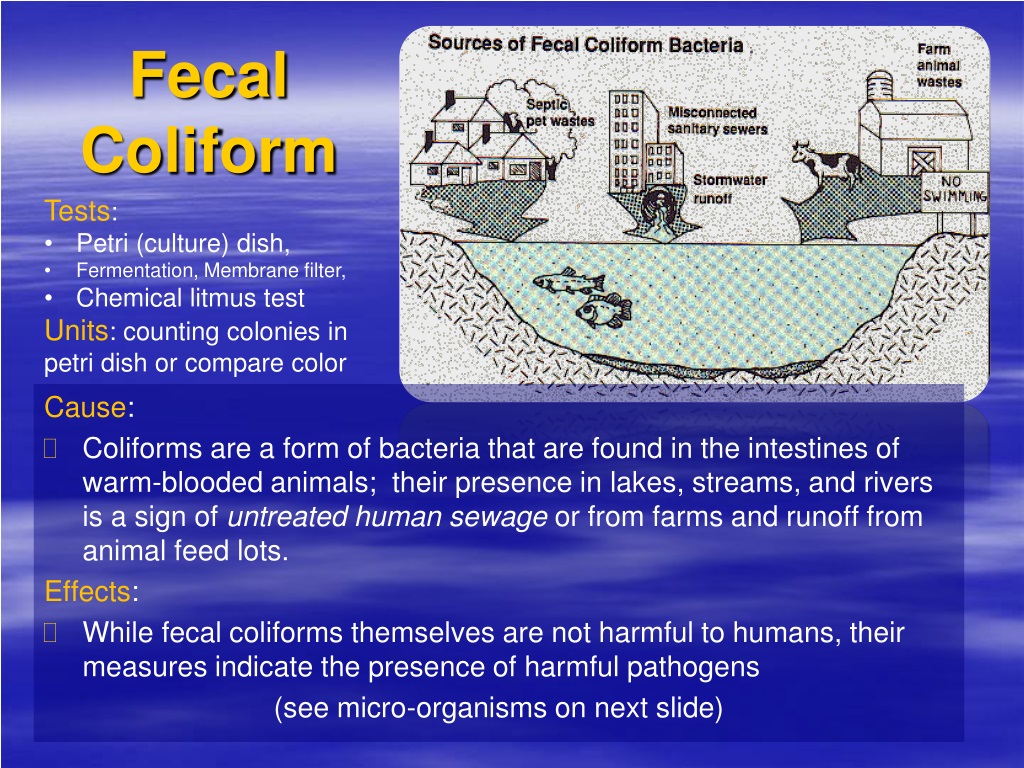 PPT - Water Quality Testing Methods for Safe Consumption PowerPoint
Membrane filters are especially cool. They’re like microscopic sieves that catch everything. Viruses, bacteria, even your ex’s lingering regrets. Okay, maybe not that last one. But close.
Now, a word on temperature. Coliform love warm water, like a spa day. If you can cool your wastewater, you slow them down. Not a long-term solution, but a nifty trick in summer.
Combine methods for the win. Use UV plus filtration. Or chlorine plus aeration. Layering treatments is like wearing armor and carrying a shield—nothing gets through.
Don’t forget to monitor. Test your water regularly. Buy a simple coliform test kit and become a wastewater detective. Who doesn’t want to say, “I caught the coliform red-handed”?
Finally, the most important step: prevention. Stop fecal coliform from entering the system in the first place. Fix leaky septic tanks. Don’t flush questionable items. Treat your toilet like a temple, not a garbage can.
Look, wastewater isn’t glamorous. But reducing fecal coliform? That’s a superpower. You’re protecting rivers, lakes, and drinking water. You’re basically a silent guardian of the public health.
So grab your test kit, your chlorinator, or your UV lamp, and get to it. The coliform don’t stand a chance. And next time someone asks what you did today, just say: “I kicked some bacteria out of the neighborhood.” You’ll be a legend.
