Why Does My Water Softener Keep Running

You know that little hum of your water softener, the one that usually fades into the background noise of your home? Last Tuesday, mine turned into a full-blown, uninvited hous...

You know that little hum of your water softener, the one that usually fades into the background noise of your home? Last Tuesday, mine turned into a full-blown, uninvited house guest that wouldn't stop talking. I walked into the basement at 2 AM to find it running a regeneration cycle for the third time that day, like a caffeinated robot trying to win a marathon.
I stood there, bathrobe flapping, watching the thing drain water with a desperate gushing sound. It was clearly not okay. And if you’re reading this, you’ve probably had your own 2 AM revelation: “Why is this stupid machine running again?”
The Classic Blame Game: Your Timer or Controller
The most common culprit is a faulty timer. These things are on a schedule, right? Well, sometimes that schedule gets possessed. If your softener is set to regenerate every three days but starts every three hours, the control board has lost the plot.
Must Read
You can test this easily. Unplug the unit for about 30 seconds (yes, like rebooting a stubborn computer). If the cycle stops immediately, your timer or circuit board is likely fried. Side note: If it doesn’t stop, the problem is mechanical—keep reading.
The Sneaky Water Leak You Can't See
Here’s the irony: your water softener might be over-working because it thinks you’re using way more water than you actually are. A tiny leak—like a toilet flapper that’s slowly failing—can trick the softener’s flow meter. A running toilet can waste 200 gallons a day, and your softener sees that as “demand.”
So it regenerates. And regenerates. And you’re left wondering if you accidentally opened a fire hydrant in your backyard. Pro tip: Go check every toilet in your house for a silent, ghostly trickle before you blame the softener itself.
The Stuck Piston or Dirty Valve
Inside that metal head, there are tiny pistons and seals that move like a well-oiled machine. Until they don’t. A grain of sand, a fleck of rust, or just plain old age can make a piston get stuck mid-cycle. This keeps the water flowing, the motor running, and the drain line going zip-zip-zip forever.
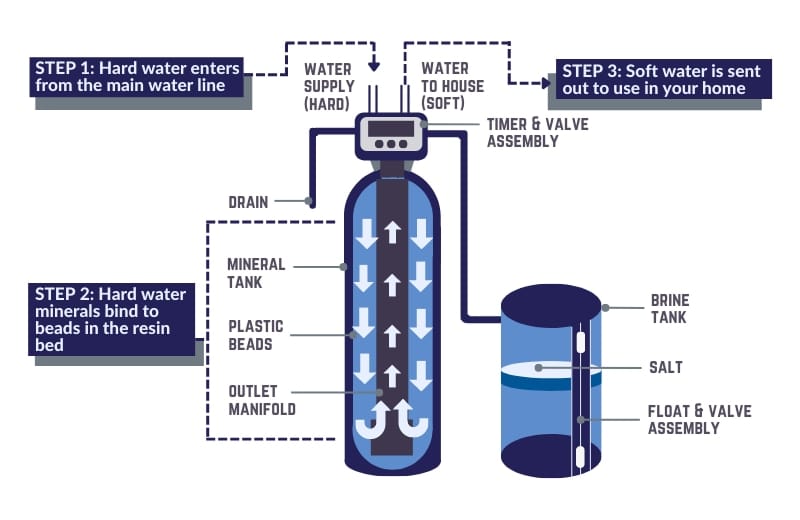 How Does A Water Softener Work Step By Step | Detroit Chinatown
If you hear a clicking, grinding, or buzzing sound that won’t stop, you’ve got a mechanical hostage situation. You can try a cleaner like “Resin Clean” to flush out gunk, but often you’ll need to replace the valve assembly. This is the point where most people call a plumber… or start shopping for a new unit online.
Brine Tank Overfill Drama
Ever seen your brine tank (the big white barrel) overflowing with water? That’s a floater problem. The little floating valve that tells the system “okay, that’s enough saltwater” might be stuck or broken. When that happens, the softener keeps trying to make brine, and the regeneration cycle just loops.
It’s like a barista making coffee until the cup overflows, but the cup is your entire basement floor. Check the float gently—sometimes it just gets sideways.
The “Low Salt” Paradox
Okay, this one is weird. You think: “Hey, I just filled the salt tank!” But if your salt has bridged—forming a hard crust above the water level—the system can’t draw brine. So it just runs and runs, trying to scrape together a solution that isn’t there.
 Water Softener Keeps Running: Troubleshoot and Fix Now!
Break up the salt crust with a broom handle (seriously, it works). If you break into a salt cave, congrats—you’ve discovered the problem. Don’t wear your nicest shoes for this job.
Power Surges and Ghost Electricity
We forget that water softeners are digital creatures living in a wet, dark basement. A power surge—even a tiny one from a nearby thunderstorm—can mess up the brain of the system. It might get stuck on “regenerate” and never receive the “stop” signal.
You can add a surge protector. Or just unplug it for a full minute, plug it back in, and hope it needed a nap. This fixes maybe 20% of issues, but it’s free and you feel like a tech wizard.
When to Just Give Up and Call the Pros
I’ve spent hours on YouTube, armed with a screwdriver and false confidence. Sometimes the motor burns out. Sometimes the circuit board becomes a crispy fry. And at that point? You’re better off replacing the control head or the whole unit. A new softener costs $400 to $800. A repair visit? Often $200—with no guarantee.
So here’s my final, honest advice: If you’ve checked the toilets, broken the salt bridge, and rebooted the controller, but it’s still running like it’s training for a triathlon, call a pro. Save your sanity. And maybe buy a white noise machine for the basement.
