How Much Is Reverse Osmosis System

So you’ve heard the buzz about reverse osmosis. Maybe it was from that wellness-obsessed friend who swears their skin has never looked better, or from the cryptic warning on y...

So you’ve heard the buzz about reverse osmosis. Maybe it was from that wellness-obsessed friend who swears their skin has never looked better, or from the cryptic warning on your tap water bill. You’re intrigued, but the first question that pops up is always the same: how much are we actually talking about? Before you dive into the deep end of hydration hype, let’s untangle the numbers with a relaxed, no-panic vibe.
The price of a reverse osmosis system is like a good avocado—it depends on the size, the brand, and where you buy it. Entry-level countertop models start around $150, perfect for renters or minimalists. These are the “dip your toe in” versions, often compact and plastic, but they do the job for a single person or a couple who just wants better iced coffee.
Mid-range under-sink systems are the sweet spot, typically costing between $300 and $600. This is where most homeowners land, and it’s the equivalent of buying a decent espresso machine—a daily luxury that pays off in taste. You’ll find names like APEC or iSpring here, with metal fittings and multiple filter stages that feel sturdy and grown-up.
Must Read
Then there’s the whole-house, “I’m-serious-about-my-water” tier, which can run from $1,500 to over $4,000. This includes professional installation, a storage tank the size of a small dog, and a dedicated faucet. It’s for the person who wants every shower, every ice cube, and every garden hose to be filtered to sparkling perfection.
A fun little fact: the “reverse” in reverse osmosis doesn’t mean it’s stubborn—it means it uses pressure to push water against its natural flow. It’s basically forcing water through a membrane that’s so tight, only H2O molecules can pass. That’s harder to get into than a VIP club on a Friday night, and it’s why these systems can remove up to 99% of contaminants like lead, chlorine, and even fluoride.
The Hidden Costs You Should Know (No Surprise Fees)
The upfront price is only half the story, like buying a vintage leather jacket but forgetting the zipper repair. Most systems require filter replacements every six to twelve months, costing around $50 to $150 per year. Think of it as a subscription to clarity, minus the auto-renewal hassle.
Installation is another silent partner in the cost conversation. DIY-friendly models can be hooked up by anyone with a wrench and a YouTube tutorial—saving you roughly $150 to $300. But if your sink is a tangled mess of plumbing spaghetti, paying a plumber $200 now prevents a potential flood later.
Don’t forget the water waste, a quirky eco-drama. For every gallon of purified water, traditional RO systems reject 3 to 4 gallons of “brine” water down the drain. Newer “zero waste” models recirculate that brine back to your hot water tank, but they cost about 10-20% more upfront.
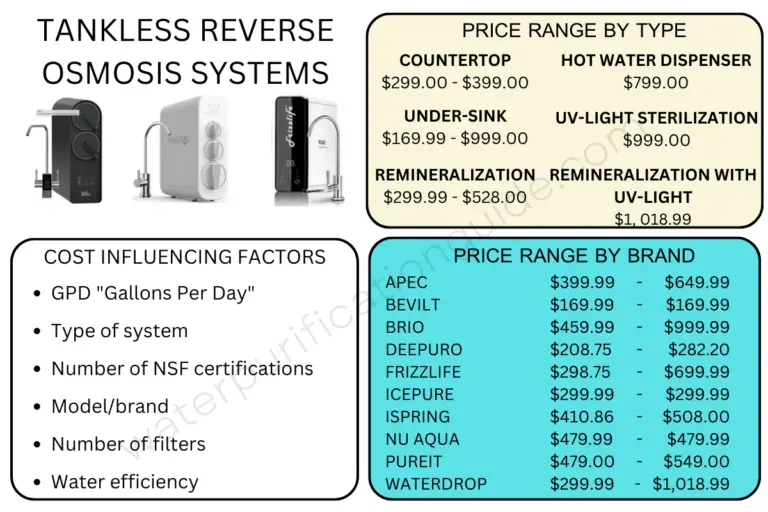 How Much Tankless Reverse Osmosis Systems Really Cost - Water
A practical tip: look for systems with a permeate pump. This little gadget improves efficiency, meaning less water waste and faster production. It’s the unsung hero of the RO world, and it typically adds only $50 to $100 to the final price tag.
Brands That Feel Like Inside Jokes
Brands matter here, but you don’t need a lab coat to choose. APEC Water Systems is the reliable cousin everyone trusts—durable, American-made, and middle-priced. Then there’s Home Master, which adds a remineralization cartridge so your alkaline-water-loving friends can still feel fancy.
For the tech-savvy minimalist, Waterdrop makes sleek, tankless systems that look like a modern art sculpture under your sink. They start around $400 and are whisper-quiet. It’s the Tesla of filtration, and yes, you’ll want to show it off to dinner guests.
Cultural reference alert: Remember the “bottled water vs. tap” debate from the early 2000s? The one that filled landfills with plastic bottles? Reverse osmosis is the upgrade. It’s the watershed moment where you stop buying cases of Dasani and start feeling smug about your own infinite supply.
And a wild statistic: the average American spends about $1,200 per year on bottled water for a family of four. A decent RO system pays for itself in under 18 months. After that, you’re basically drinking money.
 How Much Does a Reverse Osmosis System Cost? (2026)
Practical Tips to Not Overpay
First, test your tap water before you buy. Order a cheap $15 water test kit from Amazon. If your water is already low in total dissolved solids (TDS), a $200 system might be overkill. Why fix what isn’t broken?
Second, consider your space. Countertop models are great for small kitchens, but they take up counter real estate like a toaster. Under-sink models hide away but require a cabinet with at least 12 inches of clearance. Measure twice, buy once.
Third, look for sales around Earth Day (April) or Black Friday. Retailers often discount whole-house systems by 20-30%. Set a price alert on CamelCamelCamel if you’re buying from Amazon—it’s the digital version of a treasure map.
Finally, don’t let the “zero waste” hype pressure you. A standard system’s waste water can be collected for plants or cleaning. My friend uses hers to water her patio herbs, and the basil has never been greener. It’s about intentionality, not perfection.
Reflections on a Simple Glass of Water
At the end of the day, the price of a reverse osmosis system isn’t just digits on a screen. It’s about the ritual of filling a glass and thinking, “I made this better.” There’s a quiet satisfaction in knowing that the crisp, cool water in your hand has fewer impurities than a mountain spring. You can taste the difference, and somehow, it makes your morning coffee taste like a hug.
It’s a small, practical rebellion against the chaos of the world. While you can’t control the news headlines or the weather, you can control what’s in your drinking glass. That clarity is worth something, and it’s often less expensive than you imagined. So whether you spend $200 or $2,000, what you’re really buying is a little bit of peace of mind, one filtered sip at a time.
