What Water Doesn't Have Fluoride

So, my friend Karen—you know the type, always on top of the latest wellness trends—recently texted me a photo of her new countertop water filter. “Finally,” she wrote, “I’m ge...
So, my friend Karen—you know the type, always on top of the latest wellness trends—recently texted me a photo of her new countertop water filter. “Finally,” she wrote, “I’m getting the pure, fluoride-free water my body deserves!” I squinted at the screen. Sure, the filter was sleek. But here’s the irony: she lives in Portland, Oregon, a city that has famously never added fluoride to its tap water in the first place. Oops.
It got me thinking: we hear so much about removing fluoride, we forget to ask the more basic question. Where does water naturally come without it? I mean, unless you’re buying fancy bottles, isn’t all water just… water? Nope. Not even close.
Let’s start with the obvious winner: rainwater. When water evaporates and becomes a cloud, it leaves virtually everything behind—including fluoride. That’s right, the water falling on your head in a drizzle is about as pure as nature gets. Of course, unless you’re living in an industrial area, where that fresh rainwater picks up some airborne nasties on the way down. But chemically speaking? Rain is a fluoride-free country.
Must Read
Then there’s distilled water—the water that’s been through a steamy, sci-fi process where it’s boiled into vapor and then condensed back into liquid. Everything gets left behind: minerals, salts, and yes, fluoride. It’s so pure that some people joke it tastes “flat.” Honestly, they’re right. But if you’re chasing zero fluoride, this is your holy grail.
What about reverse osmosis water? You see these systems in homes and fancy coffee shops. They force water through a special membrane so fine that fluoride molecules—and pretty much everything else—get blocked. A good RO system can remove up to 95% of fluoride. Just don’t forget that it also strips out healthy minerals, which is why many people add a remineralization filter on the back end. Irony, thy name is wellness.
 Fluoride In Water
But wait—what about water from the ground?
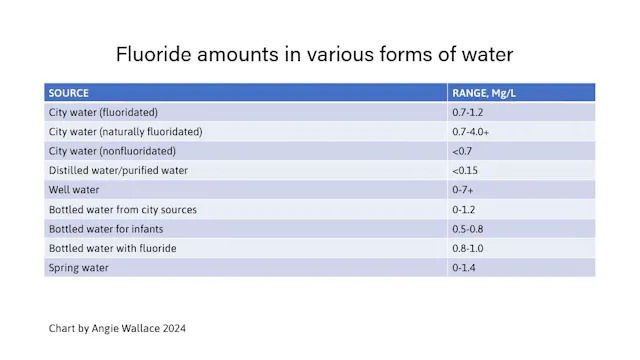
Here’s where it gets tricky. Spring water and well water are total wild cards. Fluoride is a naturally occurring element in the earth’s crust. If your local aquifer flows through rocks rich in fluorite, guess what you’re drinking? Exactly. Some wells in the American Southwest have naturally high fluoride levels that exceed the recommended limits. So “natural” doesn’t mean “fluoride-free.”
On the flip side, some spring waters—like those from volcanic regions with low-fluoride geology—can be naturally very low in fluoride. The catch? You never know unless you check the label. See what I mean? It’s a geological lottery, and the ticket price is your water bill.
The sneaky source: bottled waters
You’d think “bottled water” would be a safe bet. Not so fast. Many brands—especially the big ones like Dasani or Aquafina—are just purified tap water that may or may not go through fluoride removal. Some do, some don’t. Then you have brands like Fiji or Evian, which are natural artesian waters. And guess what? Fiji has naturally occurring fluoride—about 0.2 milligrams per liter. It’s not a lot, but it’s there. So if you’re hardcore avoiding fluoride, you’ve got to read those tiny labels like a detective.
 Fluoride in Tap Water: Does It Affect Hair Growth? - Hair GP
And please, please don’t fall for the “alkaline water” hype. Some alkaline waters are simply tap water with added minerals for pH. Spoiler: if they don’t specifically say they’re filtered through reverse osmosis or distillation, assume fluoride is still in the passenger seat.
So, what’s the TL;DR?
If your goal is zero fluoride, your best bets are: rainwater (collected cleanly), distilled water, or water processed through a verified reverse osmosis system with a fluoride-specific filter. For store-bought, look for labels that say “purified by distillation” or “deionized.” And if you’re a tap water person, check your city’s water quality report online—some towns don’t add fluoride, and you might already be winning without knowing it!
Oh, and Karen? She later admitted her “fluoride-free” tap actually had more natural fluoride than mine. But hey, the filter was pretty. And sometimes, that’s what really matters, right?
