How Much Does A Ro System Cost

So, you’ve heard about Reverse Osmosis (RO) systems. Maybe your tap water tastes a little funky, or you’re worried about that weird metallic smell. You’re probably wondering,...

So, you’ve heard about Reverse Osmosis (RO) systems. Maybe your tap water tastes a little funky, or you’re worried about that weird metallic smell. You’re probably wondering, “How much does an RO system cost, really?” Let’s dive in without the jargon—just pure, friendly info.
The Short Answer: It’s a Range, Not a Price Tag
Honestly, the cost is like buying a car. You can get a perfectly fine used hatchback, or a flashy SUV with heated seats. The price for an RO system swings from under $150 to over $1,000.
That’s a big spread, right? Don’t panic—we’ll break it down into simple pieces. The cool part is, you can find something for almost any budget.
Must Read
Budget-Friendly Options: The “Starter Kit”
If you’re just dipping your toes into clean water, look at countertop RO systems. These little guys cost between $100 and $250. They sit right on your counter, no plumbing required.
Think of them like a fancy water filter pitcher on steroids. They’re great for renters or people who don’t want to drill holes in their sink. Plus, you can take them with you when you move!
The catch? They produce water slower than bigger systems. But for the price, it’s a solid trade-off for crisp, clean water without a big commitment.
The Mid-Range Sweet Spot: Under-Sink Systems
Here’s where things get interesting. For about $200 to $500, you can get a classic under-sink RO system. You’ve seen these—the little tanks hidden under your kitchen cabinet.
This is the Goldilocks zone of RO costs. You get real, professional-grade filtration without emptying your wallet. Brands like APEC or iSpring rule this space.
Why it’s cool: These systems remove up to 99% of contaminants. Think lead, chlorine, fluoride—gone. Imagine a $400 investment that gives you bottled-water taste for years. That’s cheaper than buying cases of plastic bottles every month!
What About Installation?
Most mid-range systems are DIY-friendly. You can install one yourself with a drill and a few hours. If you hire a plumber, add $100 to $200 for labor.
 How Much Does a Reverse Osmosis System Cost? (2026)
But here’s a secret: Many kits come with all the fittings and a video guide. If you can change a tire, you can install an RO system. Seriously.
The Premium Side: Tankless & Smart Systems
Now we’re talking about the luxury cruisers of RO. These cost $600 to $1,200+. They don’t have a storage tank, so they produce water on demand—like a fancy coffee machine.
Why would you pay that much? Speed and space. Tankless systems make water faster and fit under a tiny sink. Some even have Wi-Fi apps that tell you when to change filters.
Fun comparison: It’s like upgrading from a basic bicycle to an electric scooter. Do you need it? No. But once you try it, you’ll wonder how you lived without it.
Don’t Forget the Long-Term Costs
Owning an RO system is like having a pet. You gotta feed it—with new filters. Replacement filters cost about $50 to $150 per year.
Think of it as a subscription for pure water. Most systems need a filter swap every 6 to 12 months. If you skip it, your water quality drops. But if you stay on top of it, your RO system can last 10 to 15 years.
So, a $300 system with $100 annual filters for 10 years totals about $1,300. That’s still way less than buying water bottles for a decade (which would be over $3,000, if you drink the daily recommended amount).
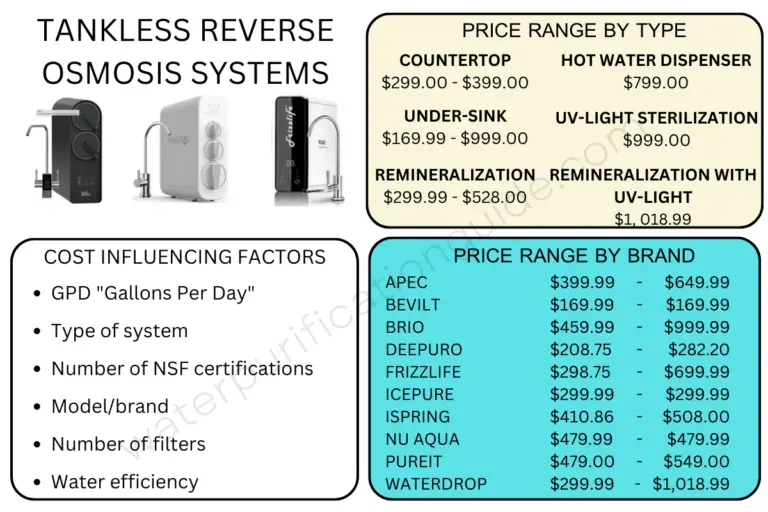 How Much Tankless Reverse Osmosis Systems Really Cost - Water
What About Installation Costs? A Quick Reality Check
If you’re not handy, professional installation might be another $150 to $300. For complex setups—like connecting to a fridge or adding a UV lamp—it could hit $500.
But here’s a rhetorical question: How much is your time worth? If you hate crawling under sinks, paying a pro is a no-brainer. If you love DIY, you save that cash for a nice dinner.
Fun fact: Some store-bought systems include free shipping and a pre-paid return label. So if you mess up, you can always send it back!
So, How Much Should You Pay?
Let’s be real. If your water tastes bad or you live in an area with hard water, don’t cheap out. A $200 to $400 system is the sweet spot for most families.
If you’re a “set it and forget it” type, the premium tankless models are worth it. They’re quieter, smaller, and frankly, cooler.
And if you’re on a strict budget? Grab a countertop unit for $120. It’s better than tap, and you can always upgrade later. The key is starting somewhere—your taste buds will thank you.
The Bottom Line (No Pressure, Though)
An RO system isn’t just a gadget—it’s a gateway to better hydration. Whether you spend $150 or $1,000, you’re making a smart choice for your health and your wallet.
So, take a deep breath. Look at your budget, measure your sink space, and pick a system that feels right. Your future self—sipping a glass of perfectly clean water—will be grateful you did.
