What Is A Build Over Agreement

So, you’ve got plans. Maybe a basement man-cave or a backyard extension to house that hot tub you definitely don’t need. Suddenly, someone mutters the phrase “Build Over Agree...

So, you’ve got plans. Maybe a basement man-cave or a backyard extension to house that hot tub you definitely don’t need. Suddenly, someone mutters the phrase “Build Over Agreement.” Sounds like a medieval tax, right? Wrong. It’s actually a secret handshake with the government—specifically, the water company.
The Real, Boring Definition (But Stick With Me)
A Build Over Agreement is permission from your local sewer authority to build over or near a public sewer. It’s like asking a grumpy neighbor if you can park your car on their lawn. Only here, the lawn is a massive pipe that carries everything you flush.
If you ignore this agreement, you might end up with a collapsed sewer line. That’s fun for no one. Especially not the guy who has to fish your lost wedding ring out of a sludge pit.
Must Read
Why Should You Even Care? (Quirky Alert)
Here’s the funny bit: 79% of people who build a conservatory have no idea a sewer runs beneath it. They think they’re just adding a sunny room. Instead, they’re building a toilet kingdom above a throne of doom.
One homeowner in London built a gym over a main drain. The sewer collapsed during a Zumba class. The class was literally shaking the earth. True story? Maybe. But it could happen.
You see, these agreements are not just paperwork. They are a shield against your toilet becoming a surprise indoor fountain.
The Weirdest Part: You’re Already Losing the Game
Here’s a fun fact: Every time you flush, you send a small earthquake through your pipes. Older sewers are made of clay. Clay pipes hate modern pressure. They crack like a dry cookie.
Build Over Agreements exist because water companies are paranoid. They’ve seen what happens when a driveway hides a busted pipe. The driveway sinks. Then your car does a slow-motion nosedive into a hole. It’s spectacularly bad luck.
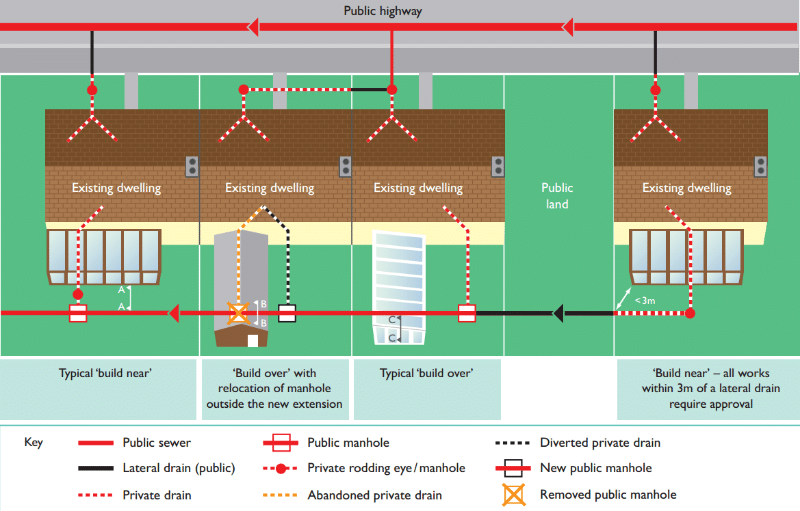 What Is A Thames Water Build Over Agreement?
So, the agreement says: “Sure, build your deck. But if the pipe breaks, you pay for the repair. And you have to move the whole deck.” Yes, the deck is the hostage here.
What Does the Agreement Actually Say? (It’s Like a Wavier for Your Driveway)
First, it forces you to use special, stronger materials. No cheap concrete. You need stuff that can handle a sewage explosion without flinching.
Second, it often demands an inspection hole—a little hatch in your floor so a person in yellow boots can look at the pipe. This hatch is called a “manhole.” But if you have a cat, it becomes a “how-did-he-get-down-there” trap.
Third, and this is the kicker: You cannot build anything permanent within 3 meters of a main sewer. No walls. No foundations. Your hot tub must sit on a removable wooden stage. It’s like a theatrical set for your weekend indulgence.
What Happens If You Just… Don’t Get One? (Chaos Mode)
Imagine you finish your new kitchen extension. It looks amazing. Then, a month later, the sewer under it explodes. Water company shows up. They see no agreement. They shrug and leave. Your insurance denies the claim because you were “building without permission.”
 News | AURA Architecture & Interiors
Now, every time you run the dishwasher, mud bubbles up from the floorboards. Your kitchen is now a swamp. And the smell? It’s a mix of regret and last week’s chili.
This is why the Build Over Agreement is actually a superhero cape disguised as a form. It forces you to plan the boring stuff so you can enjoy the fun stuff.
The Quirky Conclusion (You’ll Love This)
Most people think it’s a stupid rule made by a guy named “Boris from the Sewage Board.” But Boris has seen things. He knows that a simple garden wall can block access to a pipe that serves 200 houses.
Here’s a mind-bender: Ancient Roman sewers are still used in some cities. One in York, UK, runs directly under a nightclub. Every Saturday night, thousands of people dance on top of a 2,000-year-old toilet system. That’s a Build Over Agreement in action.
So, next time you see a “public sewer” manhole, give it a nod. It’s the unsung hero of your foundation. And if you’re planning to build anything, call the water company first. They love a good chat about pipes. And it saves you from dancing on a real-life sludge volcano.
Go forth and build. But build with a permit. Your future self—and your plumbing—will thank you.
