How Much Are The Water Rates

Ever find yourself staring at your water bill, feeling a mix of confusion and mild dread? You’re not alone. Water rates are one of those quiet mysteries of adulting, right up...

Ever find yourself staring at your water bill, feeling a mix of confusion and mild dread? You’re not alone. Water rates are one of those quiet mysteries of adulting, right up there with how 401(k)s work or why socks always disappear in the laundry.
But here’s the thing: water is actually a bargain. Think about it. You can fill an entire swimming pool for less than the cost of a fancy coffee. And yet, the price you pay depends on a bunch of weird, local factors—kind of like how rent varies wildly between a tiny studio in Manhattan and a mansion in rural Texas.
The Basic Math: What’s in a Drop?
Let’s break it down. In the U.S., the average household pays about $40 to $60 per month for water and sewer. That’s roughly the same as two streaming subscriptions. But here’s the kicker: sewer costs often make up half of that bill. Gross, right? Well, it’s the price of civilization—processing your toilet flushes and sink rinses costs real money.
Must Read
Water itself is cheap—like, pennies per gallon. Compare that to bottled water, which costs thousands of times more. You could literally fill a bathtub with tap water for a nickel, while a single bottle of Fiji would set you back two bucks. Makes you wonder why we ever buy the fancy stuff, huh?
Why Does Your Bill Fluctuate?
Here’s where it gets interesting. Water rates aren’t static; they change with supply, demand, and infrastructure. If your city had a drought last summer, rates might spike to encourage conservation. That’s not a conspiracy—it’s just economics playing hide-and-seek with your budget.
Ever heard of tiered pricing? It’s like a reverse loyalty card: the more you use, the more you pay per gallon. So, that massive lawn sprinkler session? It’s essentially the water company saying, “Whoa, buddy, maybe water the garden only on Tuesdays.” Smart, right?
The Fun Comparison Game
Let’s put water rates in perspective. A gallon of tap water costs about one cent. That’s cheaper than a single breath mint. Meanwhile, a gallon of gasoline is four bucks, and a gallon of milk? Around three-fifty. You’re literally drinking something that costs less than air (wait, air is free—okay, less than anything you buy at a store).
 Oahu Homeowners And Businesses May Soon See Higher Water Bills
But here’s a wild stat: Americans spend more on Netflix and Spotify combined than on their water bills. Think about that. For the price of a monthly playlist, you get unlimited hydration, showers, laundry, and even the ability to grow tomatoes in your backyard. That’s a pretty solid deal.
The Secret World of Sewer Charges
Now, let’s talk about the elephant in the room: sewer rates. They’re often tied to your water usage because the water you flush and drain has to go somewhere. And that “somewhere” is a massive, expensive treatment plant that’s mostly invisible under your city streets. It’s like paying for an invisible butler who cleans up after every messy party you throw.
Fun fact: sewer treatment can cost more than the water itself. So if your bill seems high, it’s not because you’re showering too long; it’s because someone has to filter your shampoo bubbles out of the local river. Next time you complain, thank a wastewater engineer.
How to Read Your Bill Like a Pro
Flip over that statement and look for the “rate per 1,000 gallons.” That’s your magic number. In most places, it’s between $5 and $15. If you use 5,000 gallons a month (typical for a family), you’re looking at $25 to $75 for water alone. Add sewer, taxes, and fees, and boom—you’re at $60.
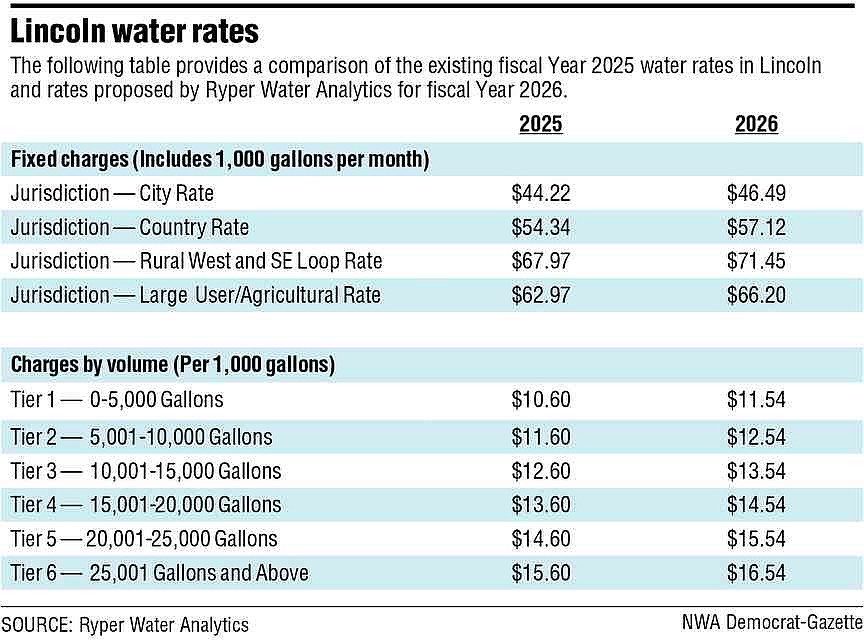 Study suggests Lincoln raise water rates in 2026 | Northwest Arkansas
But wait—there’s a twist. Some cities charge a base fee just for having a meter. It’s like a subscription fee for the privilege of turning on the faucet. Yes, it sounds a little greedy, but it pays for the pipes that run under your street, which are probably older than your parents.
The Big Picture: Why It’s Actually Cool
Here’s the cool part: water is a public good managed by your community. Unlike cell phone plans with their hidden fees and fine print, water rates are usually approved by your local city council in a public meeting. You can literally show up and ask, “Hey, why is my bill going up?” Try that with your electric company.
Water rates also tell a story about your region. Living in Florida? Your rates might be lower because of abundant rainfall. In Arizona? They’re higher because every drop is pumped from a river hundreds of miles away. Your water bill is basically a geography lesson disguised as a monthly expense.
The Final Splash
So next time you get that bill, don’t groan—get curious. You’re paying for vitally invisible infrastructure that keeps your city alive. And honestly, at a cost of less than a daily latte for an entire household’s water needs? That’s a steal. Plus, you can always save a few bucks by taking slightly shorter showers or fixing that dripping faucet. Easy, right?
Now go ahead—enjoy your glass of tap water. It’s literally the best deal in town.
