How Much Are My Water Rates

Let’s talk about water. Not the fancy bottled kind, but the stuff that magically appears when you turn a knob. The stuff you flush, shower in, and occasionally spill on your c...

Let’s talk about water. Not the fancy bottled kind, but the stuff that magically appears when you turn a knob. The stuff you flush, shower in, and occasionally spill on your cat. How much are you actually paying for this liquid miracle? Let’s dive in—pun intended.
Your bill is a secret code
Open that water bill. Look at it. It’s a tiny spreadsheet of confusion. You’ll see terms like “Ccf” and “tiered rates.” Don’t panic. A Ccf is just 748 gallons—roughly the size of a small whale. Your water company loves making you feel like a mathlete.
But here’s the kicker: you’re not just paying for water. You’re paying for infrastructure. Pipes, pumps, and the person who fixes leaks at 3 AM. Think of it as a subscription to civilization.
Must Read
Where does your money go?
Roughly two-thirds of your bill goes to “service charges.” That’s the fixed cost of keeping the water flowing. The rest? That’s your usage. If you water a lawn the size of a football field, expect a fat bill. But if you’re a minimalist who showers like a bird, you’ll pay less than a Netflix subscription.
Fun fact: The average American family spends about $1,000 a year on water. That’s less than your phone bill. Yet flushing a toilet feels free, doesn’t it?
The crazy math of faucets
Let’s get specific. A leaky faucet that drips once per second wastes 3,000 gallons a year. That’s 4,000 flushes down the drain. Your wallet leaks too—about $50 annually. Fix that drip. Your future self will cheer.
Showers are the real drama. A 10-minute shower uses about 20 gallons. If you sing for 20 minutes (like me), that’s 40 gallons. At $0.005 per gallon, that’s 20 cents per shower. Still cheaper than therapy.
Why does it feel like a mystery?
Water rates vary wildly. In a city like Seattle, you pay $0.01 per gallon. In San Francisco, it’s more like $0.03. Why? Geography, drought, and politics. Your local water supplier might be a municipal hero or a greedy monster. Check your city’s rate schedule—it’s a bizarre bedtime story.
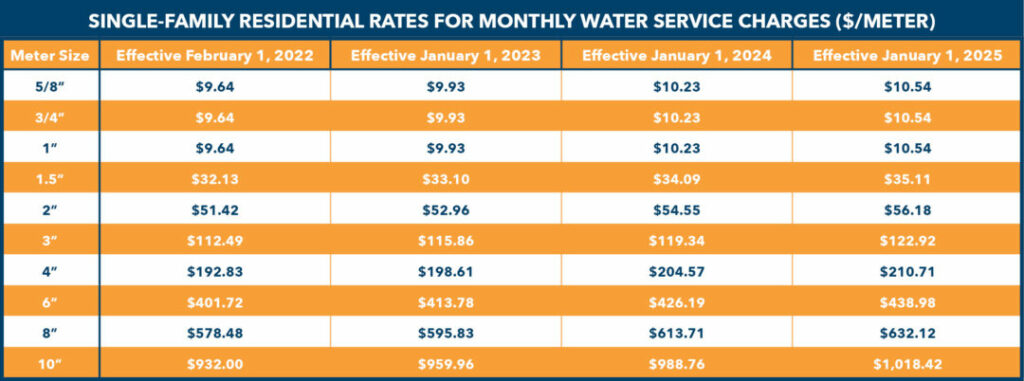 Water and Wastewater Rates - MNWD
Here’s a quirky truth: Your bill might include a “sewer charge.” That’s for treating your used water. Yes, you pay to flush it away. You’re funding a sewage party—and everyone’s invited.
The hidden heroes: meters and tiers
Most homes have a water meter. It spins like a hamster on caffeine. If it spins fast, you’re using more. Some cities use tiered pricing. Use less, pay less. Use more, and you enter the “water hog” tax bracket. It’s like progressive income tax, but for your sink.
Did you know that just 1% of Earth’s water is drinkable? Your bill reflects that scarcity. When you pay $50 a month, you’re buying access to 0.0000001% of the planet’s freshwater. That’s precious. And weirdly cheap.
How to crack the code
Want to lower your bill? First, check for leaks. A running toilet can waste 200 gallons a day. That’s $20 a month down the bowl. Second, time your showers. Be a water ninja. Third, water your plants at dawn—less evaporation.
One wild trick: Turn off the tap while brushing your teeth. Save 8 gallons a day. In a year, that’s 2,920 gallons. Enough to fill a small swimming pool. And all you did was stop drooling into the sink.
The fun part: weird water facts
Here’s a gem: The average toilet flush uses 1.6 gallons. But old toilets use 3.5 gallons. That’s like dumping a milk jug. Meanwhile, a 10-minute shower uses twice that. Pick your battles.
 City prepares for April 7 public hearing on increased water rates
And get this: Your water bill can tell you if you have a ghost. If usage spikes at 3 AM, you might have a leak—or a ghostly plumber. Spooky savings.
Why you should care (even if you’re broke)
Water rates are going up. Across the U.S., they rise 5% to 10% annually. That’s faster than rent. Why? Pipes are aging, droughts are real, and climate change is thirsty. Ignoring your bill is like ignoring a leaky boat—eventually, you swim.
But here’s the silver lining: Small changes matter. Fixing a leak saves 10,000 gallons a year. That’s $100 in your pocket. Plus, you become a water wizard.
The ultimate water rate secret
Most people never see their bill’s breakdown. Look for “water base charge” and “consumption charge.” The base keeps the system alive; the consumption pays for your splashes. If you use less, you save more—it’s that simple.
One more thing: Some towns offer “conservation rebates.” Install a low-flow toilet, get $50 back. Trade your sprinkler for a drip system, earn $100. Your water bill is a coupon book—if you read the fine print.
So, how much are your water rates? It’s not a number. It’s a story. A story of pipes, sacrifice, and the occasional drippy faucet drama. Next time you pay, smile. You’re funding the most underrated miracle on Earth. Now go fix that leak. Your wallet will thank you.
