What Is Ph In Bottled Water

Let’s be honest: you’ve probably stood in the bottled water aisle, staring at labels like some kind of confused scientist. You see words like “alkaline,” “pH balanced,” and “i...
Let’s be honest: you’ve probably stood in the bottled water aisle, staring at labels like some kind of confused scientist. You see words like “alkaline,” “pH balanced,” and “ionized,” and you just want to know if it will make your morning coffee taste less like regret. It’s basically a secret code for water nerds, and the rest of us are just thirsty.
Here’s the simple truth: pH just stands for “potential of hydrogen.” But don’t let the chemistry jargon scare you—it’s really just a scale from zero to fourteen that tells you how acidic or basic something is. If it weren’t for pH, your lemonade would be acting like a secret agent, and your stomach would be a volcano.
The Scale of Your Life
Imagine the pH scale as a party. At the very bottom (0–3) you’ve got battery acid and your car’s battery juice—they’re the aggressive, “I’ll burn a hole in your shirt” type. At the very top (11–14) you’ve got bleach and oven cleaner; they’re the type that will dissolve your problems, and also your skin.
Must Read
Right in the middle, at pH 7, sits pure water. That’s the boring friend who shows up on time, doesn’t make a mess, and just says, “I’m fine, really.” Most tap water hangs out between 6.5 and 8.5, which is the sweet spot where your taste buds stop complaining.
Your own body? It’s a control freak. Your blood likes to stay at a very strict 7.35 to 7.45—like a diva backstage who refuses to perform unless the lighting is perfect. But here’s the gag: your stomach is a pit of acid at pH 1.5 to 3.5, because it has to digest that leftover pizza you ate too fast.
Water pH: The Bottle Drama
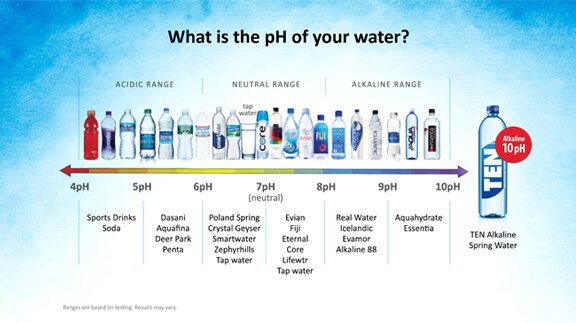
So why do bottled water companies make such a big deal about pH? Because marketing, my friend. They know that if they claim their water is “alkaline” (typically pH 8 or 9), people think they’re drinking the fountain of youth. The reality? Your body has its own pH regulation system called homeostasis, and it doesn’t care what your water bottle says.
I once bought a fancy alkaline water that cost three bucks, and it tasted almost exactly like the free stuff from the breakroom sink. The only difference was that my wallet felt about ten percent lighter. My tongue is not a pH meter—it’s a lazy judge who only cares if it’s cold and not slimy.
 Figure 1 from Is Your Drinking Water Acidic? A Comparison of the Varied
Fun fact: Some waters are acidic, like certain spring waters with a pH around 5 or 6. They taste a little zingy and can make your teeth feel like you licked a battery. But is it dangerous? Only if you’re a lab rat drinking it for three years straight. Your saliva will fix that pH faster than you can say “neutral.”
What Actually Matters to You?
Let’s be real: you’re not buying water for its hydrogen potential. You’re buying it because you’re standing at a gas station after a long drive, your mouth feels like sandpaper, and you just want something that’s not tap water from that rusty fountain. The best pH? The one that makes you go, “Ahhhh,” not “Ewwww.”
If you’re a taste snob, neutral waters (pH 7) are usually the most boring—in a good way. They don’t scream, they just whisper. Alkaline waters (pH 8–9) often feel a bit slick or “mouth-coating,” like you just drank a cloud. Acidic waters (pH 5–6) can be crisp and refreshing, like biting into a green apple that got wet.
Don’t even get me started on “ionized” water. That’s just water that’s been passed through an electric field. It’s like putting a sticker on your car that says “turbo.” It looks cool, but the car still drives the same. Unless you’re a plant or a battery, the ionization probably won’t change your life.
 Expensive Bottled Water Brands
The Takeaway (No Science Degree Required)
Here is the only thing you need to remember: Your bottled water’s pH is a fun fact, not a health crisis. Your body is a magnificent, sweaty machine that balances itself. You can drink slightly acidic spring water or trendy alkaline water, and you’ll be fine—unless you’re drinking it out of a firehose.
The real villain in your water bottle isn’t pH. It’s microplastics (tiny plastic bits from the bottle), or that weird aftertaste of plastic that makes you wonder if the factory was near a tire fire. If you want to worry about something, worry about that, not the decimal point on a label.
So next time you see a water bottle shouting “Alkaline pH 9.5!” just smile and nod like you’re at a boring party. Grab the cheapest one that doesn’t taste like a swimming pool. Your wallet will thank you, and your stomach—that acid pit of digestion—won’t even notice.
And if someone asks you about pH? Just tell them it’s the reason your lemonade feels sharp and your baking soda feels like a pillow. Then take a sip of your tap water, because it’s probably just fine—and it’s free.
Now go hydrate. Your body doesn’t care about the number, it just wants the wet stuff.
