How To Prevent Frozen Pipes

Don’t let Jack Frost turn your pipes into popsicles. Frozen pipes are a party foul on your winter vibe. They burst, they flood, they ruin your cozy floorboards. But here’s the...

Don’t let Jack Frost turn your pipes into popsicles. Frozen pipes are a party foul on your winter vibe. They burst, they flood, they ruin your cozy floorboards.
But here’s the fun part: you are smarter than water. Water is lazy, but it’s also a bit of a drama queen. When it freezes, it expands with the force of a tiny, cold Hulk.
Meet Your Home’s Coldest Enemies
Pipes hate drafts more than you hate wet socks. Air leaks are the villain here. A single crack in your foundation can drop pipe temperature by 10 degrees.
Must Read
Think of your pipes as whiny snakes. They just want to stay warm. If you don’t help them, they’ll throw a tantrum of icicles.
Step One: Wrap Them Like a Burrito
Foam pipe insulation is absurdly cheap—like, less than a fancy coffee. Wrap it around exposed pipes in basements, attics, and crawl spaces. It looks like a grey, squishy sweater for your plumbing.
Quirky fact: Romans used sheep’s wool to insulate pipes. You get foam. You’re winning.
Don’t forget outdoor hose bibs. Those spigots are suicide cords for your pipes. Disconnect the hose, drain it, and cover the faucet with an insulated dome. Yes, it looks like a tiny igloo for a tiny robot.
Step Two: Let That Faucet Drip
This sounds insane—wasting water? But hear me out. Moving water doesn’t freeze as easily. A slow, sad drip—like a leaky old man—creates pressure relief.
If water has nowhere to expand, it won’t burst your pipe. It just cries a little into the sink. One drip per second saves you a $5,000 repair bill.
Fun fact: In 2014, a frozen pipe in New York City flooded a basement full of vintage accordions. The accordions did not survive. Drip your faucet. Save the squeezeboxes.
Step Three: Open Cabinet Doors
Yes, it looks ridiculous. Your kitchen cabinets will stare at you with open mouths. But warm air from your home needs to hug those pipes under the sink.
 How Can I Tell If My Pipes Are Frozen | Detroit Chinatown
If your pipes live in a cabinet against an exterior wall, they live in a cold pocket. Open the doors. Let the heat in. Your pasta boxes might get chilly, but your pipes stay liquid.
Bonus: You’ll finally see that forgotten bag of lentils from 2019. Celebrate with a soup.
The Party Trick: Hot Water and Hair Dryers
If you wake up to a silent faucet (no water, no sound, just evil stillness), don’t panic. You’ve got a frozen pipe, not a dead one. Find the frozen spot—often near an exterior wall or a drafty window.
Never use a blowtorch. You are not a welder. You are a human with a hairdryer. Turn it on low heat and wave it gently over the pipe. It’s like a spa treatment for metal.
Start from the faucet side and work backward. The water might hiss, sputter, then gurgle back to life. That sound is sweeter than a cat purring.
What About That Weird Shed Pipes?
Yes, your garden shed has pipes. They are lonely and forgotten. If you don’t use them in winter, shut off the water at the main valve and drain them completely.
Funky fact: In Finland, people sometimes run a small electric cable along outdoor pipes to keep them warm. It’s called a “pipe sock.” It’s adorable and effective. You can buy one online for $20.
If you must use the shed in winter, keep the water trickling. A frozen garden hose looks like a giant, sad popsicle. Nobody wants that.
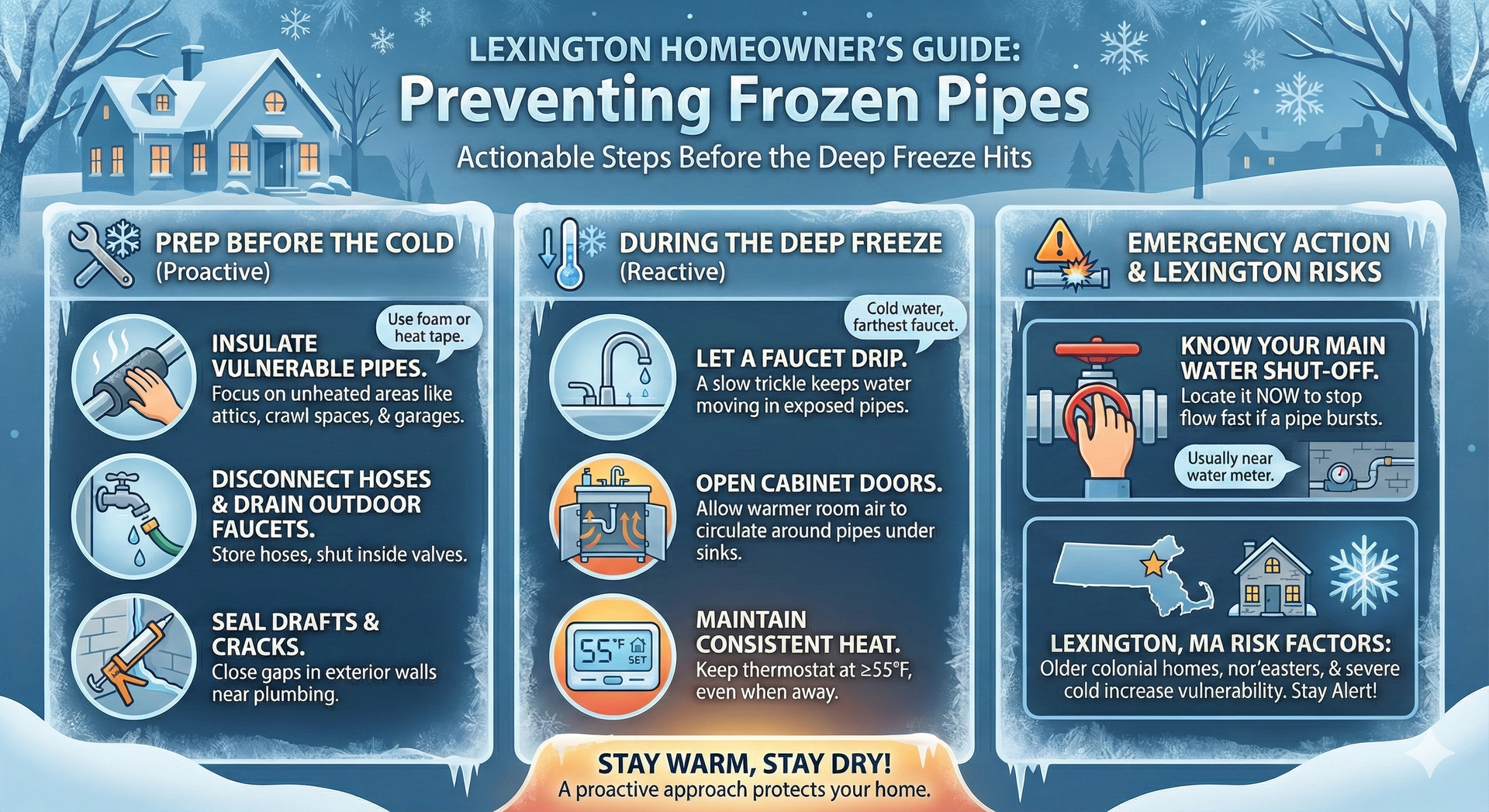 Preventing Frozen Pipes: What Every Lexington Homeowner Should Know
The Ultimate Cheat Code: Leave the Heat On
Yes, vacations are fun. But if you leave for a week in January, do not turn the thermostat below 55°F. That’s the magic number. Below that, your pipes start humming scary Christmas carols.
Set it to 60°F to be safe. Your heating bill will be slightly higher. Your repair bill will be nonexistent. Math is on your side.
Also, ask a neighbor to check on your pipes. Bribe them with cookies. Nobody ever froze a pipe while eating chocolate chip cookies.
When Mother Nature Laughs at Your Plans
Sometimes, extreme cold wins anyway. If the temperature drops below -20°F (like in Alberta or Siberia), even wrapped pipes can freeze. In that case, go full MacGyver.
Point a space heater toward the vulnerable area—but keep it three feet from anything flammable. Your pipe wants warmth, not a funeral. And never leave the heater unattended. You’re clever, not careless.
Fun fact: In 1983, a plumber in Minnesota saved a frozen pipe by wrapping it in an electric blanket. It worked. He became a local legend. You can too.
Why This Is Actually Super Fun
Think of pipe prevention as a winter game. You are a tycoon of temperature. A wizard of water flow. Every drip, every insulation wrap, is a tiny victory against the cold.
And the payoff? No flooded basement. No crying plumber. No angry insurance agent. Plus, you get to tell your friends, “I wrapped my pipes like a burrito,” and watch them nod in awe.
So go forth. Embrace the drip. Insulate that crawl space. And remember: cold water is just water that forgot its jacket. You are the jacket. Be the jacket.
