How Does Water Filter Work

So, you’ve decided to drink water that hasn't been living in a rusty pipe or sharing a bathtub with a radish. Good on you. But have you ever stared at a water filter and thoug...

So, you’ve decided to drink water that hasn't been living in a rusty pipe or sharing a bathtub with a radish. Good on you. But have you ever stared at a water filter and thought, “What kind of wizardry is happening inside this plastic behemoth?”
It’s not magic—though it sure feels like it when your tap water goes from tasting like a swimming pool to something a mountain spring would be proud of. The truth is, your filter is basically a bouncer, a librarian, and a scuba diver all rolled into one plastic tube.
Let’s start with the simplest bouncer: the physical strainer. Think of it as the velvet rope that keeps the big, dumb guys out. We’re talking sand, rust flakes, and that one mysterious black speck that always shows up on Monday mornings.
Must Read
This stage is pretty dumb. If a particle is too big to fit through a tiny mesh hole, it gets kicked to the curb. It’s not smart, but it’s effective—like a guard dog that only barks at mailmen.
The Charcoal Secret: A Carbon Party
Now we get to the active carbon part, which is the real MVP. This stuff is charcoal, but it’s been “activated,” which is a fancy way of saying it’s been treated with gas to make it super porous. Imagine a piece of charcoal with a million tiny caves inside.
Why does that matter? Because activated carbon is a chemical magnet. It grabs onto chlorine, pesticides, and that weird smell that makes your water taste like a band-aid. It’s basically the friend who adopts all the stray cats—but for molecules.
Here’s a wild fact: just one gram of activated carbon has a surface area the size of a football field. No, not a puny American one—a soccer field. Your filter has the surface area of several football fields crammed into a tiny cartridge. Take that, physics.
What About the Germs? (Hold Your Horses)
Now, don’t get too cocky. A basic carbon filter is great at removing bad tastes, but it’s terrible at killing bacteria. If you filled it with swamp water, you’d just get nicer-tasting swamp water. Which is… not an improvement.
That’s why fancier filters use reverse osmosis or UV light. Reverse osmosis is like forcing water through a sieve so small that only water molecules can pass. It’s aggressive. It pushes water through a membrane at high pressure, leaving behind lead, arsenic, and your ex’s emotional baggage.
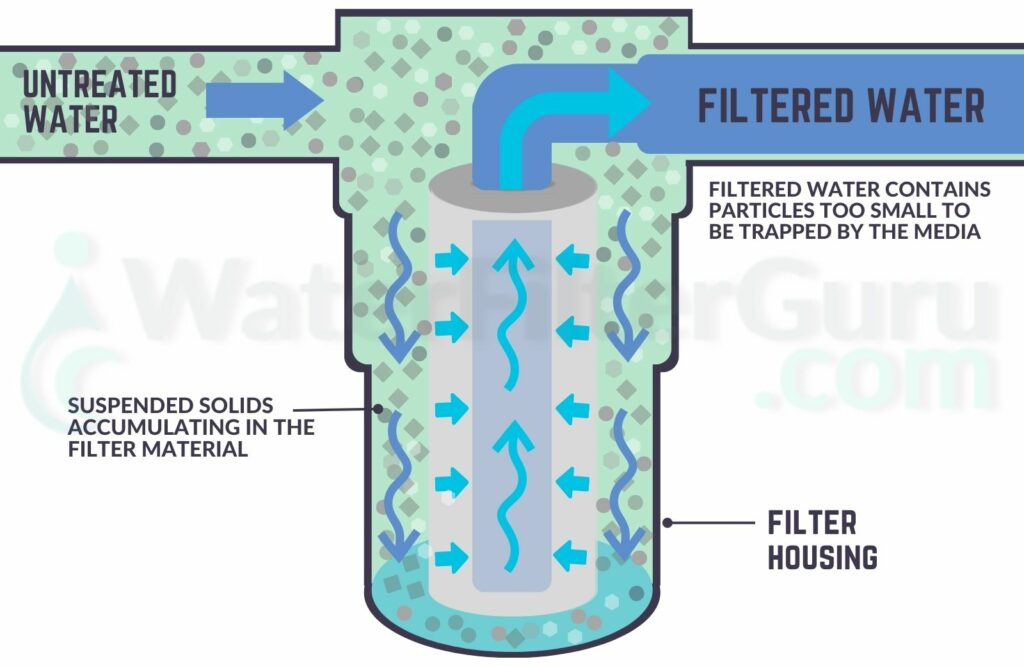 Water Filtration Process Explanation
UV light is even cooler. It’s a tiny lightbulb that zaps the DNA of any bacteria or viruses that try to sneak through. It’s like a tanning bed for microbes—except they get sunburned into oblivion. Brutal, but effective.
The Slow Squeeze: Ion Exchange
If you live in an area with “hard water”—which sounds like a fitness challenge but is actually just calcium and magnesium—you’ve met the ion exchange filter. This clever beast swaps those rock-like minerals for sodium or potassium.
Wait, does that mean your water gets salty? No. It gets slightly softer, like a pillow that’s been through a warm dryer. Funny enough, the process works because ions are basically desperate for a dance partner. Calcium ions grab the resin beads, and the beads say, “Hey, take this salt instead!”
It’s a weird chemical trade—like swapping a brick for a marshmallow. Your kettle will thank you. No more flaky white stuff that looks like dandruff from a ghost.
Pitcher vs. Fridge vs. Whole-House: The Battle Royale
So, which filter should you use? The pitcher filter is the lazy hero. It takes minutes to clean a cup of water. It’s slow, but it’s like the tortoise—steady, reliable, and you can drop it on your foot without crying.
Then you have the fridge filter. That’s the one hiding behind your freezer drawer. It uses carbon and maybe a little ion exchange, but it’s mostly there to make your ice cubes not taste like last year’s fish sticks. Don’t expect miracles.
 How Does Water Filtration Work?
Whole-house filters are the overachievers. They sit by your main water line and tackle everything. They’re the size of a mini-fridge and cost as much as a small car. But hey, if you want to wash your hair in zero chlorine, be my guest.
The Dirtiest Secret of All
Here’s the hilarious part: a water filter can get too clean. Some high-end filters strip out minerals like magnesium and calcium that are actually good for you. You end up drinking water so pure it’s basically a sad, lonely puddle.
That’s why some people add remineralization cartridges—to put the good stuff back in. It’s like taking a delicious meal, blending it into paste, and then trying to un-paste it with a fork. We live in strange times.
Also, let’s talk about maintenance. Not changing your filter is like having a net that slowly fills with dead fish. Eventually, the bad stuff just swims right through. If your filter smells like a wet sock, please replace it. I’m begging you.
The Final Sip
So, how does a water filter work? It’s part jail, part magnet, part ion swap meet, and part tiny nuclear reactor (for the UV types). It’s a genius contraption that lets you drink water that once fell as rain, ran through a sewer, and still tastes like a crisp morning.
Next time you take a sip, just remember: you’re drinking something that went through a labyrinth more complex than your last relationship. And it probably cost less. Cheers to that. Now go change your filter.
