How Does Ro Membrane Work

So, you’ve heard about RO membranes and thought, “Is that a new band, or maybe a fancy diet?” Relax—it’s neither! Reverse Osmosis (RO) is your water’s personal superhero, and...
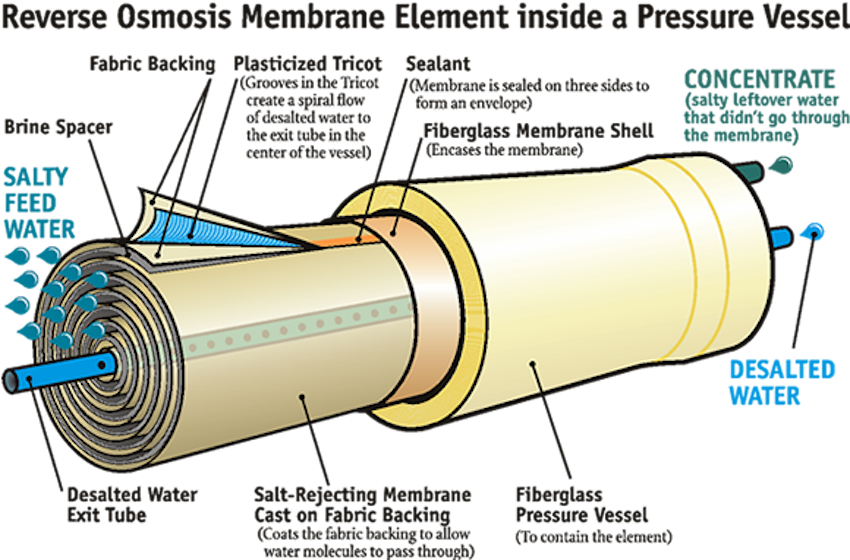
So, you’ve heard about RO membranes and thought, “Is that a new band, or maybe a fancy diet?” Relax—it’s neither! Reverse Osmosis (RO) is your water’s personal superhero, and we’re going to break it down without any chemistry textbooks or boring diagrams.
The Short Version: It’s a Super-Fine Filter
Imagine a colander for pasta. Put in spaghetti and water—the water falls through, the pasta stays. Now imagine a colander so incredibly tiny that only pure H₂O can squeeze through. That’s your RO membrane.
But here’s the twist: this colander is made of a super-thin plastic sheet rolled up like a giant sushi roll. And instead of gravity doing the work, we push water through with a pump. Cool, right?
Must Read
It’s like making your water audition to get into a nightclub, and only the VIP molecules—without any dirt, lead, or that weird tap-water taste—get past the bouncer.
How Does It Actually Work? (No, You Don’t Need a Degree)
Let’s talk about osmosis first. Osmosis is nature’s lazy way of balancing things. If you have salty water on one side of a special membrane and pure water on the other, the pure water naturally moves to the salty side to try and equalize things. It’s like your friend who always tries to balance the pizza slices at a party.
Now, reverse osmosis is the rebel. Instead of letting water go naturally, we say, “Nope, we’re going the other way!” We apply pressure—like giving the water a gentle shove—and force it against its nature through the membrane.
This pressure pushes only the tiny water molecules through, while leaving behind the bigger stuff: salt, bacteria, viruses, and even microscopic plastic particles. It’s like telling a crowd, “Only the water-sized t-shirt-wearing people can enter; everyone else stays outside.”
What’s Inside That Membrane? (A Quick Peek Under the Hood)
The membrane itself looks like a rolled-up piece of plastic wrap, but it’s way tougher. It’s made of a polyamide layer that’s thinner than a human hair—seriously, like one-millionth of a meter thin!
Water molecules are small enough to fit through the gaps in this layer, but most contaminants are not. It’s like trying to shove a beach ball through a screen door—just not happening, buddy.
 What is Reverse Osmosis & How Does It Work?
And here’s a fun fact: your standard RO system also has pre-filters (to catch sand and rust) and a post-filter (to polish the taste). The membrane is just the star of the show.
The Water’s Journey: Step by Step
First, tap water comes in and hits a sediment filter. This removes dirt and rust—the big, lazy particles. If you skipped this step, your membrane would get clogged faster than a teenager’s door during a pop quiz.
Next, an activated carbon filter grabs chlorine and other chemicals that make water taste like a swimming pool. Chlorine is tough on membranes, so this gives the RO a fighting chance.
Now the real magic: water is pushed at high pressure through the RO membrane. Only about 10-20% of the water makes it through as “permeate” (fancy word for clean water). The rest—the “brine” or “concentrate”—gets flushed away with all the yucky stuff.
Finally, the pure water gets a quick polish through another filter to fine-tune the taste. Then it sits in a storage tank, ready for your thirsty face. And yes, that water is cleaner than most bottled stuff.
But Wait—Is RO Water Too Pure? (The Myth-Buster Corner)
You might have heard that RO water “steals minerals from your body.” Let’s squash that rumor like a bug: RO water is not a thief. Your body gets minerals from food—broccoli, nuts, steak—not from the brief sip of water you take.
In fact, RO removes bad stuff like lead, arsenic, and nitrates that can hurt you. If you’re worried, you can add a mineral cartridge to your system, but it’s totally optional. Think of it like putting sprinkles on a perfect ice cream—nice but not needed.
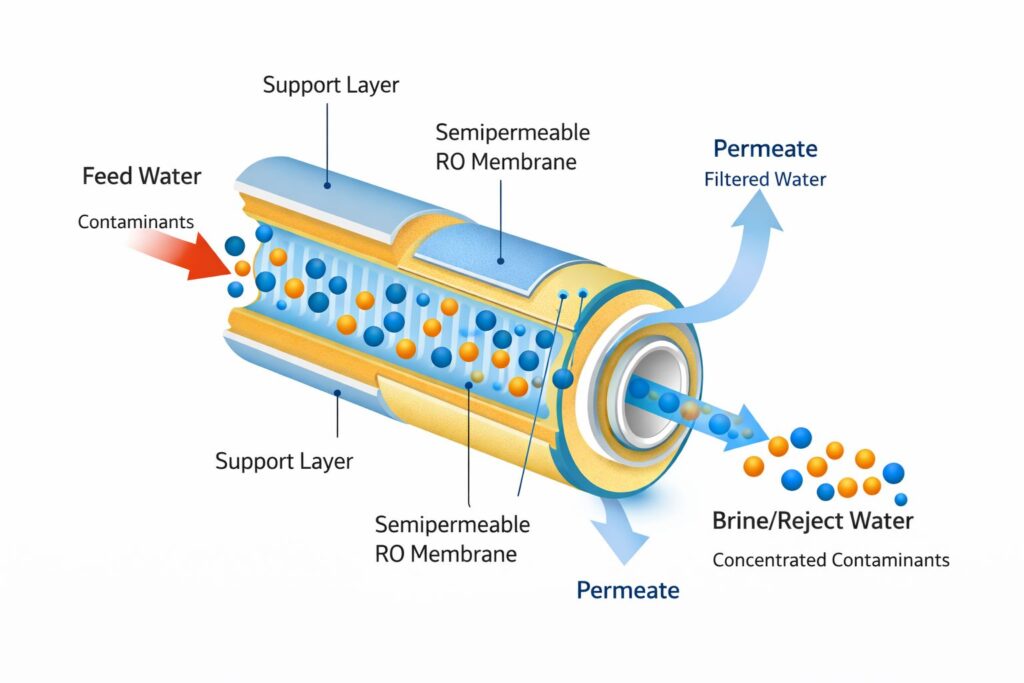 How Does a RO Membrane Work? | 4-Stage Process Explained
So, drink up! Your water is now a blank canvas, free of drama and contaminants.
Is It Worth It? (Spoiler: Yes, If You Hate Weird Tap Water)
An RO system is not a cheap date—you’ll spend $150 to $500 upfront, plus yearly filter changes. But it’s cheaper than buying bottled water for life, and it’s better for the planet (fewer plastic bottles!).
It also gives you peace of mind. No more worrying about that funny smell from the faucet, or wondering if your toddler’s sippy cup is full of mystery chemicals. You just get clean, crisp water that makes ice taste like clouds.
Plus, it’s oddly satisfying to see the dirty filters during a change. Like, “Wow, that was in my water? Gross. Glad it’s gone.”
The Uplifting Conclusion: You Now Have Superpowers
So, how does an RO membrane work? It’s simply a tiny, overachieving gatekeeper that uses pressure to let only the good stuff through. You learned it, you conquered it, and you can now impress your friends at dinner parties—though maybe save the “polyamide layer” trivia for the right moment.
Next time you take a sip from your glass, smile knowing that you’ve outsmarted nature (just a little bit). You’re not just drinking water—you’re drinking the result of a very polite, very tiny, high-pressure argument between H₂O molecules. And you won.
Cheers to clean water, clever science, and you—the brave soul who read this whole thing. Go hydrate like the champion you are!
