What Is Meant By Ph Level

Okay, let’s be honest: pH sounds like something a mad scientist would mutter while cackling over a bubbling beaker. But relax—it’s not just for lab coats and emergencies. You...

Okay, let’s be honest: pH sounds like something a mad scientist would mutter while cackling over a bubbling beaker. But relax—it’s not just for lab coats and emergencies. You encounter pH every single day, from the coffee you gulp down to the soap you use to wage war on your stink. It’s basically the universe’s way of measuring how angry or chill a liquid is.
The Acid Test (Not the One in Chemistry Class)
Picture a scale from 0 to 14. That’s the pH range, where 0 means “run for your life” (super acidic) and 14 means “slippery enough to dissolve your fingerprints” (super alkaline). Right in the middle, at 7, lives pure water—the Switzerland of substances, neutral and boring. The scale works backward from what you’d expect: a lower number means more acid, and a higher number means more base (alkaline). Yes, it’s confusing. Blame the chemists who thought logarithms were fun.
Here’s the kicker: pH is a logarithmic scale. That’s a fancy way of saying a jump from pH 7 to pH 6 means the liquid is ten times more acidic. A drop from pH 7 to pH 4? That’s 1,000 times more acidic. So a lemon (pH 2) isn’t just “a bit sour”—it’s basically a miniature acid volcano compared to water. Your stomach, by the way, clocks in around pH 1.5 to 3.5. That’s why it can dissolve a T-bone steak and still complain about a little heartburn.
Must Read
Your Body Is a pH Control Freak
Believe it or not, your body obsesses over keeping your blood pH at a very tight 7.35 to 7.45. That’s slightly alkaline, like baking soda’s cooler cousin. If it drifts even a tiny bit, you get into serious trouble—coma, organ failure, the works. Your lungs and kidneys are the bouncers of this nightclub, constantly kicking out excess acid or base. Next time you breathe fast after a sprint, thank your lungs for frantically blowing off carbon dioxide to keep your pH from turning into battery acid.
But here’s a surprising fact: the pH of your saliva is around 6.2 to 7.6, and your skin is slightly acidic (around pH 4.5 to 5.5). Why? Because your skin wants to murder bacteria before they throw a party on your face. That slight acid is your personal force field. Soap with a high pH can ruin that shield, leaving your skin drier than a stand-up comedian’s jokes. Choose your soap wisely, or your face will become a war zone.
 The pH scale measures the acidity or alkalinity of a substance. The
Everyday pH: The Weird and the Wacky
Let’s talk about your coffee. Black coffee typically has a pH around 5—mildly acidic. But a splash of milk? That stuff is near neutral (pH 6.5–6.7). Adding milk actually raises the pH, making the drink less acidic. So when your grandpa says milk “cuts the acid,” he’s actually scientifically correct. Congratulate him. He earned it.
Then there’s bleach. That terrifying liquid you keep under the sink? It’s a base with a pH of about 12 to 13. That’s why it can dissolve hair clogs and make your whites blindingly white. But also why you shouldn’t mix it with ammonia—unless you want to create chemical warfare in your laundry room. Seriously, that combo produces toxic chloramine gas. Your laundry is not a Breaking Bad episode. Stop it.
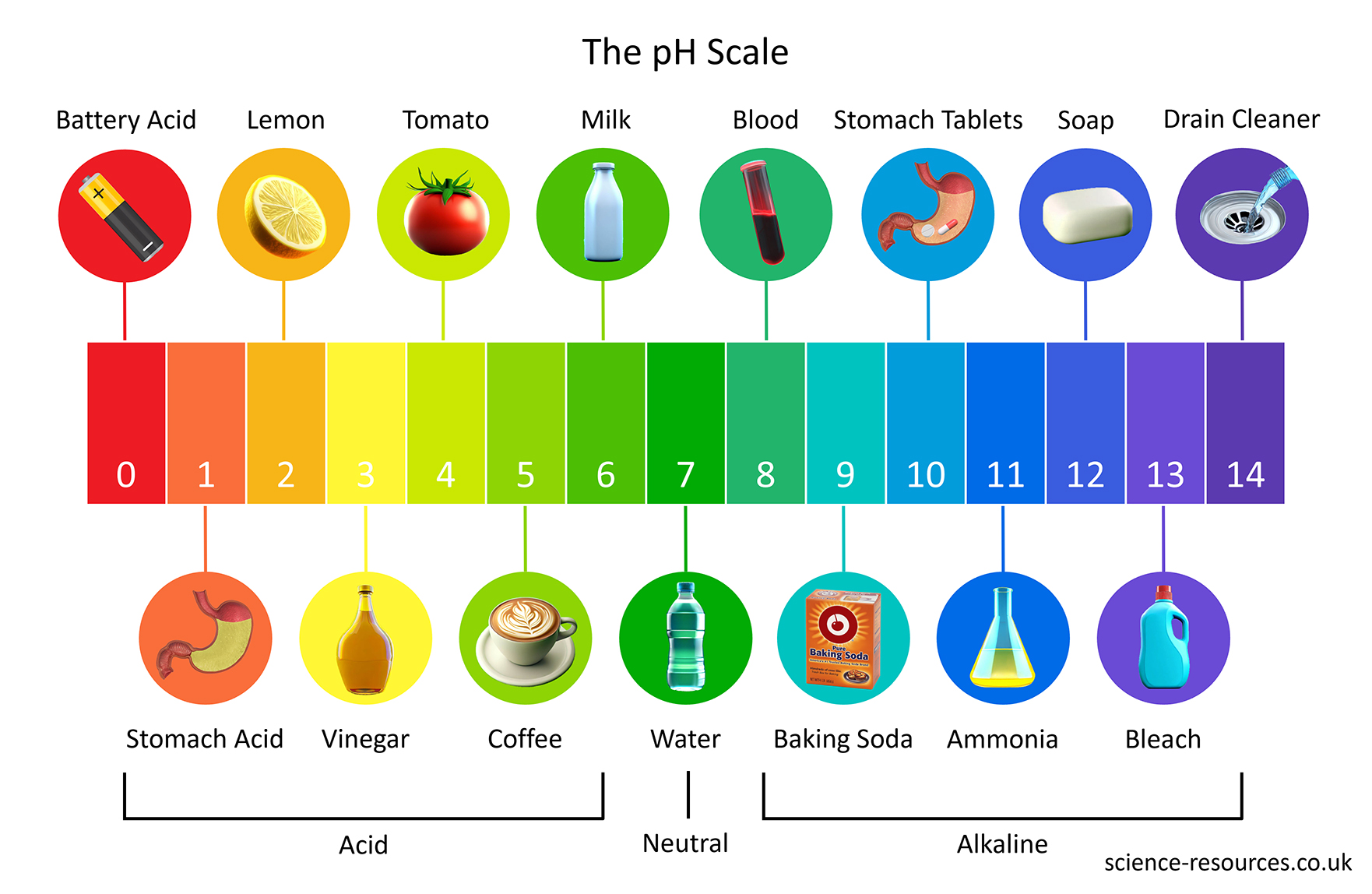 Ph Scale With Examples Neutral PH Range, Calculation & Examples Video
And pool water has to stay between pH 7.2 and 7.8. Too low, and the water eats your swimsuit and stings your eyes like a thousand tiny wasps. Too high, and the chlorine stops working, turning your pool into a green swamp of algae and disappointment. Pool owners are basically pH janitors with expensive toys.
The Final Scoop on pH
So next time you sip lemonade (pH 2–3), chew an antacid (pH 10ish), or clean your toilet with vinegar (pH 2.5), remember: you are playing with the same forces that dissolve rock and preserve pickles for decades. pH is nature’s way of saying, “Hey, this liquid is friendly… or it WILL eat your face off.”
And here’s the most absurd truth: human tears have a pH of about 7.0—perfectly neutral. So when you cry over a breakup or a badly burnt toast, you’re literally weeping neutral water. Congratulations, you’re a biological faucet. Now go enjoy a glass of water (pH 7) and marvel at how boring—and life-giving—being neutral can be.
