What Is The Test Of Water

Let’s talk about water. Not the boring stuff from your tap, but the wild, weird, alive liquid that makes up 60% of you. How do we even test it? You can’t just ask water how i...
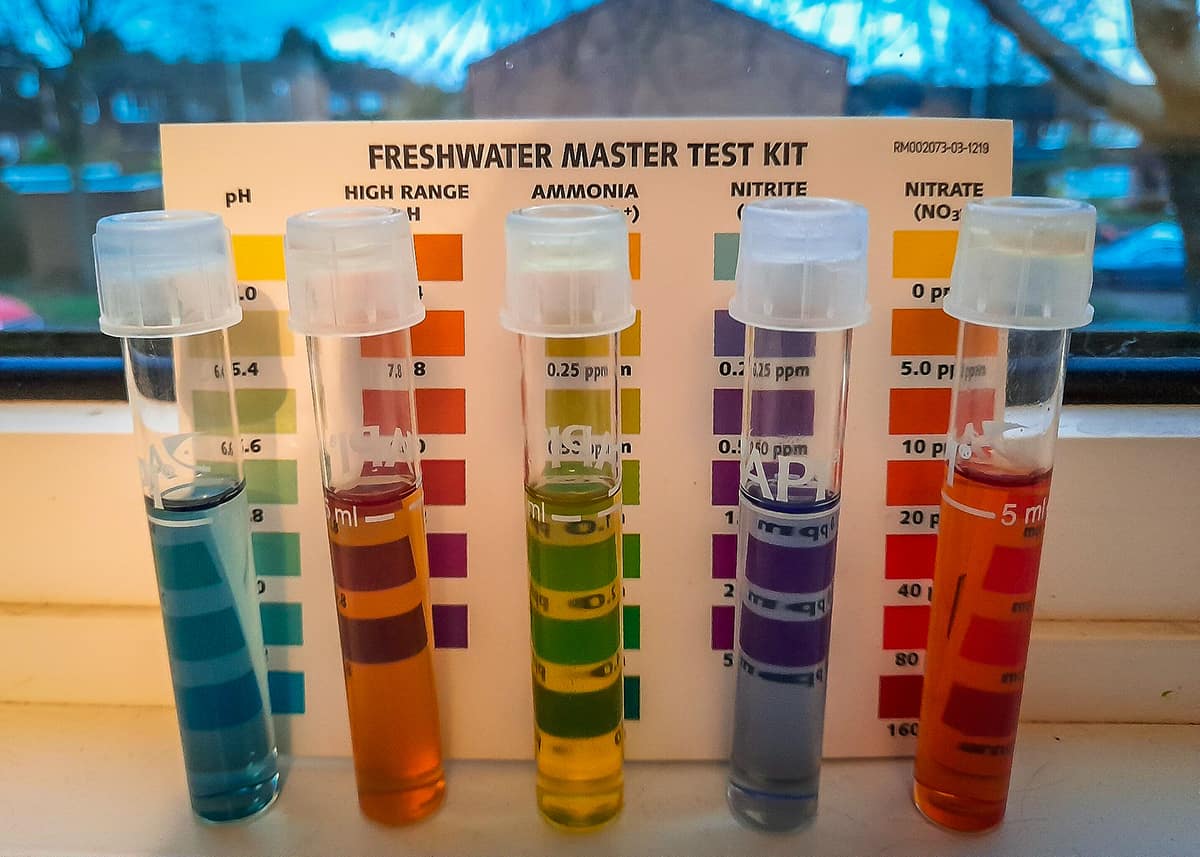
Let’s talk about water. Not the boring stuff from your tap, but the wild, weird, alive liquid that makes up 60% of you. How do we even test it?
You can’t just ask water how it’s feeling. It doesn’t talk. But it hides secrets like a grumpy teenager. Testing water is basically detective work for H2O.
The Really Basic Checklist
First, we check if it’s safe to drink. That means hunting for poop germs. Yes, really.
Must Read
Scientists look for E. coli and coliform bacteria. They’re like tiny, invisible party crashers that ruin your stomach.
If you find them, the water fails the gross-out test. No sipping allowed.
What’s Swimming in Your Glass?
We also test for pH. That’s how acidic or basic the water is. Pure water sits at a 7, which is neutral.
Imagine drinking battery acid (pH 1) or bleach (pH 13). That’s a bad day. Your tap water should be a boring, perfect 7.
Then there’s turbidity. That’s a fancy word for “how murky is it?”. Murky water is basically a mud milkshake.
The Quirky Side of Water Tests
Here’s a fun fact: Water can have a memory. No, not in a sci-fi way, but dissolved minerals leave traces. We test for those.
Calcium and magnesium make water hard. Hard water makes your soap turn into weird white scum. It’s like water with a bad attitude.
Soft water? That stuff is a silky liar. It feels smooth, but it’s full of sodium. Your plants might hate it.
The Smell Test You Can Do at Home
Your nose is a powerful water tester. Take a whiff. Does it smell like a swimming pool? That’s chlorine. Cities add it on purpose.
 How to Test Water Quality at Home: Your Complete Guide – World Water
Does it smell like rotten eggs? That’s sulfur. It means bacteria are partying in your pipes. Gross, but usually harmless.
Does it smell like nothing? Congratulations. You have boring, perfect water. That’s the goal.
Why We Test for Invisible Stuff
You can’t see lead, arsenic, or pesticides. They’re the silent ninjas of the water world. One sip won’t hurt, but a lifetime? Yikes.
Testing for heavy metals is like an x-ray for water. We use atomic absorption machines. They sound cool and they are cool.
Fun fact: A single drop of water can contain millions of microplastics. We’re just now learning to detect them. It’s like finding a needle in a haystack made of needles.
The TDS Mystery
Total Dissolved Solids (TDS) measures everything floating in your water. Salt, minerals, even tiny bits of dirt. It’s the “how much junk is in there” meter.
A low TDS (under 50) means almost pure H2O. A high TDS (over 500) means you’re drinking a mineral soup. Which is fine if you like crunchy water.
Some people obsess over TDS. They buy expensive machines to measure it. I think they just like watching numbers change.
How Scientists Actually Do It
It’s not just dip-and-taste. They use spectrophotometers. That’s a machine that shoots light through water and measures what gets absorbed.
If the water absorbs green light, it’s probably full of algae. If it absorbs blue, it’s full of sediment. It’s like a mood ring for the water.
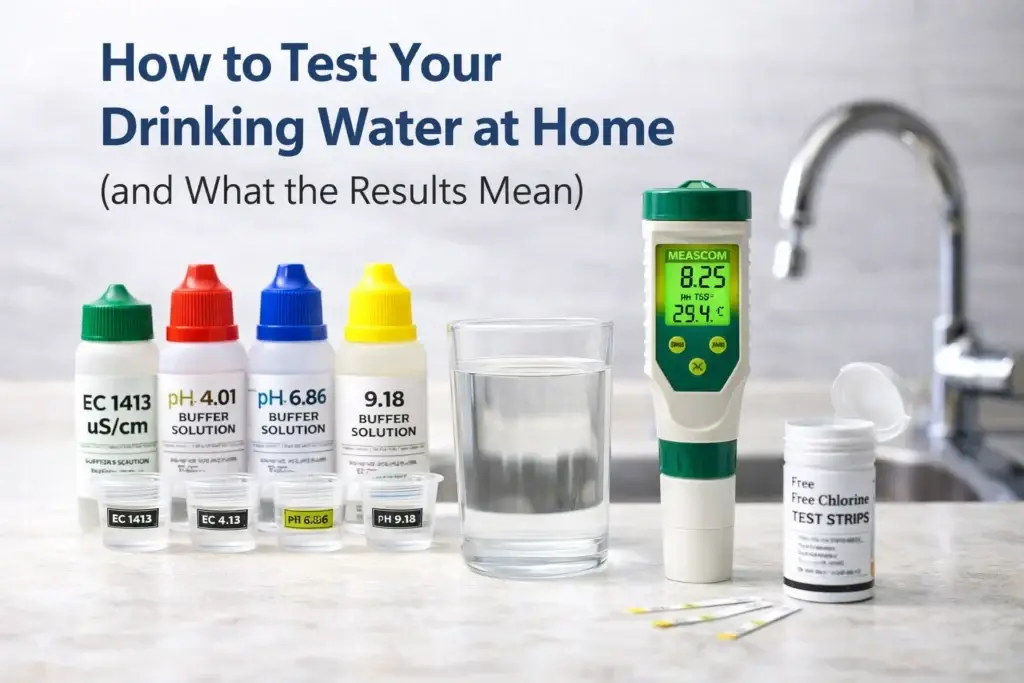 How to Test Drinking Water at Home (and What the Results Mean) - MEASCOM
They also use chromatography. That separates the water into its chemical parts. It’s like a divorce proceeding for molecules.
The Weirdest Test of All
Water can be tested for BPA—the stuff in plastics. You know, that chemical that makes scientists grimace. They find it in wild places, like mountain streams.
Why? Plastic rain. No joke. Tiny plastic fibers fall from the sky. It’s the 2020s, and our rain is fancy garbage.
Testing for BPA involves liquid chromatography-mass spectrometry. Say that five times fast. It’s like a CSI episode for your hydration.
Why You Should Care (Even If You Don’t Want To)
Your body is 60% water. If that water is full of crud, you are full of crud. Testing keeps you from becoming a walking science experiment.
And here’s the punchline: not all bottled water is better. Some is just fancy tap water that passed a test. Others? Literally from a municipal tap in New Jersey. True story.
The next time you splash your face, remember: that water passed a gauntlet of tests. It was touched, sniffed, zapped, and spun so you could live. Be nice to it.
Final Splash
Testing water isn’t boring science. It’s forensic hydrology. You’re interrogating a liquid about its past.
Did it fall as pure snow? Did it sneak through a lead pipe? Did it hang out with a dead fish? The test tells the truth.
So grab a glass. Look at it. It’s not just water. It’s a story. And now you know how to read it. Cheers to that.
