How To Switch Water Off

Let’s be honest: we don’t think about water. It’s that invisible, obedient friend who shows up every time we twist a handle or flush a toilet. But when a pipe bursts at 2 AM,...

Let’s be honest: we don’t think about water. It’s that invisible, obedient friend who shows up every time we twist a handle or flush a toilet. But when a pipe bursts at 2 AM, or your bathroom floor suddenly resembles a children’s splash pad, that friend becomes a very expensive enemy. Knowing how to switch water off isn’t just plumbing—it’s domestic survival skills 101.
The first secret is location, location, location. Your main shut-off valve is usually where the water enters your house, often near the foundation or in a basement. It looks like a round wheel or a simple lever on a copper or iron pipe. If you’re in a temperate climate, check your garage or near your water heater—that’s where it likes to hide.
Before you panic, know this: turning the valve clockwise (righty-tighty) closes it, and counter-clockwise opens it. But be gentle—old valves can be brittle. Pro tip: practice once a year. Turn it just a quarter turn and back again to keep the mechanism from seizing up. Your future flooded self will thank you.
Must Read
The Emergency Drill
Imagine this: you’re making pasta, the dog knocks over a vase, and suddenly water is gushing from under the sink. Your heart rate spikes. Stop. Take a breath. The goal is not to be a hero; the goal is to be a plumber for sixty seconds. Locate the small, angled valve under the sink—that’s the supply stop.
If it’s a lever handle, just turn it until it’s perpendicular to the pipe. If it’s a round knob, turn it clockwise until it stops. No tools needed—just your bare hands and a clear head. Fun fact: this is the same valve they use in every hotel room, so you’ve probably already done it in your sleep.
For toilet emergencies, that little hose behind the bowl? There’s a tiny knob there too. Twist it, and you’ve effectively declared a ceasefire with Niagara Falls. And if the water is spraying from a washing machine hose, pull the machine out and shut off the valves marked “H” and “C”—they’re usually bright red and blue, because plumbing companies love color-coding chaos.
When You Can’t Find the Valve
Sometimes the valve is buried behind a wall, under a crawl space, or—as in one Brooklyn apartment I visited—behind a bookshelf filled with philosophy books. If you cannot find it, search for the water meter. It’s a gray box, often outside by the street, with a metal lid. Lift that lid, and there’s your master switch.
In apartment buildings, you might have a main shut-off in the basement labeled with your unit number. If there’s no label, ask your building super—preferably before the midnight gusher. And here’s a cultural tidbit: in many European cities, the shut-off is inside the apartment by the front door. Why? Because they learned from centuries of canals and rain. We Americans hide ours in basements because we like games of hide-and-seek.
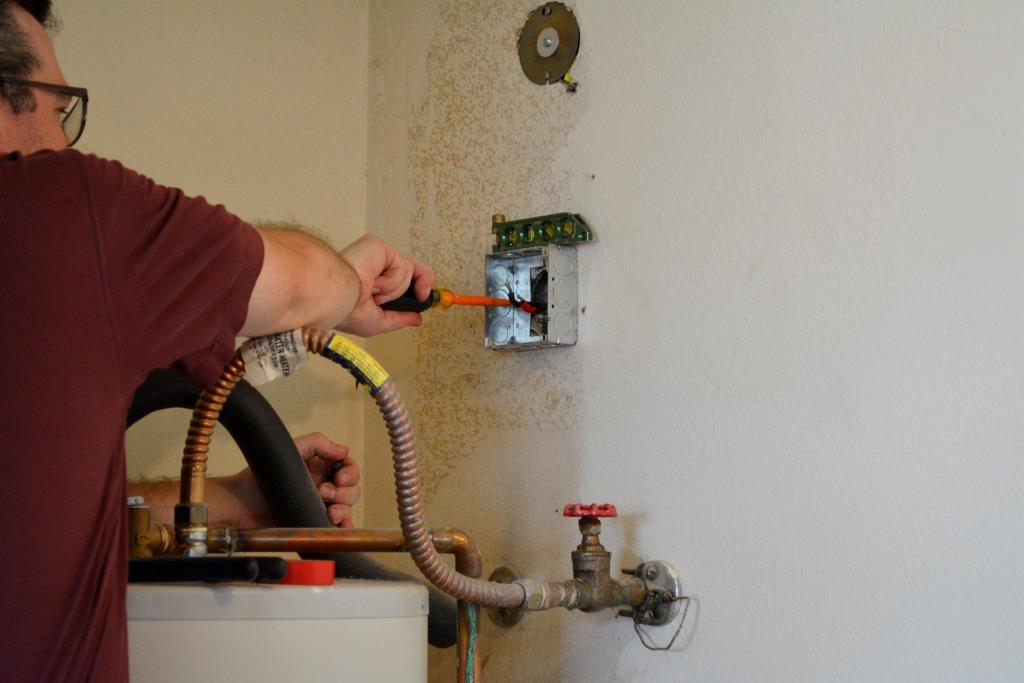 Electric Water Heater Shut Off Switch at Michael Schiller blog
Whatever you do, never use a wrench on a stuck valve unless you’re ready to replace it. Brute force is the enemy of modern plumbing. Instead, spray it with WD-40 and wait five minutes. Then try again with a gentle hand. This is not a test of strength—it’s a negotiation.
The Tools You Actually Need
You don’t need a full tool belt. Just two things: a flathead screwdriver (for those stubborn quarter-turn valves) and a pair of channel-lock pliers. That’s it. Oh, and a bucket—because even when you turn the water off, the pipe still needs to drain. Charming, I know.
Pro tip from a friend who survived a flood: keep a “water off” cheat sheet taped inside your kitchen cabinet. Include a photo of the valve location. When adrenaline hits, your brain forgets words like “basement” and remembers only “AHH!” A photo will save your carpet.
Also, let’s talk about the fun fact war: the average home loses 10,000 gallons of water a year from small leaks. That’s like filling a swimming pool with your money. Learning to shut off your water isn’t just about emergencies—it’s about saving cash and the planet at the same time.
When to Call a Pro
If your valve is rusted, stuck, or older than your parents, leave it alone. Call a plumber. You are not a medieval blacksmith. The cost of a service call is a fraction of a flooded basement. And if you live in an area with hard water, those mineral deposits will make the valve feel like concrete. Just know your limits.
 How to turn off your water heater - step by steps instructions - YouTube
Also, if the water is coming from outside the house—like a burst main under the street—you cannot fix that. Call the city water department. They have giant wrenches and a lot of insurance. You have a small screwdriver and a noble heart. Don’t confuse the two.
Finally, remember that modern homes often have a pressure regulator near the main valve. If you turn the main off and it still drips, don’t panic. That’s just residual pressure. Let it run into a bucket, take a deep breath, and celebrate that you just saved yourself from a disaster.
A Short Reflection
Learning to switch off water is really about learning to pause before the flood. In a world that constantly demands motion, speed, and flow, there’s a weirdly meditative power in knowing exactly where the stop button lives. It’s a small skill, but it keeps you dry—and sane.
So next time you’re brushing your teeth, glance at the sink valve. Smile at it. You’ve shared a secret now. And if you ever need to explain to a guest why you suddenly dove under the sink during dinner, just say you’re practicing your emergency drill. They’ll be impressed—or confused. Either way, you’re ready.
Stay dry, friends. And when in doubt, turn left until everything stops moving.
