Best Chemicals To Remove Chloramine Before Distillation

Let’s talk about chloramine. It’s the sneaky stuff your water utility adds to kill germs. Unlike chlorine, it refuses to just boil away. Distillation tries, but chloramine lov...

Let’s talk about chloramine. It’s the sneaky stuff your water utility adds to kill germs. Unlike chlorine, it refuses to just boil away. Distillation tries, but chloramine loves to hitch a ride in the vapor. That ruins your batch.
So you need chemicals. Not scary ones—smart ones. Think of them as your distillation wingmen. They break chloramine apart before it can crash your party. Ready to meet the lineup?
Why Chloramine is a Party Pooper
Chloramine is chlorine plus ammonia. It’s like a chemical celebrity couple—attached at the hip. Heat alone won’t split them up. Distillation just makes them vapor together, leaving you with funky-tasting water.
Must Read
That taste? Some say “swimming pool meets cat pee.” Not great for whiskey or coffee. You need to break the bond before the still gets involved.
Enter the chemicals. They’re cheap, easy, and weirdly satisfying to use. Let’s dive in.
Sodium Metabisulfite: The Speed Freak
This powder is fast. Drop it in water, and it reacts in seconds. It converts chloramine into harmless chloride and nitrogen gas. Poof—problem gone.
You only need four milligrams per gallon per part per million of chloramine. That’s a tiny pinch. Too much, and your water smells like burnt matches. Don’t be that person.
Fun fact: This chemical is also used to preserve wine and clean brewing equipment. So it’s basically a multitasking kitchen hero. Just don’t drink the powder—your still will do the heavy lifting.
 How to Remove Chlorine and Chloramine from Water | Atlas Scientific
Ascorbic Acid: The Vitamin C Ninja
Vitamin C? Yes—the same stuff in oranges kills chloramine. It neutralizes it without leaving a chemical taste. This is brilliant for whiskey or home distillers who hate added flavors.
Use about 1000 milligrams per 20 gallons of water. That’s roughly two tablets from a health food store. Drop them in, stir, wait five minutes. Then distill like a champ.
Quirky truth: Ascorbic acid doesn’t remove chloramine’s ammonia part. It leaves behind a tiny bit of ammonia gas. But for most home stills, that’s too small to matter. Unless you’re a perfectionist. Then read on.
Potassium Metabisulfite: The Campden Tablet
Homebrewers know this one. It’s a tiny white pill that annihilates chloramine and chlorine. One tablet treats 20 gallons. Crush it, stir, wait 20 minutes. Your water is now naked—no disinfectants attached.
It’s a favorite because it’s stable. Doesn’t fizz like sodium versions. You can store it in your pocket for years. Not that you should—but it’s possible.
Fun fact: Campden tablets are named after a town in England. They were first used to kill wild yeast in winemaking. Now they save your distillation from chemical gremlins. Who says history isn’t cool?
 5 ways to remove chlorine and chloramine from brewing water - YouTube
Sodium Thiosulfate: The Old Reliable
This is the veteran. Aquarium owners use it to dechlorinate fish water. It works exactly the same for chloramine—it neutralizes it instantly. You can buy it as a powder or liquid.
Use one drop per gallon for a 2 PPM chloramine level. Overdose, and your water might have a faint sulfur scent. Not the end of the world, but not ideal for fine spirits.
Quirky fact: Sodium thiosulfate is used in photography fixers. So while you’re saving your drink, you’re also using a chemical that once saved vacation memories. Talk about multitasking.
The Great Debate: Which One Wins?
For speed? Sodium metabisulfite. For purity? Ascorbic acid. For foolproof brewing? Campden tablets. For cheapness? Sodium thiosulfate. They all work—pick your vibe.
But here’s the kicker: None of these remove ammonia gas. If your water has high ammonia, you might need activated carbon filtration before the chemical step. That’s rare, but check your water report.
Pro tip: Test your treated water with a chloramine test strip. They’re cheap and prevent heartbreak. Don’t trust your nose—chloramine is a liar.
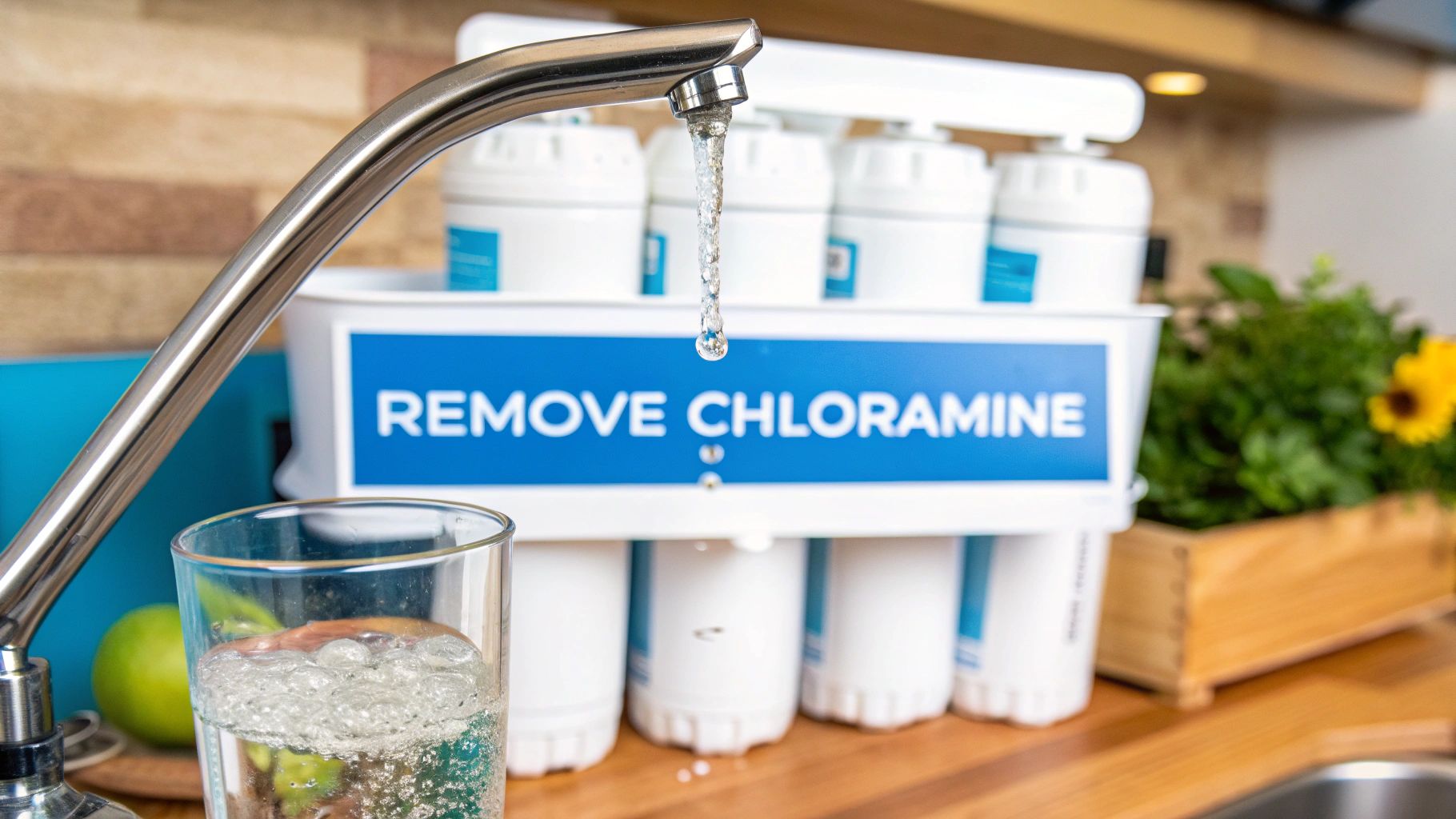 How to Remove Chloramine from Your Home Water
The Fun Part: Watching the Reaction
When you add metabisulfite to water, tiny bubbles appear. That’s nitrogen gas escaping. It’s like your water is burping with relief. Very satisfying.
Ascorbic acid fizzes a little too. Like Alka-Seltzer for your tap water. The kids will think you’re a wizard. You are a wizard—a distillation wizard.
Campden tablets just dissolve quietly. No drama. But that’s fine—chemicals don’t need to show off. They just need to work.
A Word on Safety (Don’t Be Dumb)
These chemicals are food-safe in tiny doses. But don’t snort the powder. Don’t mix them with bleach. And never use pool shock (calcium hypochlorite) as a substitute—that’s for pools, not your still.
Store these in a dry, dark place. They hate moisture like you hate bad water. A sealed jar in a cabinet works fine.
If you spill ascorbic acid, don’t panic—it’s just vitamin C. Your floor will be fine. Your cat might lick it. That’s fine too.
 Swift Green Filters on Tumblr
The Quirky Takeaway
Chloramine is a party crasher. But with these chemicals, you’re the bouncer. You decide what gets into the still. And what gets into your glass.
Weird fact: Some distillers use hydrogen peroxide instead of these chemicals. It works—but it’s aggressive and can leave oxygen in the water. Skip it unless you’re a mad scientist.
Want to go full nerd? Combine ascorbic acid with citric acid. It drops the pH, which speeds up chloramine breakdown. Now you’re cooking with chemistry.
Final Thought: Distillation is a Hobby of Patience
Don’t rush the water prep. That 20-minute chemical soak is crucial. It’s like letting your steak rest before cutting. Good things come to those who wait.
You now have the tools. Go make something delicious. And thank the chemicals—they did the dirty work so your taste buds could shine.
Cheers to clean water and bold spirits. You’ve earned it.
