Reverse Osmosis Membrane Pore Size Micron

Alright, pull up a chair, grab your overpriced latte, and let’s talk about something that sounds like it belongs in a sci-fi movie but actually lives in your kitchen: Reverse...
Alright, pull up a chair, grab your overpriced latte, and let’s talk about something that sounds like it belongs in a sci-fi movie but actually lives in your kitchen: Reverse Osmosis, or as I call it, the water’s final boss.
You’ve heard the term. Maybe you’ve even bought a fancy filter because someone told you it “removes everything.” But have you ever wondered what’s actually happening in there? It all boils down to a number so tiny, it makes your problems look gigantic: the pore size in microns.
What in the World is a Micron?
First, let’s get our heads around the unit of measurement. A micron is one-millionth of a meter. That’s not small—that’s absurdly small.
Must Read
For perspective, if a human hair were the size of a California redwood tree, a micron would be about the size of your ego after you nail a parking spot. Actually, it’s even smaller. A single grain of table salt is about 100 microns across. Cute, right?
Now, imagine something a hundred times smaller than that salt grain. That’s where reverse osmosis throws its party, and you are not invited unless you’re pure H2O.
The Secret Door: 0.0001 Microns
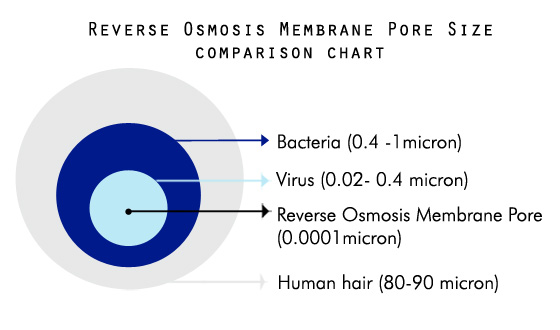
Here’s the jaw-dropper: the pores in a reverse osmosis membrane are roughly 0.0001 microns wide. Let me write that out in normal English: zero-point-zero-zero-zero-one microns. That’s like having a bouncer at a club who only lets in molecules that are basically invisible.
To wrap your brain around it: a human hair is about 70 microns thick. So the RO pore is seven hundred thousand times smaller than a single strand of your hair. If you tried to fit a hair through that pore, the hair would laugh and then disintegrate out of sheer embarrassment.
Most bacteria? They’re about 0.5 to 2 microns big. Viruses? Usually 0.02 to 0.4 microns. So yes, an RO membrane can literally block viruses. It’s like using a fishing net that catches individual atoms. Wild.
Wait, So It Kills Everything?
Not exactly, and here’s where the science gets sassy. The membrane doesn’t “kill” anything. It’s a physical filter. Think of it as a very rude doorman who says, “Sorry, you’re too big. Go away.”
Viruses, bacteria, lead, arsenic, even the fluoride your dentist loves—all of them get bounced because they’re bigger than 0.0001 microns. Even some dissolved salts get rejected because they’re too clunky to squeeze through.
But here’s the crazy part: if you were a water molecule (H2O), you’d be exactly the right size to slip through. You’re basically the VIP guest. Meanwhile, that chlorine molecule is stuck outside, crying into its tiny molecular beer.
 industrial reverse osmosis plant ~ Top 10 water purifiers in India
Why This Matters for Your Tap Water
So why should you care about a number you can’t even pronounce? Because regular filters—like the Brita in your fridge—use pores around 0.5 to 1 micron. That’s huge compared to RO!
That Brita catches sediment and some bad tastes, sure. But it lets dissolved minerals, heavy metals, and most bacteria waltz right through like they own the place. An RO membrane is the difference between a screen door and a bank vault. One keeps out flies; the other keeps out everything short of a water molecule.
Fun fact: the pressure needed to push water through these tiny pores is about 40 to 60 PSI. That’s like having a small car sitting on your countertop, forcing water through a microscopic maze. No wonder it takes a few minutes to fill a glass.
And Now, the Surprising Downside
You might think, “Great! I want water that’s basically sterile unicorn tears!” But hold your horses. Because RO removes everything, it also strips out beneficial minerals like calcium and magnesium. Your water becomes so pure, it’s almost aggressive. It will actively try to dissolve your pipes or steal minerals from your body.
Some people call this “dead water.” I call it “water that’s too pure to hang out with.” That’s why many RO systems add a remineralization filter afterward—to put back a tiny bit of the good stuff. It’s like going to the gym to get ripped, then eating a single Cheeto to feel human again.
The Takeaway (Don’t Spill Your Coffee)
So next time someone brags about their “high-end water filter,” you can casually drop the fact that a reverse osmosis membrane has pores of 0.0001 microns. Watch their eyes glaze over. That’s the sweet spot of being a science snob.
When you drink RO water, you are drinking the result of extreme prejudice. Only the most nimble, smallest molecules pass. Consider it the Harvard of water filtration—it rejects 95% of applications. And frankly, your water is better for it.
Now go forth, drink that suspiciously clean water, and remember: size matters. Especially when it’s 0.0001 microns. Cheers.
