Can You Use Distilled Water For A Fish Tank

So, you’ve got a fish tank, and you’re staring at that jug of distilled water in your kitchen. Maybe you’re wondering, “Can I just use this for my fish?” It’s a fair question,...
So, you’ve got a fish tank, and you’re staring at that jug of distilled water in your kitchen. Maybe you’re wondering, “Can I just use this for my fish?” It’s a fair question, and the answer is a little more interesting than a simple yes or no. Let’s dive in with a curious mind, shall we?
The Great “Nothing” in Distilled Water
Distilled water is basically pure H₂O—it’s been boiled into steam and condensed back into liquid, leaving everything else behind. That means no minerals, no chlorine, no impurities, and—here’s the kicker—no buffering capacity. Imagine it as a blank canvas, or a silent movie star: all potential, but zero personality.
Your fish, though, aren’t actors. They live in a world where tiny things like calcium, magnesium, and pH levels matter a lot. If you pour straight distilled water into a tank, it’s like handing your fish a glass of nothing. And fish? They need something to swim in, not nothing.
Must Read
But Wait—It Can Be Awesome
Here’s where it gets cool. Distilled water is fantastic for topping off your tank after evaporation. Why? Because when water evaporates, it leaves minerals behind, so adding more distilled water keeps mineral levels balanced. Think of it like adding a splash of pure water to your morning coffee when it gets too strong—you’re not ruining the brew, just fixing the balance.
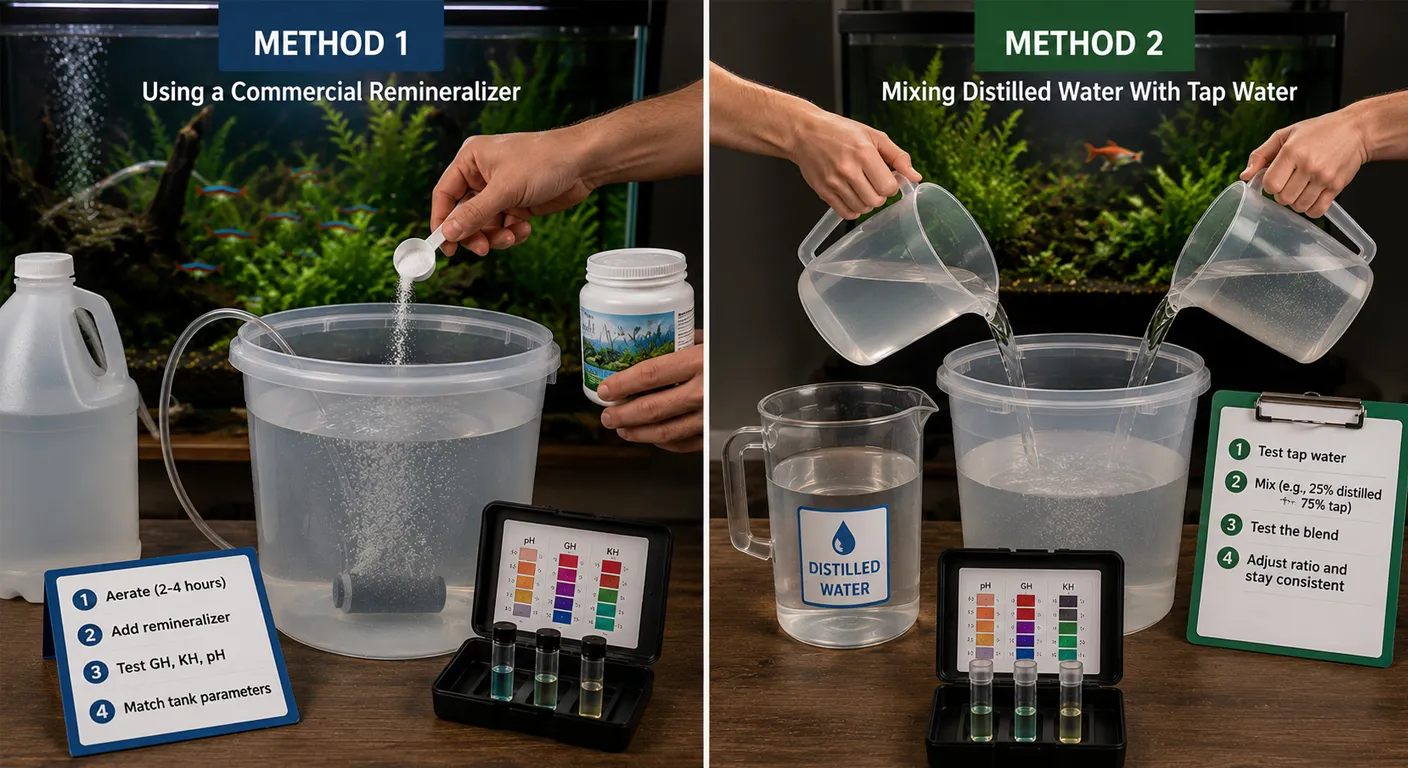
Some aquarists also use distilled water for specialized fish, like Discus or certain shrimp, that need super-soft, low-mineral water. You can remineralize it with a commercial product, turning that blank slate into a custom paradise. It’s like being a mad scientist, but for fish.
The Dangerous “No” for Most Tanks
For a standard community tank—think goldfish, guppies, or tetras—straight distilled water is a no-go. Without minerals, the pH can crash faster than a kid on a sugar rush. Fish need stable pH to breathe properly, and distilled water offers about as much stability as a Jenga tower in an earthquake.
Also, minerals like calcium are crucial for fish health—they help with osmoregulation (fancy word for “keeping water inside their bodies”). Without them, your fish might get stressed, sick, or worse. Imagine trying to live on a diet of only air—sounds cool, but you’d fade fast.
A Fun Comparison: The Smoothie versus The Seltzer
Think of tap water as a smoothie: it’s got a little bit of everything—minerals, chlorine, maybe some weird stuff. You can treat it (dechlorinate it) and it’s pretty good. Distilled water is like seltzer water without bubbles: technically water, but missing the fizz and flavor that most fish crave.
 Can You Use Distilled Water in a Fish Tank? (The Real Answer)
Bottled spring water? That’s like a craft soda—probably okay, but you don’t know what’s in it. Distilled water is the ultra-filtered, boring water you’d only drink if you were trying to be extra healthy. Fish aren’t health nuts; they’re just fish.
The Right Way to Experiment
If you are curious to try distilled water, do it safely. Never use 100% distilled water in a new tank. Mix it half-and-half with treated tap water, or use a remineralizing product. Test your pH and hardness every day for at least a week. Fish don’t love surprises.
Another trick: use distilled water for planted tanks. Many aquatic plants prefer soft water, and distilled gives you total control. It’s like being a plant DJ—you mix the perfect track of nutrients yourself. Just don’t forget the fish in the audience.
So, Can You?
Yes, you can use distilled water for a fish tank—but not by itself, unless you know what you’re doing. It’s a tool, not a miracle. For most of us, a good dechlorinator on tap water is the chill, reliable option. Distilled is the fancy guest you invite for special occasions, not every dinner.
So next time you see that jug of distilled water, give it a nod. It’s not the hero your fish tank needs, but it’s a pretty cool sidekick. And hey, curiosity is half the fun of keeping fish, right?
