Uv Water Treatment For Decentralized Systems

You know that feeling when you fill your reusable bottle from a tap in a remote cabin, and there’s a tiny pause before you drink? That hesitation is your gut whispering, “Is t...

You know that feeling when you fill your reusable bottle from a tap in a remote cabin, and there’s a tiny pause before you drink? That hesitation is your gut whispering, “Is this safe?” For the millions of us living off-grid, in tiny homes, or on houseboats, that moment of doubt is real. It’s also why ultraviolet water treatment has become the quiet hero of the decentralized living movement.
Why UV? The Science of Light, Not Chemicals
Forget the bitter taste of chlorine or the plastic waste of bottled water. UV treatment uses a simple, powerful bulb to zap pathogens. It scrambles the DNA of bacteria, viruses, and protozoa, making them harmless. Think of it as a micro-dance party where the music is ultraviolet light, and the uninvited guests instantly lose their groove.
This isn’t new tech—hospitals have used UV for decades. But now, compact, low-power units can fit under your sink or on a boat galley. And the best part? It adds nothing to your water. No weird taste, no chemical residue, just pure H2O.
Must Read
Pop Culture Check: Your Tap’s New Best Friend
Remember that scene in The Martian where Matt Damon uses his own… well, you know? UV is the less dramatic, more hygienic cousin of that survival instinct. In a world that feels increasingly like a disaster movie (hello, boil-water advisories), a UV system is your personal plot armor against waterborne villains.
It’s also dead simple. You don’t need a degree in engineering. If you can screw in a lightbulb and connect a hose, you can install a basic point-of-entry UV system. Most models even have a sensor that shuts off the flow if the bulb burns out—fail-safe thinking that feels very Silicon Valley.
Where It Shines: Decentralized Systems in the Wild
The real magic happens in places where municipal water isn’t a given. Imagine a solar-powered UV system on a tiny house in Tennessee, or a battery-operated unit on a sailboat crossing the Caribbean. These setups treat rainwater, well water, or even hauled water from a spring.
Here’s a practical tip: UV needs clear water. Think of it like sunglasses for your light beam. If your source is muddy, you’ll need a pre-filter—typically a 5-micron sediment filter. Pair that with a carbon filter for taste, and you’ve got a setup that costs pennies a day to run.
Fun fact: A single UV bulb lasts about 9,000 hours—roughly a year of continuous use. That’s cheaper than buying a six-pack of premium bottled water every week. Your wallet and the planet both say thank you.
Practical Hacks for the UV Curious
Start small. Don’t buy a whole-house system if you live in a van. Look for a residential-grade point-of-use unit (around $100–$200) with a flow rate of 1–2 gallons per minute. That’s enough for drinking, cooking, and morning coffee without waiting.
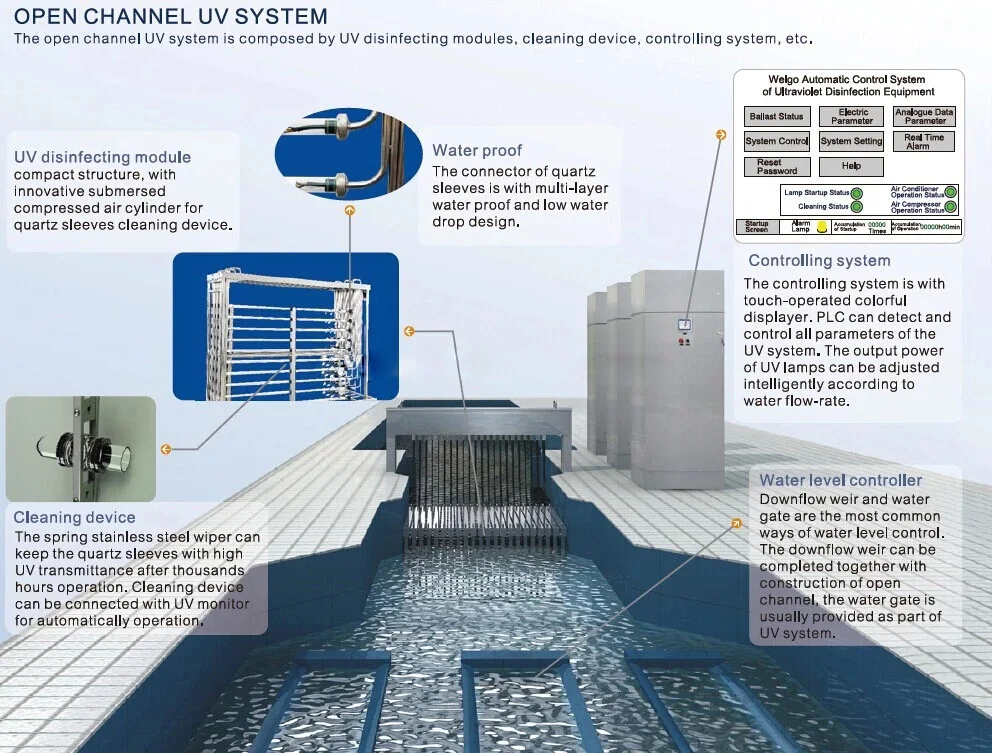 Larger Waste Water Treatment Plants Open Channel Uv Equipment 200000tpd
Pro tip: Always run the water for 30 seconds before drinking if the system has been idle for more than two hours. This clears any biofilm that might have formed in the pipes. It’s the water-filter equivalent of stretching before a run.
And if you’re worried about power? Most units draw about as much electricity as a laptop. A small solar panel and a deep-cycle battery can keep you running off-grid forever. Yes, forever.
The Cultural Catch-22: Trusting the Invisible
There’s a psychological barrier here. We’re conditioned to think clear water is safe water, but we can’t “see” UV working. Unlike a filter that traps visible particles, UV is a silent guardian. It’s the bodyguard you never see punch a virus.
To ease your mind, buy a unit with a digital display or LED indicator that shows “Sterilizing” or “Ready.” It’s the placebo effect, but it works. Pair it with a simple test kit for total coliform bacteria ($20 at any hardware store) for quarterly peace of mind.
Fun fact: UV doesn’t remove chemicals or heavy metals. If you have well water near a farm, add a reverse osmosis stage. But for 90% of microbial threats—the stuff that makes you hug the toilet—UV is the MVP.
Life in the Flow: A Short Reflection
Last month, I visited a friend’s off-grid cabin in the Catskills. We filled our glasses from a UV-treated tank, and I watched the tiny blue light pulse on the appliance. It felt less like technology and more like a tiny firefly watching over us. We talked about the weather, the lack of Wi-Fi, and how the hum of the UV lamp was oddly comforting.
In a world that’s often loud and complicated, clean water shouldn't be a luxury. UV treatment proves you don’t need a city’s infrastructure to drink safely—you just need a bulb, a bit of sun, and the guts to trust science over suspicion. So next time you take a sip from your off-grid tap, smile. You’re not just drinking water. You’re drinking quiet rebellion in a clear glass.
