Sodium Added By Water Softener Per Gpg Hardness

The Salty Truth About Your Soft Water Let’s be honest: nobody wants to shower in water that feels like you’re scrubbing off last week’s sunscreen with a rock. Hard water is th...

The Salty Truth About Your Soft Water
Let’s be honest: nobody wants to shower in water that feels like you’re scrubbing off last week’s sunscreen with a rock. Hard water is that stubborn guest who leaves a crusty film on your dishes and a grumpy look on your hair. Enter the water softener—the hero of our modern plumbing dramas.
But here’s the kicker: that hero is secretly adding sodium to your water. It’s like getting a free side of fries with your burger—except it’s not free, and you didn’t order it.
What’s a Grain of Hardness Anyway?
Hardness is measured in “grains per gallon” (GPG), which sounds like something a medieval baker would use. In reality, one GPG equals about 17.1 parts per million of calcium and magnesium. That’s the stuff that leaves white rings in your toilet bowl and makes your soap feel like sad, powdery chalk.
Must Read
Imagine your water is a party. Hardness grains are the overly talkative guests that cling to everything. The water softener exchanges those guests for sodium ions, turning your once-bubbly water into a slightly saltier version of itself.
The Sodium Math: Not Quite a Chemistry Exam
Here’s the simple breakdown: for every GPG of hardness, a standard water softener adds roughly 8 milligrams of sodium per liter of water. That’s about the same as a pinch of salt in a gallon jug—like seasoning popcorn, not like drinking seawater.
For context, if your water is hard at 10 GPG (common in many U.S. homes), each liter gets around 80 milligrams of sodium. That’s less than a slice of white bread (around 130 mg) and far less than a single dill pickle (over 800 mg). You’re not turning into a salt lick.
But Wait—A Funny Comparison
Think of your water softener as a well-meaning but slightly overzealous aunt. She means to make everything softer and more comfortable, but she just can’t resist adding a little extra salt to every glass you drink. You don’t taste it, but your kidneys nod politely.
If you drank two liters of softened water at 10 GPG all day, you’d get about 160 mg of sodium. That’s less than a single serving of canned soup (usually around 800 mg). So unless you’re chugging your tap like a marathon runner, relax.
Is This Bad for You?
For most healthy people, it’s a non-issue. Your body handles that tiny salt bump like a champ—it’s the bag of chips you eat afterward that’s the problem. But if your doctor has you on a strict low-sodium diet (like for heart or kidney issues), this matters.
A common hack: install a reverse osmosis system under your kitchen sink. That strips out the extra sodium from just your drinking water, leaving your skin and dishes still happy. It’s like having your soft cake and eating it without the guilt.
The Anecdote That Hits Home
I once visited a friend in Arizona. Their tap water was so hard it could’ve been used as concrete mix. After they got a softener, they bragged about their “silky” showers. But then they noticed a slight salty aftertaste in their morning coffee. They panicked, thinking they’d bought a defective unit.
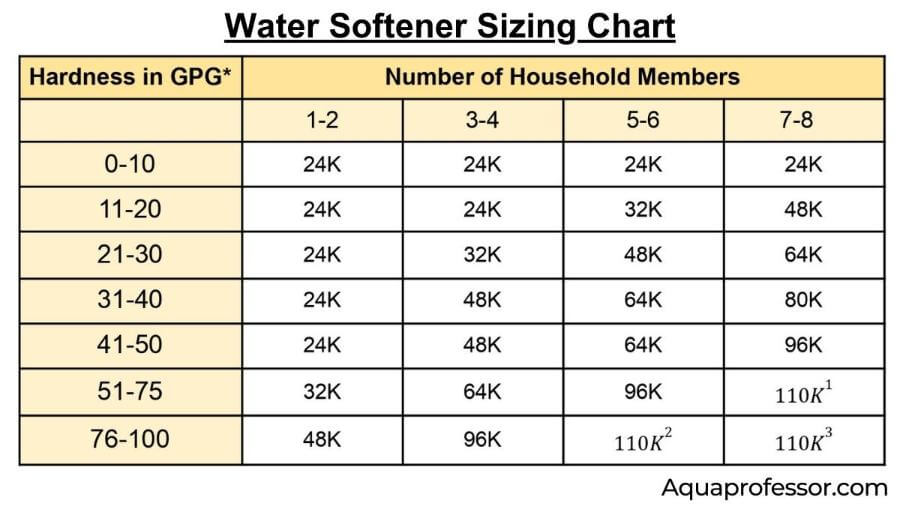 Water Softener Hardness Chart at Arnold Peete blog
Turns out, they just had 15 GPG hard water. That’s about 120 mg of sodium per liter—roughly the same as a small bag of pretzels. The coffee was fine; they just needed to stop comparing their tap to bottled spring water. We all laughed, then ordered a reverse osmosis filter. Problem solved.
So, How Much Sodium Per GPG Exactly?
Let’s nail down the official number: 8 milligrams of sodium per liter for every 1 GPG of hardness. Remember this when your neighbor starts ranting about “chemicals” in soft water.
Here’s a cheat sheet for common hardness levels:
- 5 GPG (slightly hard): ~40 mg/L, or the saltiness of a single cracker.
- 10 GPG (moderate): ~80 mg/L, like a bite of a pickle.
- 15 GPG (very hard): ~120 mg/L, close to a slice of deli ham.
- 20 GPG (glacial legacy): ~160 mg/L, the sodium equivalent of a handful of salted nuts.
See? You’re not turning into a human pretzel. Your water is just getting a mild seasoning.
What If You’re a Cooking Enthusiast?
If you boil pasta or make soup with softened water, you’re concentrating that sodium. Let’s say the pasta absorbs half the water—you just doubled the sodium per serving. But honestly, are you worried about 80 mg extra when you’re pouring marinara sauce (which has 300 mg per cup)? Probably not.
Still, if you’re baking bread, switch to unsoftened water for the yeast. Salty dough is fine for pretzels, not for sourdough. Your loaves will thank you.
Wrapping Up Without the Drama
Here’s the bottom line: water softeners add sodium per GPG hardness, but it’s a tiny amount. You’d have to drink gallons of softened water to match the sodium you willingly eat in a single fast-food meal. It’s like worrying about a single drop of rain when you’re holding a fire hose of salty snacks.
So go ahead—enjoy your soft towels, your spotless glasses, and your silky hair. Just maybe don’t water your tomato plants with softened water. They prefer the hard stuff anyway. And if you’re still worried, install a bypass for your kitchen sink. Your morning coffee will taste perfectly normal, and you can save the salt anxiety for something real, like trying to open a bag of chips without ripping it in half.
