Is Distilled Water And Deionized Water The Same

Ever found yourself staring at a bottle of water in the store, wondering if distilled and deionized are just fancy marketing terms for the same thing? You’re not alone—it’s a...
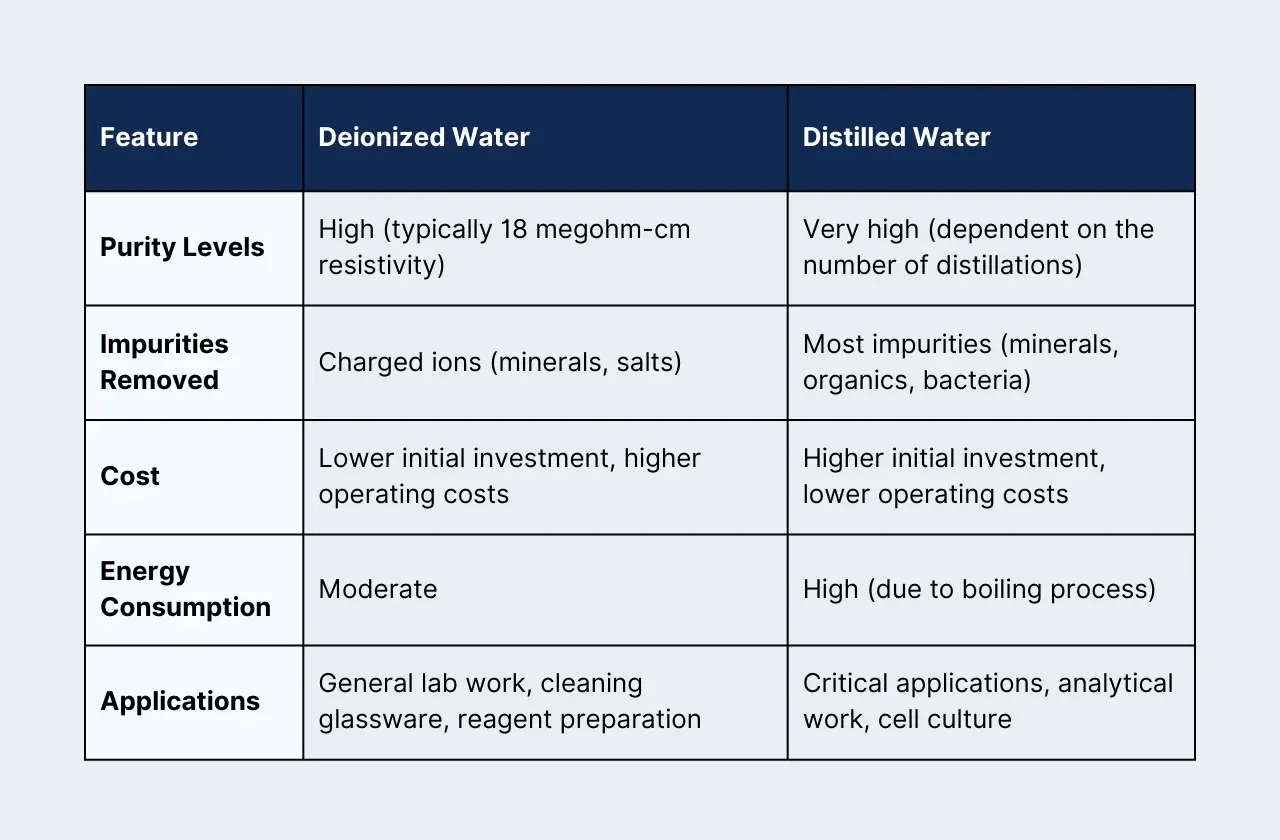
Ever found yourself staring at a bottle of water in the store, wondering if distilled and deionized are just fancy marketing terms for the same thing? You’re not alone—it’s a bit like trying to tell apart two identical-looking socks until you realize one has a tiny hole. In everyday life, it feels like they should be the same, but they’re actually cousins, not twins.
Let’s start with the biggest difference: how they get that pure. Distilled water is like steam that took a vacation—you boil the water, catch the vapor, and leave all the minerals and gunk behind. Deionized water, on the other hand, is like a magnetic bouncer at a club, pulling out charged particles (ions) from the water without boiling a thing.
Think of your kettle at home. When you boil water, the white crust that sticks to the bottom is mostly calcium and magnesium—the very stuff distilling removes. But deionization? That’s more like a water filter that uses special resins to grab those minerals by their electric tails, letting only neutral H₂O molecules through.
Must Read
Why Should You Even Care?
Maybe you’re thinking, “I just want my coffee to taste good—why does this matter?” Fair question! If you use distilled water in your coffee maker, you’ll get a clean brew with no scale buildup, but it might taste a little flat because all those trace minerals that give water personality are gone. Deionized water is even emptier—it’s almost too pure for your taste buds to handle.
Here’s a real-life story: My neighbor once poured distilled water into his iron for steaming shirts. He bragged for a week about no more white spots on his collars. Then he tried deionized water from a lab, and his iron started acting weird—the steam sizzled like it was angry. Turns out, deionized water is so pure it can strip metal ions from your iron over time. Who knew?
So, for most of us at home, distilled water is the safer bet for appliances like irons, humidifiers, and steam mops. It’s already clean enough to prevent mineral stains without damaging the machine. Deionized water is more for science labs, car batteries, or industrial cleaning where even a trace of mineral could wreck an experiment.
But Wait—Are They the Same for Drinking?
This is where things get personal. People ask me all the time, “Can I drink distilled water?” The short answer is yes, but you’d miss out on the calcium and magnesium that make tap water beneficial. Deionized water for drinking? Not recommended—it’s so aggressive at grabbing stuff that it might pull minerals right out of your body if you guzzle it daily. That actually happened to a friend who replaced all his drinking water with deionized water from a lab (don’t ask why—he’s a curious dude). He got an upset stomach because the water stripped electrolytes from his gut.
 Distilled Water Vs. Deionized Water — Microbe Online
Let’s use a fun comparison: distilled water is like a shy introvert—it keeps to itself. Deionized water is like an aggressive party host—it grabs every charged particle it can, including ones from your body. Neither is bad, but they have totally different social skills.
For everyday folks: if you buy a gallon of “purified water” at the store, it’s often reverse osmosis water, which is somewhere between distilled and deionized. Read the label! If it says “distilled,” you’re getting steam. If it says “deionized,” you’re getting low-ion water that might be overkill for your coffee.
A Little Story That Sums It Up
My mom once tried to water her orchid with deionized water because she heard “pure water” is best. After two months, the orchid looked like a sad spaghetti noodle. Turns out, orchids need trace minerals to bloom—they aren’t fancy lab equipment! When she switched to rainwater (which is naturally distilled, kind of), the plant perked up. The lesson? Context matters.
In your car’s battery, deionized water is perfect because it prevents corrosion. In your morning smoothie, tap water with a filter wins every time. And for your iron? Distilled water is the friendly choice. So no, they’re not the same—but they’re both awesome when you know what each is for.
Next time you see those two words on a bottle, just smile and think: one’s a steam-driven hermit, the other’s an ion-picking party animal. You’ve got this.
