Template Assisted Crystallization Water Softener

So, you’ve got hard water. You know the drill: filmy dishes, crusty showerheads, and soap that refuses to lather like it’s on strike. It’s like your water is secretly plotting...
So, you’ve got hard water. You know the drill: filmy dishes, crusty showerheads, and soap that refuses to lather like it’s on strike. It’s like your water is secretly plotting against your plumbing. But don’t worry, there’s a new sheriff in town, and it’s called a Template Assisted Crystallization (TAC) water softener.
Think of it as the magic trick your water has been waiting for. Instead of the old-school salt-based softeners that feel like you’re running a chemistry lab in your basement, TAC does something hilariously clever. It doesn’t remove the calcium and magnesium—it transforms them into harmless, microscopic crystals that just float away without causing trouble. It’s like turning bullies into tiny, polite dance partners.
What’s the Big Deal About Hard Water, Anyway?
Hard water is just water with too much calcium and magnesium—minerals that like to cling to everything. They form that white, scaly gunk on your faucets and make your laundry feel like sandpaper. Honestly, it’s like your water is a clingy ex that won’t stop leaving sticky notes everywhere.
Must Read
Traditional water softeners use salt to swap those minerals for sodium, which works but leaves you with salty wastewater and a monthly salt-purchasing habit. It’s a bit like fighting a wildfire with a garden hose—effective, but messy and wasteful. TAC, on the other hand, is the low-maintenance cool cousin who shows up with a solution and zero drama.
How TAC Actually Works (No Lab Coat Required)
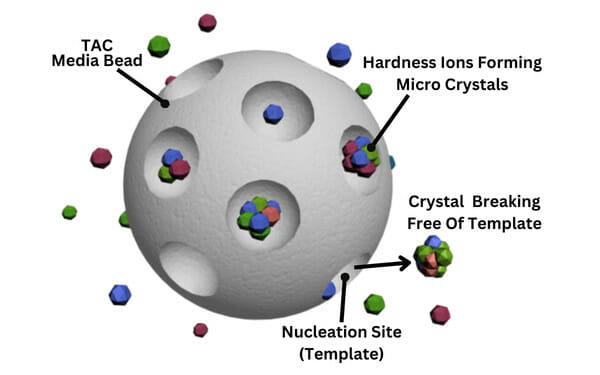
Picture this: your water flows through a tank filled with special resin beads or media. These beads aren’t magic, but they’re close. They have a template, a sort of microscopic mold, that grabs the calcium and magnesium ions and forces them to cluster together. In about a second, those ions crystallize into tiny, non-sticky particles.
These crystals are so small you can’t see them—like the dust motes that dance in a sunbeam. They just pass right through your pipes, appliances, and faucets, leaving no scale behind. It’s like the water is saying, “Oops, my bad, I’ll behave now.” And the best part? The system doesn’t need electricity, no salt refills, and almost zero maintenance. You basically install it and forget it—until your showerhead stops looking like a fossil.
Why TAC Beats the Socks Off Old Methods
Let’s talk about the elephant in the room: salt-based softeners. They work, sure, but they dump tons of sodium into your water and the environment. If you’re on a low-sodium diet or have a septic system, that’s a problem. TAC? It doesn’t add anything—just changes the shape of the minerals. Your water stays exactly as it was, minus the bad behavior.
Also, TAC systems are incredibly compact. You can slip one under your sink or in a closet without clearing out a whole garage. They’re like the Marie Kondo of water treatment: they spark joy by taking up minimal space. And because there’s no brine tank, you’ll never have to heave a 40-pound bag of salt up the stairs again. Your lower back will thank you.
Oh, and the cost? TAC systems are usually cheaper upfront than salt-based ones, and you’ll save a bundle on salt and electricity over time. Your wallet will feel like it went to a spa.
A Few Quirks You Should Know (Because Life Isn’t Perfect)
Now, TAC isn’t a superhero for every situation. It works best when your water isn’t insanely hard—like, if your water is off the charts, a traditional softener might still be better. Think of TAC as a personal trainer for moderately stubborn water, not a Hulk-level intervention.
 SpringWell Water Softener: Don't Buy Before Reading
Also, TAC doesn’t remove iron or other heavy metals, so if your water looks like rusty tea, you might need a separate filter. But for typical hard water problems—scale, spots, weak soap—it’s a delightful workhorse that just keeps going.
Installation: Easier Than Assembling IKEA Furniture (Seriously)
Most TAC systems hook up like any water filter—simple plumbing connections and you’re done. You don’t need a degree in engineering, just a couple of wrenches and maybe an afternoon. If you can change a tire, you can install a TAC unit.
Once it’s in, you’ll almost immediately notice the difference. Your glasses will sparkle, your skin will feel silkier, and your coffee maker will stop looking like it’s hosting a science experiment. It’s the little wins that make you fist-pump in your kitchen.
Is TAC Right for You? A Simple Decision Tree
If you hate buying salt, or you want to be greener, or you just want softer water without the fuss, say yes to TAC. It’s also perfect for renters or anyone who doesn’t own their home, because it’s easy to remove and take with you. You can literally pack your water softener when you move—try doing that with a salt tank.
But if your water is off-the-charts hard (like, you could carve it with a knife), you might need a traditional softener or a combo system. Check your water hardness first—a simple test kit costs ten bucks and saves headaches.
One Last Thing: The “Limescale Monster” is Defeated
Here’s my favorite part: TAC is so low-maintenance that you basically forget you have it. No monthly salt runs, no backwashing cycles, no fiddling with settings. It’s like having a pet that never needs feeding, walking, or vet visits. The only thing you’ll notice is the absence of scale—and that, my friend, is pure joy.
So go ahead, give your water a makeover. Your pipes will stop groaning, your dishes will stop crying, and your coffee maker will retire from its second career as a science exhibit. You’ll have cleaner, softer water with zero guilt and a big smile.
And isn’t that the kind of magic we all need? A little technology, a little wisdom, and a whole lot of crystal-clear happiness. Now go pour yourself a glass of water—the good kind—and toast to a future without scale. Cheers!
