Water Softener And Filtration System Installation

So, you’ve decided to wrestle with your home’s plumbing. Congratulations! You’re about to join the noble ranks of people who have stared into a water softener and filtration s...
So, you’ve decided to wrestle with your home’s plumbing. Congratulations! You’re about to join the noble ranks of people who have stared into a water softener and filtration system installation and said, “Yeah, I got this.”
Let’s be honest: your water is probably trying to kill your appliances. Hard water is basically liquid chalk that quietly murders your washing machine, coffee maker, and sense of happiness.
But don’t panic. This isn’t rocket science—it’s just plumbing with a PhD in annoyance.
Must Read
The Villain: Hard Water
First, a terrifying fact: hard water contains calcium and magnesium ions that clump together like bad high school friends. They leave scale on your pipes, make your soap turn into sad little scum balls, and turn your hair into something resembling a straw broom.
One study found that 85% of U.S. homes have hard water. That’s basically everyone except maybe those lucky folks living in a cloud.
You need a water softener. Think of it as bouncer that kicks out the calcium and magnesium before they start a riot in your plumbing.
The Hero: The Installation Epic
Here’s the funny part: installation sounds like a calm, Sunday afternoon task. It is not. It’s a three-act play with you as the sweaty protagonist.
Act One: You find where your main water line enters the house. Spoiler: it’s usually in a dark, cramped corner behind a box of Christmas decorations you forgot existed.
Act Two: You cut the pipe. Do not use a chainsaw. Use a simple pipe cutter. And brace yourself—water will shoot out like a confused fire hydrant. Surprising fact: a typical water line carries 40 to 80 psi of pressure. That’s enough to spray your face, the cat, and your neighbor’s car through the window.
The Bypass Valve: Your Best Friend
Before you cut, install a bypass valve. This little plastic hero lets you turn off the water to just the softener. If you forget it, you’ll be calling a plumber at 3 a.m., crying into a bucket.
Pro tip: Buy a SharkBite fitting. It clicks on like a Lego brick and saves you the nightmare of soldering copper pipes while your hands shake from caffeine and terror.
The Filtration Fiasco
Now, you might think a softener is enough. Nope. That’s like putting a Band-Aid on a shark bite. You need a filtration system to catch sediment, chlorine, and that weird metallic taste that reminds you of licking a battery.
Most filters sit in a big blue housing that looks like a water bottle for a giant toddler. You screw it onto the pipe, then realize you’ve tightened it so hard it’s now part of the house’s foundation.
Here’s a surprising fact: a single carbon filter can remove up to 99% of chlorine from your water. That’s why your morning coffee will suddenly taste like something from a fancy café, not a swamp.
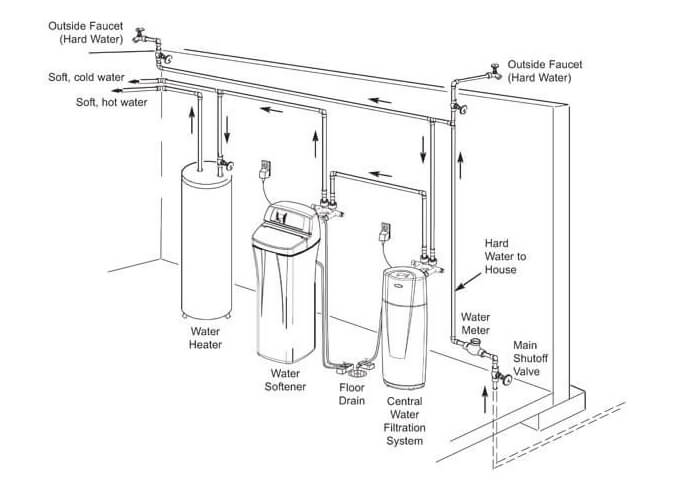
 Water Softener Installation Diagram
The Brine Tank: Where the Magic Happens
The water softener needs a brine tank—a big plastic bin filled with salt pellets. It regenerates every few days by flushing salt water through the resin beads.
Funny thing: the salt doesn’t enter your tap water. It just cleans the softener’s guts. So no, you will not become a human pretzel.
Many first-timers fill the tank with table salt. Don’t. Use solar salt pellets or you’ll have a salty sludge that looks like alien oatmeal.
The Final Hookup: Plumbing Comedy
Connecting the softener and filter to your water line is like a plumbing tango. You’ll need flex hoses, brass fittings, and Teflon tape. The tape actually makes you whisper “lefty-loosey, righty-tighty” like a mantra.
Surprising fact: a small leak can waste 10,000 gallons of water per year. That’s enough to fill a small swimming pool—or water your neighbor’s lawn if they annoy you.
After everything is connected, turn the water on slowly. Expect a hiss, a gurgle, and maybe a small flood. This is normal. Call it “testing the system.”
Do You Really Need a Plumber?
Honestly? If you can assemble IKEA furniture without crying, you can install this yourself. But if your DIY skills involve duct-taping a lawn chair back together—hire a pro.
A licensed plumber will laugh at your pipe cutter skills, but they’ll do it in under two hours. Cost: about $200 to $500. Your sanity: priceless.
But if you do it yourself, you earn bragging rights. You’ll be the hero at barbecues: “Oh, you have hard water? I fixed mine with a wrench and sheer willpower.”
The Grand Reveal
Once installed, run the water softener through a regeneration cycle. It’ll sound like a washing machine having a heart attack. That’s normal.
After an hour, fill a glass. Your water will look so clear it might be invisible. And your soap? It will lather like a shampoo commercial. Your dishes will sparkle. Your skin will feel like silk.
You’ve done it. You’ve defeated the calcium. You’ve tamed the magnesium. You are now the Water Wizard of your neighborhood. Enjoy your clean pipes and your gloriously soft towel—just try not to brag too much at the café tomorrow.
