Does A Reverse Osmosis System Remove Fluoride

So, you’re staring at a water filter catalog again. Maybe your dentist just gave you the “fluoride is great for kids” spiel. Or maybe you’re on a total “get that stuff out of...

So, you’re staring at a water filter catalog again.
Maybe your dentist just gave you the “fluoride is great for kids” spiel. Or maybe you’re on a total “get that stuff out of my body” kick.
The big question pops up: Does a reverse osmosis system actually remove fluoride? Let’s spill the tea.
The Short, Sweet, and Slightly Exaggerated Answer
Yes. A reverse osmosis (RO) system is basically the Terminator of water filtration.
It doesn’t just try to remove fluoride—it obliterates 85% to 95% of it.
That’s like showing up to a water fight with a fire hose when everyone else has a squirt gun.
But wait. Is it 100%? Nope.
Nothing in life is perfect, except maybe pizza.
RO systems use a semi-permeable membrane that’s so tight even fluoride ions get the boot.
Must Read
How Does This Magic Membrane Work?
Picture a bouncer at the world’s snobbiest club.
Water molecules are the cool kids who get in.
Fluoride? It’s that friend who’s trying to sneak in with a fake ID. The bouncer (the membrane) says, “Nope, not today.”
The system pushes water through that membrane under pressure.
Fluoride is too big or too charged to slide through.
It gets flushed down the drain, leaving you with water that’s as pure as a mountain spring. (Okay, maybe cleaner.)
But Is Every RO System a Fluoride Assassin?
Not quite. You need to check the fine print.
Some cheap countertop units are like the dollar-store version of a bouncer: they pretend to be tough.
Look for systems that specifically list “fluoride reduction” or “TDS reduction.” That’s your clue.
Also, don’t forget the pre-filters.
Many RO systems come with a carbon filter that removes chlorine, big junk, and some fluoride.
But the real heavy lifting? That’s the membrane’s job. Without it, you’re just filtering your water through a fancy straw.
 Does Reverse Osmosis Remove Fluoride and Chlorine?
What About the “Good” Fluoride vs. “Bad” Fluoride?
Ah, the debate that makes water nerds fight at parties.
Some folks think fluoride is a cavity-fighting superhero. Others call it a neurotoxin in disguise.
I’m not here to pick sides.
Here’s the thing: RO doesn’t care about the drama.
It removes all forms of fluoride—sodium fluoride, calcium fluoride, even that fancy “cool” fluoride from your dentist’s mouthwash.
It’s equal-opportunity removal.
The Catch (Because There’s Always a Catch)
RO systems are thirsty beasts.
For every gallon of pure water you get, they waste about 3 to 4 gallons down the drain.
That’s a lot of water to flush away just to kick fluoride to the curb.
Also, they’re slow. Like, drip-drip-drip slow.
Don’t expect to fill a bathtub in five minutes.
You’ll be waiting longer than you do for your morning coffee to brew.
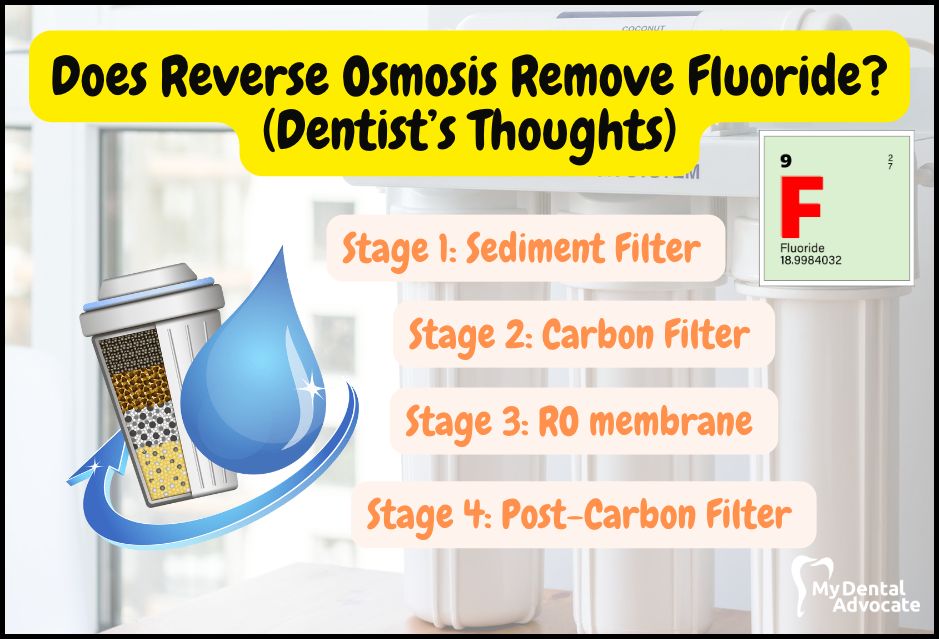 Does Reverse Osmosis Remove Fluoride? A Dentist's Take
Is It Worth the Hype?
If you’re obsessed with removing fluoride, yes.
If you just want better-tasting water without the drama, a simple pitcher filter might do.
But for fluoride? RO is your ride-or-die.
Just remember: it also removes good stuff like calcium and magnesium.
Your water becomes so pure it’s almost boring.
Add a pinch of salt or a remineralization filter if you miss that “earthy” taste.
Final Thoughts (Over Your Imaginary Coffee)
So, does a reverse osmosis system remove fluoride? You bet your sparkly teeth it does.
It’s not perfect, it’s slow, and it wastes water. But if fluoride is your nemesis, this is your laser blaster.
Now go forth, filter your water, and drink like the paranoid-yet-hydrated genius you are.
Cheers to that! 🥤
